




AACSB Pulse: Business Education’s Era of Rapid Change
 Podcast
Host Eileen McAuliffe, AACSB’s executive vice president of EMEA and chief thought leadership officer, talks with current AACSB board leaders Joyce Strawser and Ian Williamson about the recent evolution of business education. They explore the forces of the past 10 years that have shaped the industry and look ahead to its future possibilities, focusing on three big questions:
- What are some of the key ways that business education has evolved in the past decade?
- There’s increasing scrutiny around the value and impact of business education. From your vantage points, do you think business schools are keeping pace with what today’s learners and organizations need? Where are business schools meeting the moment, and where might there still be gaps?
- When you imagine business education 10 years from now, what excites you most? And what changes do you think will be necessary for business schools to truly thrive in that future landscape?
Transcript
[00:00] Intro: Welcome to AACSB Pulse, the podcast that tackles critical topics in global business education today, three questions at a time. We talk with deans, industry leaders, and other big thinkers about the trends reshaping education, leadership, and the future of work. AACSB Pulse brings these topics and more into sharp focus. AACSB Pulse: Three big questions. Bold Answers. Better business schools.
[00:26] Eileen McAuliffe: Welcome to AACSB Pulse. I’m so pleased to have two special guests here today: AACSB’s current board chair, Joyce Strawser, who is the dean at Seton Hall University, and our vice chair-chair elect, Ian Williamson, who is dean at the University of California, Irvine.
[00:47] Ian Williamson: Hello.
[00:47] Eileen McAuliffe: I am truly privileged to have this time with you both today.
[00:51] Joyce Strawser: Good to be here.
[00:52] Eileen McAuliffe: Thank you. In recognition of AACSB’s 110th anniversary this year, we’re going to take a look retrospectively at business education. We’ve been around a long time, so I guess we feel kind of quite comfortable talking about this. So we’re going to discuss where it is now and perhaps throw a little caution to the wind and speculate on what the next 10 years might hold.
[01:14] Ian Williamson: It’s not every organization that makes it 110 years. And certainly I think one of the things we left our last board meeting with was what do we have to start doing to prepare for the next 110 years? So a very timely conversation.
[01:25] Eileen McAuliffe: Isn’t it?
[01:26] Joyce Strawser: An exciting milestone.
[01:27] Eileen McAuliffe: I think it is interesting; when people say 110 years, you have to think hard of other organizations that have sustained 110 years.
Today, we’ve got a lot to discuss, so let’s get started. As you know, you’ll be familiar with our format. We have three big questions.
Question 1
[01:43] Eileen McAuliffe: Ten years ago, when AACSB celebrated its centennial, business education—and in fact, the whole world—looked remarkably different. Right? It was such a different place. So would you like to just talk with me a little bit about the transformation that’s taken place in the past decade? What are some of the key ways in which business education has evolved?
[02:07] Joyce Strawser: Well, I’ll start off by saying I think we’ve become more connected—by desire, but also by necessity. So we’ve moved out of our traditional ways of doing things, looked outside of ourselves, more committed to our communities, more interested in collaborations with others, domestically, internationally as well, but even within our schools.
So I, within my College of Arts and Sciences, for example, have many more collaborative programs than I did 10 years ago. And I’m sharing faculty, which we would have thought unthinkable to have a tenure-track faculty in two different colleges or schools. And greater connection to practice. So I think that’s really something that has changed for the positive over the last 10 years.
[02:53] Eileen McAuliffe: I mean, that move towards a greater connection and having greater impact with and for practice and business and industry is something that, you know, we’re still pushing on, but we’ve made huge strides over the past 10 years. So I do agree with that. That’s wonderful. Ian, what about you?
[03:09] Ian Williamson: I would say one of the big observations I’ve made is, over the last 10 years, the speed with which curriculum has changed. That, if you look at—I guess this would be the empirical test—if I went and looked at a syllabi from 2000 and compared it to a syllabi in 2010, and then I looked at a syllabus from, say, 2020 and compared it to a syllabus from 2025, my hunch is that, in the latter case, there’ll be more changes in what we’re teaching, how we’re teaching, even the format in which we’re teaching—in person or virtual—versus the 2010 syllabus compared to 2000. Probably there were some differences, but not as dramatic.
[03:50] Ian Williamson: If I looked at the portfolio of programs that universities had today versus what they had 10 years ago, probably more changes, more additions, more subtractions than would have been in the previous 20 to 30 years. The way I think about it, the shelf life of the offerings that we’re providing is getting shorter. They’re having to be changed, updated, mothballed, in some cases, new things are coming on.
The fact that we’ve done it for decades doesn’t necessarily mean it’s good, which is the opposite of what our historical norm has been. —Ian Williamson
And that’s a very interesting space for a university setting, which historically puts a lot of value on doing something for a long period of time as an illustration of quality. And we’re sort of moving more into a space of, the fact that we’ve done it for decades doesn’t necessarily mean it’s good, which is the opposite of what our historical norm has been. And maybe now newer is better, and that’s a big shift for us.
[04:42] Eileen McAuliffe: It really is. And I just want to continue with this because that heritage piece is sometimes lost on our learners, right? Our learners come in, they need quick, digestible ways of learning. Are they necessarily focused on the fact that something’s been around for a long time and therefore it’s good for them, you know, good for you to learn Accounting 101, perhaps?
So I’m really interested in that perspective as well as how the learners have changed. I mean, we talked a little bit there about the syllabi changing, but the learners, I think, are they driving that change?
[05:17] Ian Williamson: I definitely think they’re driving that change. They’ve heightened their expectations of what they want from us. They are more inclined to share those expectations for us. They want to be more of a partner in their educational experience. I think they’re less likely to say, You know best, and I will do what you tell me to do.
There’s still an aspect of that, and it varies based on whether you’re talking about an 18-year-old undergraduate or a 35-year-old who’s in a master’s degree. But at all levels, there’s more of a, I actually know what I want to do with my life, and I’m here to get help, but that doesn’t mean that I don’t have any agency in this process.
[05:54] Ian Williamson: So when I tell you,I want to take this class in that order, and I want to take this class in person and that class online, and I want to be able to have this optionality, and I want to be able to bring this work experience in, I’m not saying it as a suggestion, that I expect that you as a provider of a service will honor and work with me to achieve that.
Well, I think in the past, it was much more likely for people to go, I don’t really know what I want, and the reason I’m coming to you is that you will give me the answer to that problem. I don’t think that’s the case. In some ways, they don’t trust the university to necessarily have their answer. We probably didn’t have it in the past either.
[06:34] Ian Williamson: But they also are more expecting of the university to accommodate and go out of their way to accommodate. So I think that’s a big shift.
[06:42] Eileen McAuliffe: Yes, that flexibility, isn’t it? I mean the students are coming so much more formed, both intellectually and, in sense, maturity of some ways, as well. You know, they’re looking at the world in a different way than maybe we did when we went to university, perhaps.
[06:59] Ian Williamson: I don’t know if the 18-year-old today is more mature than an 18-year-old 30 years ago. I won’t push that on them. But I will say they’re tremendously more informed. They just have access to way more information. They can quickly compare, they’re able to gather data in a way that’s almost cost-free. These are just not things that were available even 20 years ago. So they’re acting on that, which I think is appropriate.
[07:23] Eileen McAuliffe: Moving on a little bit. You’ve been around a good while in this sector. I mean, I’m not going to probe and say—
[07:29] Joyce Strawser: Thanks for classifying it that way. [laughs]
[07:31] Eileen McAuliffe: I’m generous, I’m generous [laughs]. Because I’ve been around a good while as well. I’m generous in this respect. But I mean, when you look back over 10 years, it’s nothing really. For me, it’s gone in a blink. But what’s the biggest lesson you’ve learned as a business school leader, perhaps, or an educator, or your own professional growth?
[07:51] Joyce Strawser: Well, I would say it’s what a valuable resource relationships are. So you can have a great deal of funding, you can have physical facilities that are wonderful, but if you haven’t built strong relationships that you sustain and grow, you really cannot be nimble and pivot the way you need to in this environment.
So it’s come down to really making partners—and I love the word that you used, I think, Ian, about students wanting to be partners—and I think that is so true. Students want to be our partners. Alum want to be partners. We need to partner with employers. So it really is about that strength of your connections.
If you haven’t built strong relationships that you sustain and grow, you really cannot be nimble and pivot the way you need to in this environment. —Joyce Strawser
And again, back to your point, Ian, about students coming in knowing what they want, they want to know about those relationships and those connections.
[08:39] Joyce Strawser: So students, their parents are expecting you to tell them, well, OK, when will I meet alums? How will they help me? How many do you have? Where do they live? They understand in a way that I know I didn’t when I started, and in a way that students, when I first started out teaching, didn’t really think about, how important it is to build those relationships.
[09:03] Eileen McAuliffe: And those relationships are not only centered around the institution, the business school that they’re attending, but they are global now, right? We have to impart upon our students that they need a global perspective because of everything that’s going on in the world. What about your reflections on your career, Ian?
[09:21] Ian Williamson: Ten years ago, 2016, we probably would have been talking about the rise of Asia, the influence that was having on the global economic environment. Fast forward to 2020, we’re talking about COVID. Fast forward to 2022, we’re talking about generative AI. Fast forward to 2026, AI is truly here. We’re really having conversations about major changes in the global political environment. That’s a lot in a very short period of time.
I think the professional growth, for me, has been leading organizations through that, from a dean’s role: How do you create a sense of meaning for a group of individuals that is real but not scary, in the sense that it shuts everyone down, and allows that organization to continue to go forward?
[10:20] Ian Williamson: That has been a really interesting professional growth opportunity for me, personally, as a leader, in picking up on those things, understanding them, learning how to convey them in a manner that’s effective, getting people’s feedback—because we are in universities, it’s a shared governance model, by and large—and having an ability to navigate some type of plan in an environment that has largely changed dramatically every two years.
[10:51] Eileen McAuliffe: And it’s not slowing down. In fact, it’s speeding up, right?
[10:55] Ian Williamson: I think the stakes have gotten higher around that, the speed with which we go through that. So I would say, for me, it’s really been a lot of personal learning around, how do you show up as a leader in an environment where you have even less perfect information that you would have had in the past?
I have a phrase I always use with my team. They’ll ask me a question in a faculty meeting, and I find myself always saying, “As of today,” because I have no idea what’s going to happen tomorrow. But they expect the answer, and the organization kind of does need answer. Like, you can’t just sit there and wait till tomorrow. So, as of today, this is what we know, and this is what we’re doing.
How do you show up as a leader in an environment where you have even less perfect information that you would have had in the past? —Ian Williamson
[11:36] Ian Williamson: And I would not have been saying that in 2016, but today I say that always. That’s the common phrase before I give any answer about anything that we’re doing. Recent history is telling us that it could look wildly different in a week.
[11:48] Eileen McAuliffe: And I think listeners, deans, leaders, aspiring leaders will take that and use it as a mantra. [laughter] I’m quite sure. I’m quite sure. Because it is the best summation of where we are in this world today. Do you find that, Joyce, at your school as well?
[12:05] Joyce Strawser: Oh, absolutely. And I always try to think of, we know there’s a solution, we just don’t know what it is yet, but we know there’s a solution. But we have to be patient about it a little bit. I know, you know, we can’t go without an answer. We have to make an answer at the moment. And there was no better teacher of that lesson than the pandemic, than COVID. Because every day was a different script. Every day, the things that we realized we’d worried about and planned for didn’t happen, and something completely different did.
You need more trust in those situations, because you need to know that, while you can’t have perfect information, you’re going to work together and build something that makes sense or take the direction that will see you through.
[12:51] Joyce Strawser: But you have to make that assessment that, yes, we’re moving forward without the kind of information we might have had in the past.
[12:59] Ian Williamson: I think this is a particularly interesting leadership challenge in our context because our context is one which is built around expertise. So our faculty are trained to stand in front of a group of people or on a screen and speak with great confidence in almost definitive statements based on expertise and experience. That’s the environment of a university. And they oftentimes draw upon data and length of time to provide credibility to that opinion. We don’t have the data, we don’t have the time, and we’ve never been here before.
So, in an environment that typically gives credibility to expertise and experience, you still must have statements of, we will do X. But you can’t rely on those other forms of credibility. And I agree with Joyce that I think trust becomes far more important.
[13:51] Ian Williamson: But trust was not necessarily the go-to move of leaders in the university setting prior.
[13:57] Eileen McAuliffe: Indeed. And it talks to the point you made earlier, Joyce, about relationships at times of crisis or development, such as the pandemic. You probably drew quite heavily on your relationships with your alums and with your student bodies and partners around the world.
[14:14] Eileen McAuliffe: Let’s move on a little bit. So we’ve talked a little bit about your leadership in your comfort zone, which is your school and your academy and so on. But you’ve been great leaders for AACSB as well. You’ve both been involved with AACSB for what, the last decade, as well, probably? Maybe even a little more for some people, Joyce, maybe longer?
[14:33] Joyce Strawser: A little bit longer, right, yes. But it’s been a good journey.
[14:37] Eileen McAuliffe: It has. So how would you reflect on AACSB’s evolution over that period?
[14:41] Joyce Strawser: I always think about when I first became dean, and I pictured AACSB as this remote organization where I didn’t want to bother anybody with questions, right? I thought of it as not a resource for me but instead almost a challenge I had to meet. I had to demonstrate that my school was meeting the standards.
Our perception of AACSB has evolved. So we see it now as a true, important, critical member of the business education ecosystem, a partner in what we do, a thought leader. —Joyce Strawser
But I didn’t think of this as being a relationship type of organization. And I was so wrong. And I always tell that story to new deans. This is a partner for us as an educational institution, as a business school.
[15:19] Joyce Strawser: And I think AACSB has evolved a lot in that way. And our perception of AACSB has evolved. So we see it now as a true, important, critical member of the business education ecosystem, a partner in what we do, a thought leader—much more than an accrediting body. And I think that’s an evolution on my part as well as an evolution on AACSB’s part.
[15:43] Eileen McAuliffe: And I would share that insight. As a young dean, a new dean, I remember looking up to this kind of utopia of AACSB, this shiny thing that everyone was striving to be part of. It seems so far away at some points in the journey of the school. But the connections and the relationships built through the regional offices and through the developmental programs, but also as we see thought leadership now developing alongside, it’s a huge kind of resource, but also a supportive network and relationship. So I agree with you. Ian, what about your experience?
[16:18] Ian Williamson: Over the last 15 years, I have worked in an organization that was going for its initial accreditation. I’ve led multiple organizations through re-accreditation, and my first time going to an AACSB, like, event would have been 2017. When I think about our initial accreditation activity, AACSB was the standard from on high that we may or may not have agreed with, but we had to acquiesce to [laughs]. That was sort of the logic of it.
But look at AACSB, like, we changed the standards in 2020 in a very substantial way. We have a proposal to change the standards again in 2026. The organization’s activities have changed. We are far more involved in the development of our membership in terms of programming to support new deans and other types of activities.
[17:09] Ian Williamson: We’re far more global in terms of the activities that we’re doing around the world with different types of members. Our membership has shifted dramatically in that period of time where it’s now far more diverse in terms of its geographic representation. So I would say AACSB has been moving through this cycle of change similar to what we’re seeing more broadly in the setting.
And, as a result, I think not only just because of my participation but also because of the behavior, AACSB is less the standard on high on the hill that kind of surveys and tells everybody this is what you need to do; it’s more around gathering information from the members to summarize what that is back to the members, versus a white puff that comes out and says, we’ve decided now, this is what it is.
AACSB has been moving through this cycle of change similar to what we’re seeing more broadly in the setting. —Ian Williamson
[18:03] Ian Williamson: I think the organization has become more relational with its constituency over this period of time.
[18:08] Eileen McAuliffe: I love that—the high on the hill and the white puff—because I think that kind of sums up maybe what a lot of people felt when they were first embarking on their accreditation journey or their first connections with AACSB. And AACSB’s transformation over that 10-year period has been nothing short of phenomenal. Yeah, go ahead, Joyce.
[18:28] Joyce Strawser: I was going to say, too, what Ian said, I would add that I feel like AACSB has been challenging us in a good way to be better, to stretch a little. And when I think about societal impact, for example, that’s one where, originally, when we discussed that, I thought, oh, yeah, sure, this is a great goal, but can we do this? But you see that we are doing it, right? You see that business schools are embracing this and that this is what young people want to be involved in. They want to be and grow into the type of leaders who are going to be empathetic, who understand that they’ve got a commitment to others. And I think AACSB has, through convening business schools, through establishing these relationships, has the power to motivate us on to greater aspirations than we had previously. And it’s powerful.
[19:18] Eileen McAuliffe: It is very powerful, and I think it really is nothing short of a phenomenal evolution, and I’m really delighted to have been part of that journey and to have great colleagues like yourselves as well.
Question 2
[19:31] Eileen McAuliffe: And it naturally brings us on to another question, which is quite critical, particularly for industry today, and that is one of relevance.
So, increasing scrutiny—we hear it quite a lot in the regions, but globally as well, around the value and impact of business education. So from your points of view, do you think business schools are keeping pace with what today’s learners and organizations need? And where are business schools meeting the moment, and where might there still be gaps?
[20:03] Joyce Strawser: I think we’re trying, but there’s still always room for improvement. I think about things that I would like to do with my school, and we do a lot of experiential learning, but we need to do more.
We partner with employers, we partner with our alums, but that needs to be even a greater partnership with more frequent interactions and more meaningful interactions. So actually having our employers, having our alums bring business problems, real problems that students can assess, can help to solve, and to practice on, that’s the kind of thing that I think we need to, as business schools, do more of, is bring that real-world experiential education.
But in terms of a gap, I sometimes think that people undervalue or don’t think about as much the real benefit of having young people.
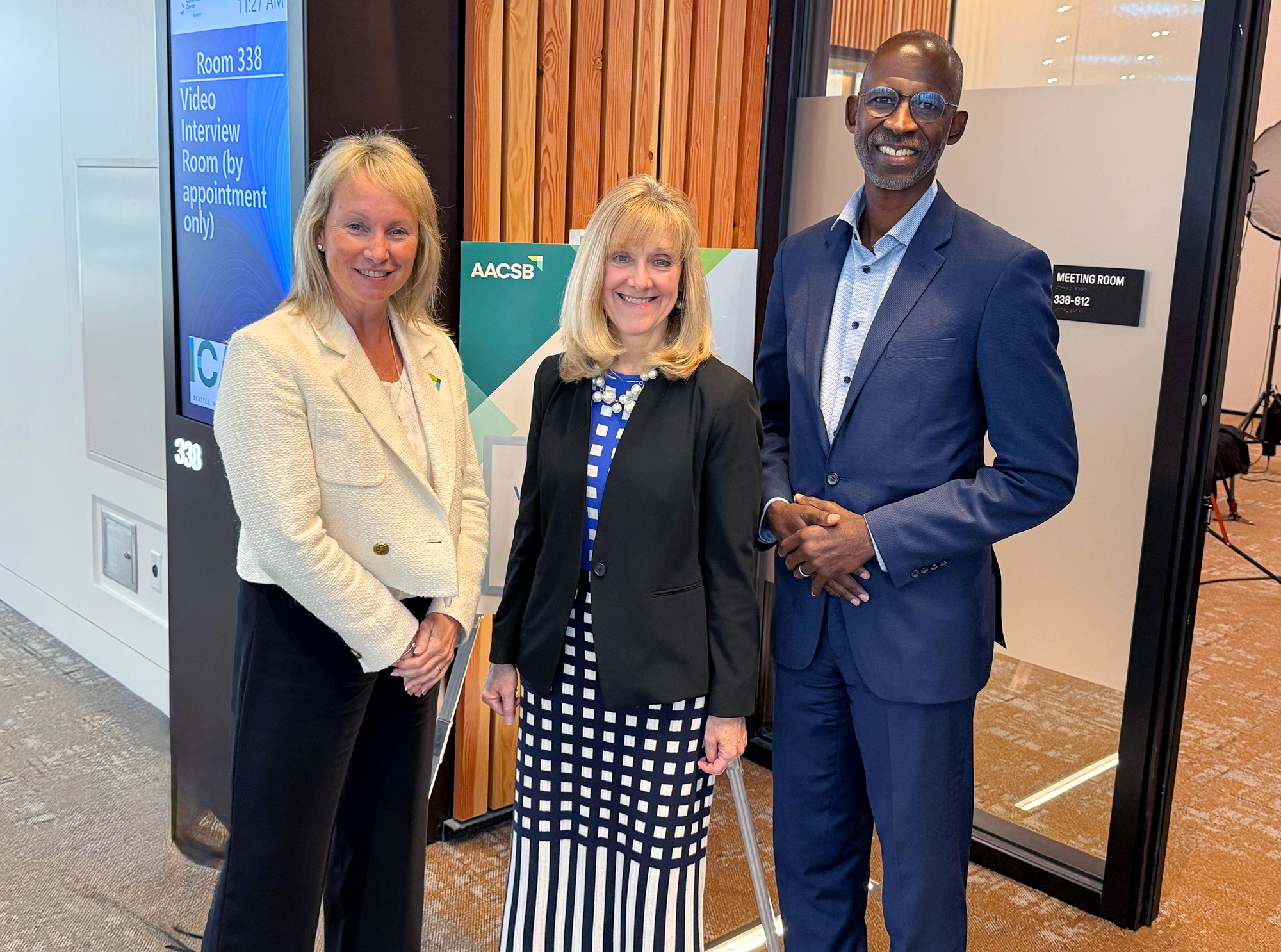
Eileen McAuliffe, Joyce Strawser, and Ian Williamson, Seattle Convention Center - Summit Building
[20:57] Joyce Strawser: So I’m thinking now a lot about undergraduates, but of having them together in a place where they’re going to meet and interact with individuals from all over the world and have a diversity of thought and experiences before them than they would in any other place.
So when people suggest that, well, employers can train their employees, we don’t need an education, a higher education, I disagree with that because they’re missing that socialization that makes young people into better citizens, better people, more empathetic leaders.
[21:35] Eileen McAuliffe: Yeah, I agree with you. I think it gives time and space for that connectivity. Yeah. Ian, what do you think?
[21:42] Ian Williamson: I mean, the Dickens quote—“It was the best of times, it was the worst of times”—that would be the way I would summarize it.
If I look at the U.S. context, as one example, the largest major in undergraduate education in the United States is business. So that is certainly a sign of relevance. If the largest number of students who want to go to college want to study business, and it probably could be more, if we had more capacity, then certainly something we’re doing has conveyed value to those students, their parents, and obviously the employers who would hire those individuals.
So on one hand, I think we should celebrate that, as that would not have been the story 50 years ago, if you looked at the role of a business school and a university.
[22:27] Ian Williamson: And in fact, there were many studies done on business schools fighting for legitimacy at universities. We’re not fighting for legitimacy at universities in that way anymore. In fact, that burden has shifted to other schools, which 50 years ago would have been seen as the proper education. And now they’re the ones that perhaps are struggling to get students to apply to their schools. So that’s, by every metric, a success.
I would say, though, that we have not solved all problems. There are still huge segments of society that don’t get access to university education. In the United States, it’s only about 30 percent of the people in the country that go to college. So when you hear people say you don’t need to go to college to be successful, the reality is, for 70 percent of the people, that was true.
[23:19] Ian Williamson: So it’s not like they’re making that up either. And it does raise a question around, we have increased our relevance, but there’s still a large portion of people, the majority of people, who have not had access to this or did not see value in it.
So by definition, we’re far more relevant, but we’re not relevant enough. And I think that’s a challenge that we should be taking on as leaders in this space and as educators in this space.
[23:47] Ian Williamson: I also think that as great a job as we’ve done in creating curriculum that met the moment for our students, the moment changed, and it changed pretty rapidly, as we discussed earlier, and that it’s probably the case that some of what we’re doing right now in education of students in business will not meet the mark in the next two or three years if we don’t change it.
By definition, we’re far more relevant, but we’re not relevant enough. And I think that’s a challenge that we should be taking on as leaders in this space and as educators in this space. —Ian Williamson
And that’s not necessarily because we did something wrong. It’s just, the employers are different, the work is different, the technology they’re using is different. And it happened quite quickly, and we needed some time to retool. So I don’t have a lack of confidence in our ability to retool.
[24:34] Ian Williamson: But I also would acknowledge that if someone says there’s a gap between what I want a person to do in the workforce today and what they’re learning in a specific class, I would take that as being a fair criticism because you didn’t even know you were doing that in the workplace yesterday. So how did you expect me to read your mind? Give me a second, I’ll catch up. Right.
And I will go one step further. I would say the other area of relevance that people have raised about is our research. And in some ways, I think our research has been extremely transformative—you know, in some cases, in fact, transformative in positive and negative ways.
[25:16] Ian Williamson: So, you know, the rise of the technology firms, a lot of the work around platform organizations, and the logics of how you’ve been able to create trillion-dollar organizations came from business schools. And that has transformed all of our lives. We also have to hold responsibility for, we had a global financial crisis that came in some way, shape, or form from business schools. And I think we have to acknowledge that. And that was out of the innovations from the research in business schools.
So I don’t think we’re doing work that’s not impactful. I do think we have not necessarily kept pace with conveying and making the impact of that work or making it accessible enough to a large enough group of people. And that is, I think, a concern.
[26:09] Eileen McAuliffe: Thank you for those comments. We’ve talked a lot about relevance and, are we still relevant in our marketplace?
Just over the last few days we held the Global Summit, the first AACSB Global Summit, where we had around 80 different businesses and business school leaders from different countries, 31 different countries. And when we asked what the biggest risk to business education if it does not evolve quickly enough, the most common response was relevance—or irrelevance is what we saw a lot of the time. What’s your take on this?
[26:43] Joyce Strawser: I think we are dealing with—Ian, you referenced this earlier—we’re dealing with a much more sophisticated consumer now, and they are looking for things that are different. I think in their mind they want to be in a classroom—and this is especially true for graduate students—but they want to be in a classroom and walk away with something that either makes them a better businessperson or a better potential businessperson, or that they can immediately apply in the workplace.
So they want this to be about certainly learning concepts, but how those concepts are applied and the way that this is going to help them make change. So it is a greater demand to be more impactful, more up to the moment, but it’s going to require different resources.
[27:33] Joyce Strawser: You spoke about a syllabus, and the structure that creates, and even the approval process is one that is unwieldy.
It is a greater demand to be more impactful, more up to the moment, but it’s going to require different resources. —Joyce Strawser
[27:39] Eileen McAuliffe: It’s very lengthy.
[27:40] Joyce Strawser: Right. So what we have to do, I think, is we have to be prepared to meet that need by creating class structures that are a little more fluid. So we have a course now that’s called Emerging Technologies. Within that particular capsule or that module, we could teach a lot of different things. We don’t need to define it to be specific to this moment in time; we just need it to be, and in this course, you will learn about what is the most important or most impactful emerging technology set at this moment.
But that takes a lot. That takes a faculty member who’s willing to be thinking constantly about change and an infrastructure that’s different. So more training, more support. So I do think that relevance is something that’s much more thought about, much more demanded, and it’s going to take more to respond to.
[28:35] Eileen McAuliffe: It’s difficult, isn’t it? Because we hear it a lot. We do hear it in the context of research or in the context of our graduate outcomes. I sometimes wonder, why is it manifesting, or where is it manifesting? Is it the media fueling this? Is it in the eye of the beholder?
This notion of relevance is quite perplexing for us because, as you said, we recruit well, mostly globally, I would argue, not just in America, to either undergraduate business courses and certainly graduate business courses. So where does it come from, this notion of relevance? And why is there always this kind of dark cloud kind of following our discipline around?
[29:14] Ian Williamson: I think if I take a big step back, I just left a session maybe 30, 40 minutes ago with a group of new deans, and we asked them, “What do you see as some of the biggest challenges you’re facing?” And many of them said, there’s a growing sentiment among the populace that you don’t need a university education to do anything successful in your life.
And last year I wrote an article for our local newspaper in Southern California, where I took this statement head-on and I said, the data are very clear. You will live eight years longer. You will be more involved in your community. You will be half as likely to be unemployed. You’ll make twice as much money. Like, there’s just this whole list of benefits associated with more education in your life, period. And it’s not like one study.
[30:02] Ian Williamson: It’s been done over decades. So we have tremendous amounts of evidence on this. And I think we’re in an interesting challenge, right? One of the reasons why people were excited about education, and one of the things we did, is we conveyed education as a way for you to have certainty in your life. That this was going to provide less uncertainty about you being able to achieve certain outcomes, and it gave you a sense of stability.
We are now in a situation where there’s less stability, and we’re not necessarily trading you on, if you do A, then you get B—that causal link is not as linear, perhaps, as people thought of it as a path. I think we should be acknowledging that we, as a sector, as an institution, conveyed that logic: If you do A, you will do B.
We conveyed education as a way for you to have certainty in your life. ... What we’re doing now is just as useful, but we’re kind of preparing you for eventualities. And that’s a slightly different type of logic to provide to a student. —Ian Williamson
[30:52] Ian Williamson: In fact, I did that in my article. I said, listen, there’s a relationship here between these things. That relationship is still there, but it’s not the linear path that perhaps it was, and what we’re doing now is just as useful, but we’re kind of preparing you for eventualities. And that’s a slightly different type of logic to provide to a student.
We’re not saying, well, we don’t know what your linear path is going to be. But whatever that is that you decide to go down, you have a toolkit that you can draw upon. And that’s a slightly different story than, take accounting and you’re going to make this much money. And parents love that, students love—who doesn’t like certainty in their life? And so our value proposition is shifting.
[31:33] Ian Williamson: And in that shift from A to B creates certainty to we’re preparing you for eventualities, people go, “Is this still relevant?” Right? Because you used to tell me, A equals B, and now you’re saying, well, you’ll be OK. Is it still relevant? Are there other things?
And so in that sense of uncertainty, there’s questions being raised. Not necessarily bad questions, not necessarily questions we can’t answer, but questions we must answer. And I think that’s the part that we’re like, what do you mean you’re expecting us to justify? It’s like, yeah, that’s happening now.
[32:06] Eileen McAuliffe: We do. We have a responsibility now to shape that narrative.
[32:10] Ian Williamson: We have to be very active in it.
[32:12] Eileen McAuliffe: I love the way you express that. That certainty of linearity is no longer there. And when I spoke with, on one of the podcasts with a colleague from Meta, he was really clear that he did not necessarily need trained accountants coming from an undergraduate degree. He can do that himself when they join. He needs people that have these multiple skills that can react in various situations and can tell him in two sentences what the problem is and what the solution is. That’s what he’s looking for. Agility.
[32:45] Ian Williamson: It’s a different value proposition. And we’re having to articulate a different value proposition to our, not just our students, but our funders—government being the main one—but also, you know, philanthropic organizations and the like. You know, I think the accounting example is a good one because we would say, we’re going to teach you how to do X, we’re going to teach you how to measure something, we’re going to teach you how to record something, we’ll teach you how to interpret that, and that has value.
And today, because of changes in technology, because of changes in business formats, and a whole host of reasons, perhaps those skills don’t lead linearly to the outcomes of choice. But what is not changed is the need to sit down with someone and ask the question, “What do you think we should measure?”
[33:30] Ian Williamson: And in fact, if you break down the actual foundational aspects of accounting, that’s the skill—understanding what to measure. Because you can’t measure everything because it costs too much money, it takes too much time. You have to be able to discern what to measure when.
[33:43] Ian Williamson: And a highly skilled accountant, the one who has the actual conceptual underpinnings, can answer that question for you. And that’s extremely valuable. And they don’t actually need to go out and do the measuring or record it or any of that other stuff today, but they still need that. We still do that, but what we’re doing now is teaching you how to do that, but we’re not telling you where to use it.
[34:03] Eileen McAuliffe: Absolutely.
[34:04] Ian Williamson: And that’s a different change.
[34:05] Eileen McAuliffe: And this really opens the door to thinking more boldly about where we’re going, the direction, the future for us, but also our schools, our members, but also, I mean, more importantly, our learners.
Question 3
[34:18] Eileen McAuliffe: And it kind of comfortably slides us into our third question, our third of three big questions. So we talked about where business education came from, your pathway through the last 10 years, now if we look at the next 10 years, looking forwards, I mean, this is an interesting and exciting time. I mean, at some points we’re tearing our hair out thinking, my goodness, what next? But 10 years from now, what excites you the both the most?
[34:44] Joyce Strawser: So I would say even more Integration in the ecosystem. So more international partners, different types of faculty contracts. So I might be bringing someone in as a professional to join an academic in the classroom as a partner, right? Because think of all the ways that shapes and enhances the class.
If I bring a professional in to co-teach with an academic, that professional is making sure that the currency is there, that there’s discussion of what’s going on in that particular profession. So the faculty member is learning, but the student’s getting a connection. And the students are also hearing that there is not the certainty that they think they should expect.
[35:29] Joyce Strawser: And so I would love to see, and I hope to see that we do more of these interesting things where we’re pulling different partners in and using people in different ways, being more fluid about the kinds of courses we offer and relying on some courses that are taught by work that’s being done in partnership with a business, with a professional, with a startup or entrepreneur—that that could be part of the learning process.
Because I think, to your point, Ian, of where students are not going to get anymore that, you do this and this will happen. What I think we can give them is practice in resiliency, practice in saying, you know what, they didn’t respond to my question when I had a question about a business practice they’re doing.
[36:18] Joyce Strawser: I don’t know how to move forward. But getting the sense of what they do then. Getting the sense of, how should they react when something goes in a way that they’re not expecting?
So when we first started offering more experiential courses, students were, they were uncomfortable. They had to work through some challenges and come up with a solution on their feet. And that’s the practice that we will give that’ll be much more valuable.
[36:45] Eileen McAuliffe: Yes. So dealing with uncertainty.
[36:47] Joyce Strawser: Exactly. In fact, and recognizing that’s something not to avoid but something that you’re going to have to become good at.
When we first started offering more experiential courses, students were uncomfortable. They had to work through some challenges and come up with a solution on their feet. —Joyce Strawser
[36:55] Eileen McAuliffe: And to embrace, right?
[36:56] Joyce Strawser: Yeah.
[36:57] Eileen McAuliffe: Because everything’s changing all the time at 100 miles an hour. How about you, Ian?
[37:02] Ian Williamson: I would like to see us take on this idea that education is more accessible to a larger number of people, that we have great outcomes for individuals that have been able to get access to world-class business education. We have all types of data in many places all around the world to illustrate this can have very positive impacts for individuals, their families, and their communities.
We also have tons of data that shows a large percentage, the majority, do not have access to this, and we have not been able to meet them where they are. We haven’t had the resources, we haven’t had the tools, we haven’t—for a whole host of constraints. Can we use this moment to revisit those constraints?
[37:47] Ian Williamson: Can we open ourselves up to using new technologies, new ways of teaching, new formats, to actually make ourselves more available at a high quality to a larger number of people, if we really believe that business education has a positive social and economic impact on a community?
And that’s a very important distinction for us to make, even as AACSB, because there has been a thought process in education which has been that it becomes the barrier that differentiates those who can and those who cannot, those who have and those who do not. That has had its benefits for certain organizations by creating sort of a notion of elite.
I think the opportunity for us now, we won’t have the same resource constraints. We can do distance education at great quality. We can create personalized educational tools through AI. We can do things with our international partners in ways we could not have done before.
There has been a thought process in education that it becomes the barrier that differentiates those who can and those who cannot, those who have and those who do not. —Ian Williamson
[38:47] Ian Williamson: Will we take that on and take on a challenge of saying, what would it look like for a community if it was 40 percent of the people in that community had access to an undergraduate degree, 50 percent of the community. That, to me, would be transformative for us as a field. We would no longer be having conversations about relevancy if we focused on that.
[39:06] Joyce Strawser: And I think we could leverage the skills of our students in doing that, in getting them out—you know, I’m thinking financial literacy, for example—getting our students out to speak with people in the community about important issues around being financially savvy and making good judgments in terms of budgeting and saving and investment. Those are things that we could help students build their competencies but also serve to bring some level of education and enlightenment to people in our communities.
[39:38] Eileen McAuliffe: Those two points, I think, are top priorities. I mean, would you agree? I mean, AACSB, we talk a lot at board and we talk a lot in our meetings about, what are the top priorities that we should be addressing in the world as business educators? Are we agreeing that these are the kind of things that we should be focusing on?
[39:58] Ian Williamson: As AACSB has moved to standards as an expectation, more so than just accreditation, but more to standards and embraced this notion of continuous improvement, what that logic does is it says, well, we may have today 1,000 accredited institutions, but that doesn’t mean that there’s only 1,000 good universities, right? We can actually make 3,000 good universities.
Like there’s not a necessarily inherent constraint on creating great educational experiences if you adopt the standard in a logic of continuous improvement. That we collectively as a field, because we have this mechanism called AACSB, can share insight, can do development with ourselves to increase the capability of all of our members such that the quality level is not tiered as much as it’s, wherever you are, we can make you better at what you’re doing.
[40:56] Ian Williamson: And in doing so, if you make that accessible to people you serve, wherever they are, they’re going to get better at what they do. And that’s that, I think, would be a shift in the logic of how we’ve thought about education in some settings, but I think a very powerful one for us as an organization, but more importantly for us as a field.
[41:13] Eileen McAuliffe: And just projecting forwards, we’ve looked back, let’s go forwards to 2036. One or two sentences on realistically, where do you think business education or the landscape thereof will be in 2036? This is a tough one.
[41:27] Joyce Strawser: I think there’s going to have to be more connections in terms of partners. I think there’s going to have to be a more solid infrastructure because nimbleness is going to be important, agility is going to be important, and we’re not really set up to pivot quickly. Currently, higher educational organizations are going to have to be prepared to move quickly. They’ll have to be kind of a different organization.
Higher educational organizations are going to have to be prepared to move quickly. They’ll have to be kind of a different organization. —Joyce Strawser
[41:52] Eileen McAuliffe: Yeah, absolutely. Ian?
[41:53] Ian Williamson: The desire for business education will be as high, if not higher, and the organizations that can provide more customized, localized offerings to meet that demand will be cherished by their community.
[42:09] Eileen McAuliffe: Absolutely. Cherish. That’s a great word. Joyce, Ian, it has been beyond lovely to have this conversation with you this morning. And I’ve had the privilege of getting to know you over the years, and now it’s our honor to be able to share these conversations to our listeners all around the world that can enjoy your insights and your perspectives and your future predictions.
And who knows—in 10 years’ time, we might be still around to give another podcast interview and see where we got to.
[42:39] Joyce Strawser: Thanks for inviting us into this conversation.
[42:41] Eileen McAuliffe: And Ian as well. Thank you so much.
[42:42] Ian Williamson: My pleasure. And thank you, Eileen, for all that you’re doing for AACSB and the community.
[42:46] Eileen McAuliffe: You’re very welcome. And to our listeners, if you’ve enjoyed this conversation, be sure to follow AACSB Pulse on AACSB Insights, Apple, Podbean, or Spotify. We have got so many great more episodes coming up on the biggest issues shaping global business education today.
About AACSB Pulse
A podcast produced by AACSB International, AACSB Pulse explores current topics impacting global business education—three questions at a time—with business school deans, industry leaders, and other big thinkers of today.
To receive new episodes, make sure to sign up for AACSB’s email newsletter, LINK, or subscribe to AACSB Pulse on Apple Podcasts or Spotify.
 Article
 Video
Video