





AACSB Pulse: Why Finance Leaders Must Lean Into AI
 Podcast
Host Eileen McAuliffe, AACSB's executive vice president, chief thought leadership officer, and managing director of EMEA, has a conversation with Meta’s director of modern finance, Jason Pikoos, on how AI is reshaping the finance industry—and what that means for how business schools need to prepare future finance leaders. She delves into three big questions:
- You’re working at the forefront of technological innovation at Meta, and you’re in a finance role that’s especially ripe for AI-driven transformation. Given that vantage point, what does the future of finance look like?
- How is AI changing the way companies structure themselves and develop their people?
- Thinking about the next generation of finance leaders, what skills and competencies will matter most—and how should business schools evolve to prepare them?
Transcript
[00:00] Intro: Welcome to AACSB Pulse, the podcast that tackles critical topics in global business education today, three questions at a time. We talk with deans, industry leaders, and other big thinkers about the trends reshaping education, leadership, and the future of work. AACSB Pulse brings these topics and more into sharp focus. AACSB Pulse: Three big questions. Bold answers. Better business schools.
[00:26] Eileen McAuliffe: Welcome to the AACSB Pulse. We’re delighted to have a guest from the business world on this episode. Jason Pikoos joins us from the formidable organization that is known as Meta. And Jason is the director of modern finance. Amazing title, I have to say, Jason.
And I note that you’re also an AI enthusiast, which clearly would go with the company that you work with. And I know that we’re going to have a fascinating conversation on what the future holds for finance and accounting and the whole industry, really. So, Jason, thank you so much for joining us.
[01:04] Jason Pikoos: I’m excited to be here. I look forward to the conversation. AI is probably, I feel like I talk about it 20 times a day nowadays.
[01:10] Eileen McAuliffe: For those listeners that have heard this series before, you’ll know that we go with three big, chunky questions. So let’s get started, Jason, with the first of our three big questions.
Question 1
[01:22] Eileen McAuliffe: So, looking at the big picture, you’re working at the forefront of technological innovation at Meta. Meta is in the news daily, which is probably one of the typical signs of an innovator, you know, breaking boundaries and moving forward. And you’re in a finance role that is especially ripe for AI transformation. And I note your title, director of modern finance. Can you tell me a bit about this role and how you see this transformation happening?
[01:54] Jason Pikoos: Sure, happy to. The title is certainly, I guess I get a lot of comments on the title. I think it’s a cool name, but I think when people ask me what we do, I think it’s probably most akin to what people would see as a finance transformation function. Although I like the idea of the modern finance because it talks a little bit about the direction that we’re going. I mean, the role and the organization is really focused on a few things.
[02:18] Jason Pikoos: One, is we—and it’s probably the largest part of our team—is we do help with the execution of large scale initiatives. So. we have a big project management group which helps with driving and executing—what you would think of as large strategic and finance initiatives.
[02:32] Jason Pikoos: Additionally, we have a team that we refer to as our projects and portfolio, which is really partnering closely with the functions to really think about, what are the priorities, what are the outcomes, what should we focus on, how do you organize your roadmap? Ultimately, this team is responsible for helping us architect our short-term and long-term roadmaps and making sure. That those are aligned to outcomes.
[02:54] Jason Pikoos: And when I talk about outcomes, I’m referring to the ultimate outcome. We don’t talk about, oh, I’m going to automate automation rates. We’re not necessarily focused on cycle times, we’re focused on what our customers care about. Those could be employees, external customers, it could be related to efficiency goals, whatever it might be. But we’re really very diligent about focusing on outcomes.
[03:16] Jason Pikoos: And then I’d say the last component on my team is, we do have a small automation group, where we help with what you might think of as last-mile automation. Much of our automation is built by our engineering organization, but there’s lots of manual tasks around finance that may not necessarily make sense for the engineering team to focus on, as they’re focusing on bigger automation opportunities.
[03:37] Jason Pikoos: So we have an automation team that uses our tools and some third-party tools to really do some of that kind of quick-win automation, if you like to think about it. Although we do focus on stuff that’s bigger sometimes than just a quick win. So that’s kind of the organization. Hope that all answers the question.
[03:51] Eileen McAuliffe: It does, it does. And it gives a good start point for us to think about the future of finance and what that’s going to look like. So I guess, a typical kind of organization of a finance function is, you know, it kind of runs the financial statements, it pays the bills, we have some management reporting, and pretty much it kind of sat on its own. And finance does touch other parts of the organization, of course, in terms of strategic sense.
But I get the sense from you, from what you describe, that finance is much more embedded earlier on in the strategy, the deliverables, and is much more of a partner in that than it ever was in the old-fashioned sense of a measurer and a kind of seeing how we’ve done in a reflective sense. This is more kind of current, live stuff.
[04:39] Eileen McAuliffe: Have you got any examples of how that day-to-day working has changed for somebody working in finance?
[04:44] Jason Pikoos: Yeah, there’s a few things that you touched on there. One is playing a bigger, more strategic role, and we actually see that a lot and we operate in the tech space—and I won’t get specific examples per se—but Meta and many other companies right now are undergoing major, you know, business transformations. And AI is making a lot of companies rethink how we operate, what are those opportunities, as well as obviously creating the need, a whole set of new needs.
[05:09] Jason Pikoos: It’s not news that Meta is building a lot of infrastructure—that is a fairly complex transactional operation, in addition to obviously operationally itself. So, you know, we are seeing that our organization and finance is more actively involved in enabling business strategies and objectives.
So when we look at our roadmaps, we see a lot of efficiency type of projects or transformational type projects, which are more about how we deliver our day-to-day, but we also see a lot of those business enablement projects, and those enablements—which are really exciting for myself and our team—are really enabling core aspects of the business.
[05:50] Jason Pikoos: So it’s really fun to be able to be part of an organization which is really enabling business strategy, and it’s fun to see that. But what we are seeing from a practical standpoint, and how some of this technology specifically in the world of AI is changing how we operate, one, is—and I described our internal automation team that I have—but what we’re seeing is, those technological capabilities are becoming disseminated and put in many people’s hands.
Meaning, if you just go six months ago, what an individual user could do with technology has entirely changed to what users can do today with some of the amazing, powerful tools.
[06:28] Jason Pikoos: If you’ve used agentic tools, which we obviously acquired Manus recently, Claude Code, I mean these tools are so powerful, and you can build things and do things in plain English that before required an engineer. So that’s really changing the dynamic of, when we think about, well what is it that we want our engineering team versus what do we want others to be building, and how do we kind of keep a cohesive strategy?
Just go six months ago, what an individual user could do with technology has entirely changed to what users can do today ... you can build things and do things in plain English that before required an engineer.
[06:52] Jason Pikoos: But it’s also meaning that our engineering teams are using these technologies and it’s accelerating the development cycle in an enormous way. So anyway, so it’s a really interesting one where it changes how you think about the portfolio and how you focus when you have this new type of technology.
[07:08] Eileen McAuliffe: I love what you’re saying there, and it almost leads me to this space where, are accountants going to be redundant at some point? Are we going to see accountants, you know, finance and accountant folk, disappear altogether?
[07:23] Jason Pikoos: It’s such an interesting question. I’ll be careful that, you know, nobody is allowed to hold me to any predictions that I make in this moment. But my sense is, it’s not necessarily going away, I do think it’s significantly changing. And I think, what we will see in the role of accountants, because there is still complexity and there’s still judgment required, there’s still business enablement required.
[07:45] Jason Pikoos: When I mentioned some of those kind of strategic initiatives, those are not recurring. This is not about how do I operationalize this. They are very bespoke, and they’re very unique, and businesses continue to evolve.
[07:55] Jason Pikoos: So, I think there is going to be a continued need for that subject matter expertise. And that could be, if you kind of think of it from the accounting side of the house, that subject matter expertise about how you apply the accounting standards and how do you operationalize it from a kind of a day-to-day standpoint some of these bigger deals or bigger complex initiatives. But there’s also the, call it, what you might think of the financial diligence side of it. Does this make sense? How do we architect these deals?
So, I think that still will exist. I think it will, on the other end, be very efficient because it will be AI-enabled. But then you go to the other side of the spectrum, I mean a lot of the manual, a lot of the transactional stuff that we do, will get automated. AI is getting better at a staggeringly rapid rate, and the tooling around it is getting better, which means we can use it more.
[08:42] Jason Pikoos: I just think we will see an evolution. An accountant won’t be, their job won’t be to process invoices or reconcile a [general ledger] account. Their role will be to manage agents and resolve issues and transform. And I think it’ll be a really interesting merging of what we think of as our traditional, call it, technology engineering role with our kind of operational accountant kind of merging into one. That’s my hypothesis, but I don’t think we’re disappearing anytime soon.
[09:08] Eileen McAuliffe: But I think what it shows is that the, we talk about the evolution, but we also talk about, if we can talk about the evolution of the mindset of finance leaders. So, gone are the days when you qualified as an accountant or you know, you got your CFA qualification or whatever you wanted to do. This changing mindset thing is going to be, it’s going to break that kind of stereotype of the boring accountant, right?
Because people used to say accountants get trained and then they stay in their room and they do accounting or finance. And that stereotype has been around for many years. But this kind of changing mindset of finance leaders intrigues me. I’m curious to see what kind of human skills we’re now going to need to develop in our graduates coming out of these programs.
[10:00] Eileen McAuliffe: The kind of people you’re hiring—what sort of particular mindset skills are you looking for?
[10:05] Jason Pikoos: You know, it’s a great question. You know, one, just to comment, I think the education of college needs to change enormously. Because the reality is, coming out of college with a highly theoretical degree that is founded on knowledge and data—in other words, I know how to technically process transactions, I understand debits and credits, accounting. Not to say that’s not important, but if that’s the crux of your knowledge, the reality is that knowledge is already embedded in the technology.
[10:34] Jason Pikoos: I, to be honest, don’t need you because my technology is able to do that. I think what we’re seeing and when we think, when we look at people now, flexibility and adaptability is so important. Problem-solving is so important, and problem-solving oftentimes in the context of technology: How do I use technology to do this better? Critical thinking. When I get something from technology or from other people, what does it mean? Is it right? Is it right in the context of what I’m doing? I think those are some of the really important skills.
AI will give you most of those answers. But can you apply them? Can you think about how to implement them? Can you evaluate outcomes, and then can you work with a community of people to make a reality of your idea?
[11:09] Jason Pikoos: I think one of the other ones which I think won’t go away, although you may be interacting with fewer people as organizations become very efficient, is that people side. We still have humans around all these processes, and humans in many respects are both the enablers and the biggest obstacles of any process and every outcome. So that human interaction, I think, will actually become increasingly more important. Those type of skills, you know, some of them are not trained or developed at all at colleges and universities today. And some of them are, I guess, inadvertent results of some of the training that we do. And I think we need to reorient, to focus on those. Yes, you need to have a basic understanding of the subject matter.
[11:47] Jason Pikoos: But the AI will give you most of those answers. But can you apply them? Can you think about how to implement them? Can you evaluate outcomes, and then can you work with a community of people to make a reality of your idea? I think that’s going to become really important.
[12:02] Eileen McAuliffe: I love what you said there at the end, is creating solutions and persuading people that your solution is correct. That’s a big shift for this profession. Right. We’ll come back to this in a minute. Should we move on to our second of three big questions?
Question 2
[12:17] Eileen McAuliffe: So, building on what we’ve already talked about, what about turning it around and looking from the outside in, what does it mean for your organization? I mean, you’ve talked a little bit about how you connect with other areas in your organization.
But fundamentally, how is AI changing the way Meta structures itself and how it develops people? But, if I can just say as well, maybe if we take it from a strategic-planning perspective.
[12:46] Eileen McAuliffe: So you’ve been in so many strategic-planning days, away days, development days, and everyone has a strategic plan and everyone kind of throws everything into the pot and then there’s typically a bit of a fight over resources and so on, and then KPIs are developed. You know the process.
How is that different in Meta, just from an organizational structure point of view, with AI?
[13:08] Jason Pikoos: Yeah. You know, I would say that it’s, I mean we’re probably very similar to many other organizations. I mean, you know, there’s always more stuff that everybody wants to do than we have resources. I think one of the things that—and I don’t know if it’s necessarily unique to Meta—but I think we’ve been very focused on this year is saying, when we think about our resources and how we use them, can we make sure they’re tied to very explicit outcomes, and outcomes that we all agree on and have defined consistently?
[13:32] Jason Pikoos: My boss likes to use this expression: “It’s very easy to be busy. It’s difficult to be impactful.” So that is our real goal, is, how do we focus on the outcomes? So we’ve gone through, as we build out our plans and our roadmaps, especially as we think about transformational investments, we made sure that, does it line up to one of these outcomes? And if it doesn’t, why is it on the roadmap to begin with?
And it’s a really interesting exercise to go through, and it sounds so simple, but actually in many cases it’s not a simple one because some people are not used to, you know, I feel like this is going to be a good project, and I have general ideas, and that’s oftentimes, hey, there’s ROI in it. But when you really lock them down and say, so what exactly is the capacity that we’re going to create through this, and how big? It’s where we find people struggle.
[14:19] Jason Pikoos: But also, another thing that’s difficult is kind of getting people to unhook from those projects. I’m so invested in this project, and now you’re telling me I can’t do it. When we overlay the AI lens to this, which I think is an interesting dimension, again, it’s not unique to Meta—I was actually at an event speaking about this—I think we need to start thinking about a paradigm shift when we come around to technology and projects that we plan to do.
[14:42] Jason Pikoos: Historically, there’s a reason why people spend a lot of time doing discovery and ROI and business case and planning. If you’re a project management person, you’ve heard the expression, “one hour of planning saves 200 hours of execution.” And that is true, historically, because of the fact that these projects that we do, especially if you talk about implementation of technology, is a major investment—millions of dollars over a very long window of time. And if you make some mistakes at the beginning, man, oh, man, that pays terrible dividends at the end. So it’s all about getting it right at the start.
[15:17] Jason Pikoos: But those assumptions are changing. And a few of those: one is the cost of the technology was one of those things which was high. It is shrinking very quickly, and that’s both if you’re buying and building—and if you’ve been watching the stock market, there’s a lot of discussion around software companies, their license costs are going to come down because they will have to compete—so cost of technology is going to be coming down.
[15:40] Jason Pikoos: The other thing is those timelines. Oh, it’s going to take me six, nine, 12 months to implement. It’s going to rapidly change from nine months, 12 months, to one month, two months, to maybe one week, two weeks. So when you say, my cost has come down a lot, and my timeline impact is—the cost of a mistake is actually considerably lower. It also means you can put much more stuff in, which lowers my ROI bar as well.
So I have a lower ROI bar, and the cost of the mistake is lower, which means I really don’t want to invest as much. I’m not suggesting you shouldn’t do discovery and know what you’re doing, and I’m not suggesting you shouldn’t think about the right things, but don’t overengineer it. At some point in time, it’s actually better to move and iterate because this technology also allows you to course-correct so quickly.
[16:30] Jason Pikoos: And I think we’re seeing that a lot, which is changing our mindset, and then something we’re very actively thinking about and we haven’t solved is, how do you get to much more dynamic planning? So, rather than once a year come back and plan, how do you regularly plan? How do you regularly rethink?
At some point in time, it’s actually better to move and iterate because this technology also allows you to course-correct so quickly.
[16:45] Eileen McAuliffe: Yeah, I completely agree with you. I mean, just taking your first couple of points—easy to be busy, hard to be impactful. And the paradigm shift. But the latter point that you make is, it’s that iteration really. It doesn’t require groundbreaking new discovery that requires millions and millions of investment. I think that has happened in the market. It’s now the iteration going forward, and I think I’m curious about the ROI piece. So much of what we’re seeing is quite intangible for quite a while, and then suddenly there’s a shift. So really interesting stuff.
You touched on something that’s close to my heart, and lots of listeners will know this, which is impact—how to measure impact. So what sort of measures have you got for measuring impact? I’m assuming they’re beyond financial KPIs, for example.
[17:37] Jason Pikoos: I mean, some of them are financial. I mean, some of them we’re, how do we be, you know, cost efficient? And those are very easy to measure. But some of them are around creating capacity within our organization, right—how do we create capacity? It’s one of the trickiest ones to measure, to be totally honest, because it’s somewhat judgmental at the beginning and judgmental at the end.
[17:55] Jason Pikoos: And we’re cognizant of that, to be totally honest. I mean, I think that when you walk in with measuring success, it’s not about getting perfection, but it’s at least recognizing where there are flaws, but also creating some sense of, OK, where are we trying to get to? But some of the other measures that we are focused on are impact to the organization, meaning, how do we make our employees’ life easier, right?
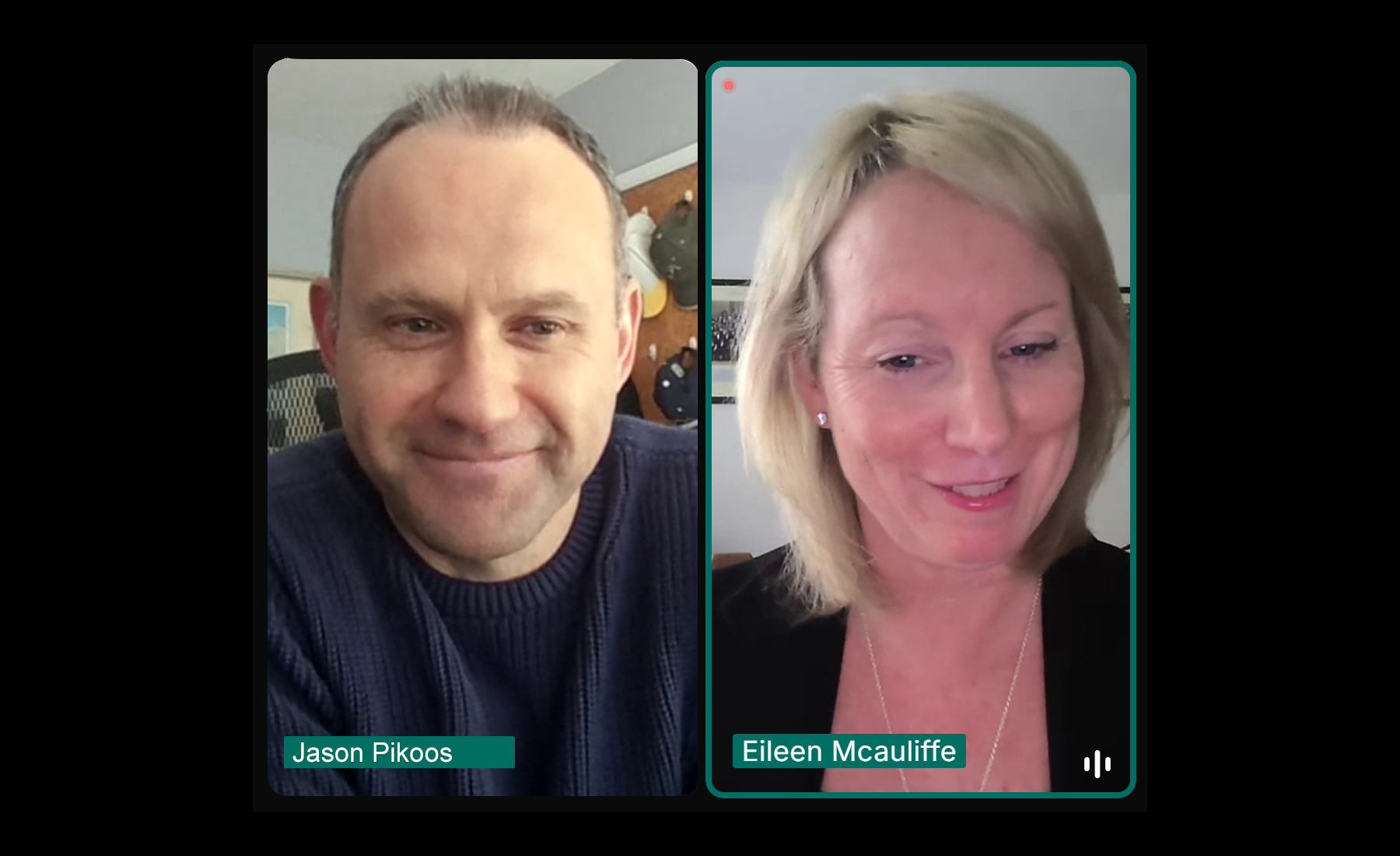
Jason Pikoos talks with Eileen McAuliffe about the AI-driven evolution of the finance industry in a video interview.
[18:12] Jason Pikoos: You know, there are a lot of individuals, they buy things, they spend money on their credit cards. How do we use AI to make those things better? But also how do we have a measure that really reflects what they care about? And it’s a really interesting one because we assume a lot. And that’s when we think about, we call those oftentimes enterprise value-oriented measures, and our view on those is those need to be outside-in, not inside-out. Just because I think that a procurement process that’s faster is better doesn’t mean my customer thinks that way.
[18:45] Jason Pikoos: So we need to make sure that we ask those individuals impacted. Hey, if I go to a customer, one of my employees is going to do a purchase or submit an expense report, well we need to determine, when they say this is a good user experience, what does that mean to them?
[19:00] Jason Pikoos: It might mean that they don’t mind waiting nine, 10 days to get it done. But what they do mine is a terrible user experience. What they do mind is spending—yes, the nine to 10 days I don’t care about—it’s the fact that I spend 20 hours that I care about. So take as long as you want, but just make it one hour rather than 20.
So I think that’s when we think about those and those are very varied, so it’s difficult to come up with a unique list. But again, as you start up with these major projects, one, you need to make sure that this is a strategic priority, and then come up with a tangible measure that reflects what your customer cares about, not what you think they care about.
[19:35] Jason Pikoos: Because oftentimes I think people choose these measures that they can, call it influence, but not what the customer cares about. I can influence the following, so I can make it easier, but actually I care about something else, and therefore I do these projects, I’m very busy, but ultimately when I get done and I ask my customers, so how do you feel about it? I accelerated your timeline. They’re like, yeah, you accelerated my timeline, I still spent 20 hours, and I don’t like it at all. Right, so that’s, that’s kind of how we think about those.
[20:04] Eileen McAuliffe: When we were chatting a while ago, were talking about the kinds of roles and jobs that we thought might disappear. And I think quite a lot of the narrative has been around transactional type roles. So accountants, you know, professional services type roles. But you mentioned to me something about coders—data scientists, computer scientists.
Can you just explain a little bit of your thinking around that area—the speed at which coding is developing now that, you know, graduates coming out with data science degrees or computer science degrees maybe need to be a bit more swift on their feet really to keep up with this?
[20:45] Jason Pikoos: Yeah, I mean, if you just, I think that was the story of 2025 and early into 2026 was how the AI tools really changed the way we think about software engineering and coding. And there’s just so much information and articles. And it was throughout the year, but then when really Claude Code came out in the latter part of the year and Opus 4.5, not to get a bit too nerdy here, only it was a real sea change.
[21:13] Jason Pikoos: There’s so many posts about, you know, very prominent software engineering individuals saying, oh my gosh, it actually now works. And so, what we’re observing is, this is no longer a tool that is a little bit of a help for you to code; it’s a tool that in many cases can code much better and much faster.
One, it means that everybody can actually do development now, right now. I mean, you know, it doesn’t take a lot to get set up on Claude Code. But what you’re seeing is even an evolution on that side of the house where there’s a move towards more managing, again, agents and they’re seeing it more quickly. It’s almost an interesting one, is if you look at that software space and the engineering space and the technology and IT space, that might be a precursor to what other organizations are going to go to.
This is no longer a tool that is a little bit of a help for you to code; it’s a tool that in many cases can code much better and much faster. ... It means that everybody can actually do development now, right now.
[21:56] Jason Pikoos: They are very rapidly moving away from being hands-on-keys to being agent managers, right. And they’re able to get many of them going. So as opposed to them having to sit in front of a monitor and work one thing at a time, they can get 10 agents working on 10 things all at the same time, and they’re troubleshooting throughout.
[22:11] Jason Pikoos: And remember, it’s not just about the coding itself. You have AI embedded in the entire process. It’s the coding, it’s the testing, it’s the error resolution. So when you get this flywheel going, the speed of development is accelerating, but it really, really changes the requirements for those individuals as well.
[22:28] Eileen McAuliffe: And what I loved about what you described just there is that space for innovation, almost risk-free innovation, and the opportunity to fail and fail again. Because if they have eight, 10, 15, 20 agents working on different things, they’re going to have a strike rate. Some’s going to be successful, some is not. But the learning is still going from both. So, I mean, I really am excited about what’s going on but also quite terrified at the same time. It is really quite frightening what’s happening so quickly.
Just jumping into our third question, and this is really just spinning it back into the business school ecosystem, I want to focus on thinking about the next generation of finance leaders, but also think about business schools.
[23:19] Eileen McAuliffe: You know, we hear quite a lot of criticism sometimes from governmental organizations and about graduates coming from business schools and you know, they’re not getting graduate jobs perhaps, or, you know, they’re soft degrees perhaps. We would, of course, disagree with that. We see the value in that.
Question 3
[23:39] Eileen McAuliffe: But from your perspective, what would you be saying to a dean of a business school if you went to dinner with them or you met them for a chat or whatever? Because business school deans are incredibly interested in what organizations like Meta, any of the tech companies, would be looking for in their graduates, and in turn the research that business schools produce, and thirdly the teaching in the curriculum that they prepare.
So what would you be saying to a business school dean about how they’re running their business school and how they should prepare for the future?
[24:14] Jason Pikoos: Yeah, these will be my opinions, not necessarily representing Meta’s point of view, but a couple of things. One, it’s—especially folks when they’re in the business school and they’re doing post grads—I actually think one of the things that people, by the way, don’t take enough advantage of, and it’s true historically and still true today, is really leveraging that relationship-building and the networking capabilities that you can.
[24:32] Jason Pikoos: Because I actually think it’s one of the best—I didn’t do it, but I’ve spoken to a lot of folks and folks that worked for me over the years—and I think that’s an enormous opportunity that people let slip through their fingers. Meaning, you meet a whole bunch of exceedingly bright people that will land in leadership roles, and maintaining those connections.
Because I do believe in a world of highly automated workflows, relationships are going to become increasingly important rather than less so. So the network that you build is super valuable, and I’d really lean into that—both in terms of that community that’s with you in your class, I guess, but even how do you actually use that as an opportunity to connect with others?
[25:10] Jason Pikoos: You know, one of the things that, if I was to suggest, I think we need a lot more unstructured learning versus structured learning, where we are challenging people to think and solve things—and it’s not about the answer, it’s about the thought process to go through it. We’re doing some of those trainings right now to teach people the use of, you know, technology and AI. We’ve given, we’ve asked people to come up with a real business need, but it’s not about the outcome and whether it works. I want you to learn the journey. How does the technology work, what worked well, what didn’t, and how do you share it with others?
I think we need a lot more unstructured learning versus structured learning, where we are challenging people to think and solve things—and it’s not about the answer, it’s about the thought process to go through it.
[25:44] Jason Pikoos: I think, to me, those unstructured exercises really open people’s mind to problem-solving, to exploration, to learning to learn, which I think is going to be such, well, is now such an important skill. And ultimately, I think not grading people fully on the answer but on the process also creates the space for experimentation and innovation being the objective.
I think, oftentimes when we are so focused on the outcome as being the thing, that creates this insecurity that, if I do not figure out how to get that answer, then I’m going to be penalized. But if we encourage the process and the learning, we find a way to reward those: Hey, these people tackled this thing in an innovative way. They shared their learning in a way that everybody else in the organization can benefit from it.
[26:40] Jason Pikoos: They evolve their ways of learning, and they shared insights, and you know, if the answer worked, great; if it didn’t, it doesn’t matter. I think you create an entirely different way of teaching people, but it is a bit of an antithesis of what we actually do today.
[26:55] Eileen McAuliffe: It is, it really is. You know, we’ve talked about paradigm shift in different contexts, but maybe there’s a paradigm shift required in the curricula of business schools and the way where we’re working with our professional accreditation bodies and also the professional certification bodies. So, you know, the professional bodies of accounting and so on. So that’s in the teaching curriculum.
What about research? When was the last time you read a research article from a business school?
[27:21] Jason Pikoos: No, I have read a few because I write a couple of papers as a [Brigham Young University] professor I work with. So, I’ve read a few, but I don’t, I read them in the context of the fact that we’re working on a paper together rather than necessarily because…. My opinion, and I do think it’s a bit of a challenge for what you might think of as more well-established traditional organizations, is speed. Speed and relevance. And I think, it’s not to say that they’re not necessarily doing things that are relevant because oftentimes they are.
But in this world, by the time it comes to market, it’s too late. And I’m talking, I’m not talking about it, you know, because some of these papers take years to write, especially in the accounting space. Man, when we need stuff is in weeks and months, and that is enormous. Like, you need to do it 10 times faster, and how do you do it? And how do you go through all those peer reviews and all that type of stuff to publish to the right type of standard, but also get it to the industry really quickly? I think speed is one of the challenges. I also think that it’s oftentimes not as connected. I think sometimes these are hypothetical or theoretical.
[28:17] Jason Pikoos: I don’t think there’s a clear realization that universities want to come collaborate more with, I guess, companies, and companies would like to collaborate more with universities. There’s an interest on both sides—I’m just not sure that both parties realize there’s an interest. But I would love topics that are more relevant to the things that I am dealing with today, rather than the hypothetical application of an accounting standard in a certain weird way.
[28:42] Eileen McAuliffe: So, I love that you say, you know, business and professions would like to work with the universities and likewise the reciprocation. How do we build that bridge between academia and practice or professional industry? It’s a persistent issue, as is the timeliness, the speed. I think the work is mostly relevant, but by the time it gets there, it’s out of date, as you say.
I would love [research] topics that are more relevant to the things that I am dealing with today, rather than the hypothetical application of an accounting standard in a certain weird way.
But in the context of a conversation where, I don’t know, 10, 15 minutes ago you said, you know, things we could do six months ago we can do in double time, triple time now, I mean, that in itself is an indicator of the speed at which we need to move at in this area. So, I’ve got one kind of killer question, just kind of to wrap all three up.
[29:29] Eileen McAuliffe: AI is consuming everyone. It’s consuming everyone’s life, I think, everyone’s livelihoods, everyone’s day-to-day work. I think you’d need to be under a rock somewhere if you haven’t heard of AI. But what are people underestimating or getting wrong about AI in the future?
[29:51] Jason Pikoos: Ooh, wow, that’s a really good question. What is it they’re underestimating? Maybe, can I answer that in two ways?
[29:59] Eileen McAuliffe: Of course, yeah. And maybe, maybe into the discipline of finance would be nice to kind of wrap up with as well.
[30:05] Jason Pikoos: Yeah, I think the one thing that they are getting wrong is they keep underestimating what it actually will be capable of doing.
[30:12] Jason Pikoos: I think we, when I speak to a lot of people—and it’s not necessarily Meta, even in other organizations—they keep thinking about, they’re talking about the opportunities of AI into the future but benchmarking against what it can do today. They’re like, well, you know, the complex accounting or whatever the topic might be, or judgment, and it’s like, yeah, you know, we never, that’s, AI can’t do that. AI can’t do that now.
And I’m not suggesting it’s going to take over all of that, but we are going to have expert AI systems that are very good at actually making judgment calls. They will have access to context that historically has not been available, meaning the surrounding business justifications, reason, history. You have to recognize that.
[31:00] Jason Pikoos: And it’s, one of the statements, a guy from OpenAI, I think, said this: The model that you’re using today is the worst model you’re going to use for the rest of your life. So that, to me, is a mistake. I think we have to, as we think about innovation, and as we think about where the future is going, and as we’re designing our processes, design for where we think it might go; don’t ground yourself in where it is now. You implement with where you are, but you plan and design for where it’s going.
[31:27] Jason Pikoos: Now the thing that I would then recommend people do, and I think this is the one thing that people say over and over again, but, you have to lean into this. You have to lean in. It’s curious, because when I tell people to lean in and engage, they keep the, oftentimes the response is, well, how do I get trained? Where do I learn? Who is going to tell me how to do it? And that’s the wrong starting point.
AI is about—what are you as an individual going to do yourself? Not what I or some other educational institution is pushing. I’m not suggesting there aren’t good courses out there to get you going and level-setting. But if that’s the mechanism by which you think you are going to become good at AI, in other words, if you’re going to do a bunch of courses and think that’s how you’re going to get there, it’s just, I mean, you’re just getting it wrong, to be totally honest.
[32:13] Jason Pikoos: You have to lean in, you have to invest the time, you have to teach yourself, you have to challenge yourself. That learn-to-learn mentality, that step out of your comfort zone, using technologies in ways you haven’t done before. By the way, when you get confronted with a problem, how are you going to push through it using the tools at your disposal? That is the world that we’re going to. And I think that is where I would really encourage, frankly, everybody to do. And it’s extremely relevant in the accounting space.
You have to lean in, you have to invest the time, you have to teach yourself, you have to challenge yourself.
[32:44] Eileen McAuliffe: And doesn’t that link back to what were talking about earlier around the paradigm shift? It’s the fundamental philosophy of the way, for many years, we’ve all learnt, which is, you know, you do module X, program Y, you get credit for it, you build, and so on and so on. And this is a real flip. This is, you own your learning, really, you own it yourself. And you have to roll up your sleeves and just get down and dirty with AI, really, right? That’s what it’s requiring. Entirely, entirely different paradigm shift and an entirely different pedagogic philosophy. And I love when you said, the model you’re using today is going to be the worst you’ll know in the future. I think I quoted you correctly.
[33:30] Eileen McAuliffe: I think that is so true with the speed of change, and it’s really clear to me that AI is not just a technology shift; this has to be a leadership shift as well. And the conversation that we’ve just had, it gives us so much to reflect on. And I think our listeners, they can think about how we need to prepare the next generation of leaders in terms of the things we’ve talked about today. So, the humanistic skills that they’re going to need in terms of critical evaluation, networking, all of those kind of things, as well as the way the business schools and wider universities develop their curriculum. And then we moved on to research and how that needs to kind of almost step up and get in speed with AI, really, doesn’t it?
[34:19] Eileen McAuliffe: The conversation gives us a lot to reflect on. You know, from AACSB and all our members and listeners, I want to just thank you, Jason, for taking the time to share your insights with us today. It’s been absolutely superb and fascinating, and I look forward to our next interaction.
[34:33] Jason Pikoos: Thank you so much. Really appreciate the invite. Love to share these insights, and again, I encourage everybody lean in. This is a, it’s going to be a bit of a bumpy ride, but it’s going to be a fun journey. So lean in and have a good time.
[34:45] Eileen McAuliffe: And to all our listeners, if you’ve enjoyed this conversation, please be sure to follow AACSB Pulse on AACSB Insights, Apple, Podbean, or Spotify. And we have got many more great episodes coming up on the biggest issues that are shaping global business education today.
About AACSB Pulse
A podcast produced by AACSB International, AACSB Pulse explores current topics impacting global business education—three questions at a time—with business school deans, industry leaders, and other big thinkers of today.
To receive new episodes, make sure to sign up for AACSB’s email newsletter, LINK, or subscribe to AACSB Pulse on Apple Podcasts or Spotify.
 Article
 Video
Video