



Leveling Up: Gamifying the Future of Procurement
 Article
- A four-week procurement simulation helps students move beyond memorizing theory to practicing supplier negotiations, risk management, and strategic decision-making in realistic scenarios.
- By combining classroom instruction, industry partnerships, and hands-on gameplay, the course strengthens students’ understanding of how procurement decisions unfold in real organizations.
- The simulation reframes AI as a support tool rather than a substitute for human judgment, emphasizing adaptability, collaboration, and strategic thinking as essential professional skills.
In a world where students can use artificial intelligence to generate comprehensive lecture notes or summarize a semester’s worth of readings in 30 seconds, the traditional lecture hall can become a room full of missed opportunities. The “memory-first” model of education, where rows of students passively highlight their textbooks while a professor lectures about slides on analysis matrices, is a relic of the past. Today’s learners don’t just want to read about supply chains; they want to live them.
But how do we bridge this gap between a static lecture environment and the chaotic, high-stakes, data-driven reality of the modern workplace? How do we move away from dry frameworks toward immersive simulations where students’ decisions carry genuine consequences?
The Crisis of Relevance in the AI Era
For decades, strategic procurement—the business of finding and managing suppliers—has been taught with a linear approach. However, the problem is that real-world procurement is anything but linear. Traditional lectures fail to capture the pressure of a supplier falling through or the thrill of clinching a last-minute deal.
When students only memorize theory, they often “freeze” the first time they face an actual supplier crisis in the workforce, frequently defaulting to low-cost selections they later regret. Their response represents a critical gap between the lessons taught in our classrooms and the industry skills required to assess and manage suppliers.
To address this discrepancy, the Department of Supply Chain and Logistics at RMIT University in Melbourne has collaborated with a global leader in the aerospace industry to develop Chain Reaction, a new procurement simulation. Developed in Microsoft Excel, the simulation uses a modular design that allows educators to easily update data sets every semester to keep the learning experience fresh, authentic, and sustainable over the long term.
We use this simulation as part of Strategic Procurement Management, a postgraduate course enrolling 90 to 100 students. Chain Reaction isn’t just a simple exercise in which students become procurement specialists at a fictional company; it is a four-week assessment that measures how well they make real decisions in a range of contexts, from selecting suppliers to negotiating contracts for rare earth metals.
The Weekly Rhythm: Theory, Industry, and Action
The course is structured so that students aren’t just playing a game; they are developing key professional competencies. Each week follows a rigorous learning loop designed to bridge the gaps between academia, industry, and the classroom.
This loop encompasses four parts:
Learn—The lecturer introduces key theoretical concepts and frameworks in class, providing the foundational knowledge needed for the assignment’s mission.
Connect—An industry expert from the aerospace corporate partner explains how a procurement specialist would use these specific concepts in real-world procurement scenarios.
Apply—Teams play the game by making supply decisions with limited information, applying their frameworks as they “live” the scenario.
Reflect—Groups debrief their strategies and share insights in class to connect their game experiences back to real-world lessons.
Leveling-Up Indicators: Cost, Value, and Risk
The simulation is designed to scaffold learning, introducing complexity one layer at a time to keep students in an “optimal zone” where they are challenged but not overwhelmed. Before the simulation begins, teams must create their companies and assign their strategic procurement priorities, deciding if they want to compete as the least expensive, the highest quality, or the most reliable provider in the market.
Throughout the game, students must make one main choice: Do we stay with our current partner, or do we switch suppliers based on the new data and news bulletins we received?
Each week of the simulation represents one year in the life of the students’ hypothetical companies:
Year 1—The cost trap. Students focus almost entirely on the cost of procurement. They are given baseline pricing data and, as many rookies do, often fall into the trap of simply picking the lowest bidder without considering long-term implications.
Year 2—Data transparency and value. As the simulation progresses, more data becomes available, revealing the true performance of the teams’ suppliers. The definition of “value” shifts depending on each team’s initial strategic priorities—a low-cost supplier, for instance, may now be seen as a liability if it fails to meet the high-reliability mandate the students’ companies originally set.
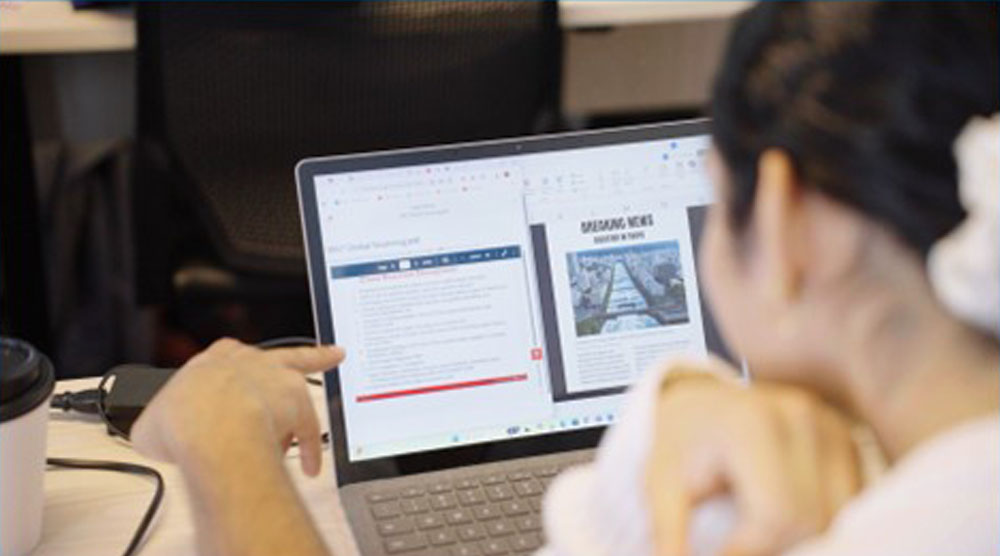
Students playing Year 3 in the Chain Reaction simulation share their notes during in-class discussions.
Year 3—Measuring and evaluating risk. The focus shifts to the analytical side of volatility. Students are hit with an initial disruptive event and must measure and evaluate the risk within their current supply chains. Using this data, they must identify vulnerabilities before they escalate into a total system failure.
Year 4—Active risk mitigation. Students move from analysis to direct action. They are hit with another disruptive event, such as increased tariffs, and must execute mitigation strategies.
Throughout the game, students must make one main choice: Do we stay with our current partner, or do we switch suppliers based on the new data and news bulletins we received?
Enhancing Assessment: Observing the Process
This model shifts assessment away from end products such as essays toward a week-by-week evaluation of students’ professional judgment. Instructors do not only assess the final answer; they look at how each team makes decisions, explains its reasoning, and adapts when new information appears.
The simulation does require a different type of assessment, but not necessarily much more work for faculty. Students produce weekly decision logs, short statements justifying their decisions, dashboard results, and pitches outlining their final strategies. Together, these outputs provide clear evidence of students’ thinking over time. With a clear rubric, instructors can assess students’ judgment by looking at reasoning, use of evidence, response to risk, and ability to adapt.
The main assessment challenge is that judgment is less mechanical to mark than technical proficiency. However, the structured simulation makes it manageable and allows instructors to give more targeted feedback to students about where their thinking was strong and where it needed improvement.
From Passive Learning to Professional Mastery
The true measure of Chain Reaction’s effectiveness lies in how well it transforms the way students understand and evaluate their own professional skills. By shifting the focus from a static end product to a live, evolving process, the simulation creates a measurable bridge between the classroom and the global supply chain.
The data from the postgraduate cohort reveal a significant shift in how students perceive their own learning. In a recent program, more than 95 percent of students felt this model allowed them to demonstrate their skills more effectively than traditional methods, while more than 91 percent reported high personal engagement with the scenarios.
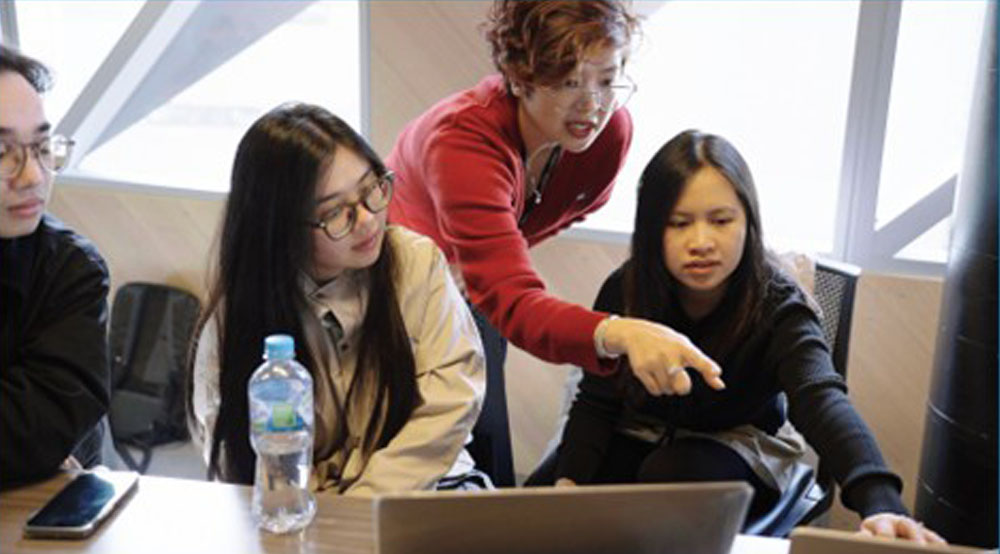
Instructor Tram Nguyen guides students through different decision-making frameworks and methods.
The “Connect” phase, during which students interact with industry experts, has proven to be a critical anchor for this assignment. On an experience survey we conduct at the end of the course, students have reported a 0.44-point increase (on a Likert 5-point scale) in “clarity of industry expectations” compared to previous semesters. This indicated that they no longer felt they were just “doing an assignment,” but were instead training for their careers.
This clarity, combined with the hands-on nature of the simulation, drove an overall satisfaction increase of 0.42 point, which offers early evidence of success for the gamified model.
In Their Own Words: The Hands-On Difference
The qualitative feedback echoes this sense of transformation. Students consistently point to the simulation as the moment the theory becomes “real.”
For instance, one student wrote, “The guest lectures gave us amazing insights into the industry. I also loved the game-based assessment; it gave us the chance to have a simulated hands-on experience.”
Other students noted that the simulation provided something a textbook never could: the weight of responsibility. As another student noted, the most effective part of the course was “the gamification, as it gave us an actual experience of procurement decision-making rather than just reading about it.”
Why This Matters for the AI-Driven Workplace
As AI increasingly handles the “boring” or routine business tasks such as organizing information, summarizing data, and identifying patterns, the value of human professionals is shifting toward their ability to demonstrate judgment, adapt to change, and be resilient.
That’s why, during the simulation, we emphasize that students should use AI as a support tool, not as a decision-maker. Students may use AI tools such as the Virtual Assistant for Learning, or VAL, the conversational AI agent developed by RMIT. Students ask VAL to help them summarize supplier information, compare options, test ideas, and prepare for their strategy pitches. However, they must produce and be able to justify their teams’ final decisions.
As faculty, we can move beyond static, content-heavy assessments toward a model of game-based learning that enhances skill development and builds professional resilience.
This reflects the future workplace, where professionals will use AI to work faster and smarter, but still need to question AI’s output, apply context, and take responsibility for decisions. As the simulation releases new information—such as supplier delays, price changes, or quality risks—students must adapt their strategies and defend their choices.
Through the simulation, students learn that AI can support analysis, but it cannot replace:
Adaptability. Students still must learn how to pivot when a shipment is stuck or a supplier doubles its price.
Teamwork. Groups must collaborate under pressure, which is exactly what happens in modern companies.
Big-picture strategic thinking. Students come to realize that procurement isn’t just about saving money; it’s about building a supply network that can survive a crisis.
Preparing for the Real Thing
Chain Reaction proves that, as faculty, we can move beyond static, content-heavy assessments toward a model of game-based learning that enhances skill development and builds professional resilience. The game-based approach represents a fundamental shift in how we prepare people for a world reshaped by technology, especially AI. While AI is great at crunching numbers, it’s the human professional who must navigate the “messiness” of a real crisis.
After graduation, when our students eventually hit real-world roadblocks, they will have more than just memorized definitions or theories to guide them. They will possess experience and confidence in their skills, having already practiced solving unexpected problems.
In other words, it is time for business schools to level up business education. Game on!
 Report