






When Post-it Notes Are Not Enough
 Article
- The traditional workshop-based model of design thinking struggles to keep pace with modern innovation.
- Business schools must teach orchestration, not just ideation, if students are to critically evaluate AI outputs while retaining creative and strategic authority over decisions that carry ethical weight.
- The Augmented Double Diamond framework makes the human-AI tension visible while allowing faculty to assess students’ judgment and agency.
Picture a familiar scene: MBA students are clustered around a whiteboard, armed with colored markers and sticky notes, working through a design-thinking sprint. They revisit user interviews, map empathy, brainstorm solutions, and prototype ideas—all in the span of a day. This process is energizing, human-centered—and increasingly insufficient.
It falls short not because design thinking is broken, but because the problems our students will face—and the tools that are available—have fundamentally changed.
In other words, design thinking needs an upgrade to stand up to today’s innovation challenges, which are data-rich, fast-moving, and global in scope. Research on how organizations implement design thinking has consistently shown that workshop-based models struggle to keep pace with the data volumes and speed demands of contemporary innovation. Meanwhile, a comprehensive survey of large language model (LLM) agents confirms that artificial intelligence systems capable of recognizing patterns, generating perspectives, and rapidly synthesizing information are already becoming standard features of the innovation landscape.
The question for business schools is no longer whether AI will change how design thinking is practiced. It already has. The question is whether we are preparing students to lead that change—or simply to watch it happen.
The Gap We Are Not Talking About
Design thinking has earned its place in business school curricula. It builds empathy, tolerance for ambiguity, and iterative problem-solving skills—capabilities consistently cited by employers as essential. Yet the frameworks we teach still largely reflect a pre-AI world.
Most design thinking courses center on the Double Diamond—the model and visual representation developed by the Design Council in the U.K. This model structures innovation into four stages: Discover, Define, Develop, and Deliver.
As currently taught, traditional models for teaching design thinking make no room for the AI capabilities that practitioners are already deploying.
Tim Brown’s landmark case for design thinking and the Design Council’s original Double Diamond framework remain foundational texts in most curricula. But as currently taught, these models make no room for the AI capabilities that practitioners are already deploying at each of those stages.
This is more than a minor curriculum gap; it is a structural mismatch between what we teach and what our graduates will actually need to do. Recent research on AI’s impact on creativity and innovation practice confirms that systematic integration of AI capabilities into design process architecture remains largely aspirational—and that the field urgently needs frameworks bridging both.
Augmentation, Not Automation
Before we can teach AI-augmented design thinking, we need to get the mental model right. Unfortunately, the dominant narrative in our classrooms is often wrong.
The conversation about AI and creativity tends to swing between two poles: utopian efficiency (AI will do the work faster) and dystopian anxiety (AI will replace human judgment). Neither is a useful frame for design education.
The more productive concept is augmentation—using AI to amplify human cognitive capacity rather than replace it. Human-centered AI research makes clear that the goal is not to automate human roles but to build systems that are reliable, safe, and genuinely supportive of human judgment. In design contexts, AI agents can handle scale and pattern recognition while humans retain empathy, creative authority, and final accountability.
This distinction matters enormously for how we structure learning. Rather than training students to outsource their thinking to AI, we are training them to orchestrate hybrid human-AI systems that achieve more than either could alone.
The Augmented Double Diamond: A Teaching Framework
To make this distinction concrete in the classroom, consider implementing the Augmented Double Diamond (ADD) framework. This practitioner-ready model embeds four specialized AI agents into the Double Diamond. Governed by deliberate human control points, each of these agents is linked to one of the model’s four stages (see the graphic below).
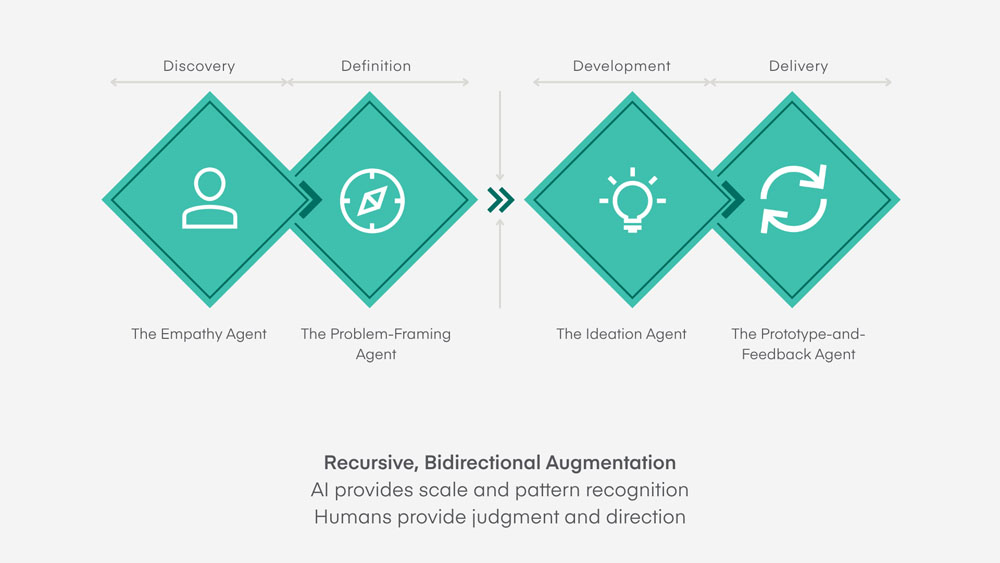
- Empathic Processing (Discovery). An empathy agent synthesizes qualitative data at scale—processing hundreds of user interviews to surface patterns, while human designers validate contextual accuracy and direct follow-up. Work on complex sociotechnical design systems highlights that the challenge is preserving the contextual understanding and emotional sensitivity that distinguish design thinking from pure data analysis. At this stage, students learn to interrogate AI-identified patterns rather than accept them, developing critical judgment about what data can and cannot reveal about human experience.
- Frame Expansion (Definition). A problem-framing agent generates alternative perspectives and challenges assumptions baked into early problem definitions. Foundational research on the core of design thinking shows that the quality of problem-framing determines the quality of solutions, while studies on cognitive obstacles in innovation demonstrate how bias narrows problem exploration even among experienced designers. Students learn that good problem definition is an act of leadership, not just analysis.
- Creative Synthesis (Development). An ideation agent draws on cross-domain knowledge to generate novel concept combinations, while humans evaluate originality, feasibility, and fit. Research on cognition and creative entrepreneurship shows that analogical reasoning—connecting distant concepts—is the engine of genuine creative breakthroughs. Students learn to distinguish between AI-generated novelty and creative value, a skill that requires taste, domain knowledge, and strategic awareness.
- Iterative Acceleration (Delivery). A prototype-and-feedback agent accelerates testing cycles while human designers manage stakeholder relationships and make final decisions. Evidence from parallel prototyping research confirms that more iteration cycles produce better outcomes, while Jeanne Liedtka’s analysis of why design thinking works shows that the discipline of structured experimentation is what separates productive iteration from mere repetition. Students learn that speed without quality learning is just noise.
What connects these four elements is not technology—it is structure. Each agent operates within explicit interaction protocols: validation loops that keep humans accountable for AI outputs, direction loops that align AI processing with human strategic priorities, and learning loops that continuously improve both agent configurations and human judgment.
What This Means for Our Curricula
Teaching AI-augmented design thinking goes beyond adding an AI module to an existing design course. Business school faculty and program leaders need to rethink what design capability means in an AI-enabled world. This will require them to make four strategic moves in their approach to design thinking:
Reframe the student’s role. The core skill is no longer ideation or synthesis—it is orchestration. Students must learn to deploy agents purposefully, validate outputs critically, and maintain human authority over decisions that carry ethical weight.
Make the tension visible. The most important learning in an augmented design course is how to manage the tension between computational efficiency and human depth. Assignments should require students to confront moments where AI outputs are fast but shallow, and where human judgment must override algorithmic suggestion.
Business schools need to move beyond teaching design thinking and AI literacy as separate competencies and start teaching them as integrated practices.
Design for agency, not automation. Courses that treat AI as a productivity tool miss the point. Students should be assessed on whether they preserve empathy, maintain creative authority, and make deliberate choices about when to follow—and when to override—their AI agents.
Bring practitioners into the room. Innovation leaders, design directors, and AI specialists are already navigating these trade-offs in practice. Their experience should inform how we frame case studies, structure simulations, and set assessment criteria.
The Measure of Success
The ultimate test of our graduates’ AI-augmented design thinking is whether they can solve more important problems, serve more diverse stakeholders, and generate more innovative solutions. An even more important question is whether they can do so while developing, rather than degrading, their own human capabilities in the process.
That is a high bar. Meeting it requires business schools to move beyond teaching design thinking and AI literacy as separate competencies and to start teaching them as integrated practices.
As AI continues to take hold, Post-it notes are not going away. But they need some company.
 Report