



Rising to the Challenge of a Polycrisis World
 Podcast
Host Eileen McAuliffe, AACSB’s executive vice president of EMEA and chief thought leadership officer, talks with David Steingard, head of Principles for Responsible Management Education and former business ethics professor. They discuss the heightened need for responsible leadership today and how business schools can meaningfully contribute to the many challenges facing the world. They center their conversation on three big questions:
- Why do you think responsible business education has become more important in today’s environment?
- How should business schools think differently about preparing responsible leaders?
- Many of today’s biggest challenges—from climate change to AI governance—depend on thoughtful public policy. What responsibility do business schools have to contribute research that informs those conversations?
Transcript
[00:00] Intro: Welcome to AACSB Pulse, the podcast that tackles critical topics in global business education today, three questions at a time. We talk with deans, industry leaders, and other big thinkers about the trends reshaping education, leadership, and the future of work. AACSB Pulse brings these topics and more into sharp focus. AACSB Pulse: Three big questions. Bold answers. Better business schools.
[00:29] Eileen McAuliffe: Welcome to AACSB Pulse. Today, I am and just beyond delighted to welcome David Steingard, a dear friend of mine who recently became head of the Principles for Responsible Management Education, or better known locally as PRME [pronounced “prime”].
PRME has spent nearly two decades working with business schools around the world to advance responsible management education. And David has dedicated much of his academic career to leading similar efforts at the St. Joseph’s University Haub School of Business. David, it is my absolute pleasure to welcome you to this podcast.
[01:06] David Steingard: I really appreciate it. I’m really looking forward to it. Thank you.
Question 1: Why Is Responsible Management Education More Important Today?
[01:09] Eileen McAuliffe: OK, so as you know, we have three big questions, so let’s move on into our first big question of the day. So we often see around us in popular media and conversations with students, colleagues, that the world is confronting today’s business leaders, and it’s more complex than ever, really, in terms of what we’re dealing with.
So organizations are being asked to create value, but not just for shareholders—for employees, communities, and, as we’re seeing with these raging temperatures all around the world, the planet.
Why do you think responsible business education has become more important in today’s environment?
[01:50] David Steingard: Today’s environment—both the physical environment and then the environment around geopolitics and government regulation and supply chains—the world has a polycrisis situation. Not to start out on a dour note, Eileen, but we’re looking at years of problems that have now accumulated, and they’re starting to manifest.
So we have an obvious environmental crisis. So we have the climate, we have geopolitical tumult, as we might say, that is affecting higher education and business schools, the value proposition of scientific knowledge, advancement of the role of the academy in preparing leaders for the future—this is all sort of in question. And then we also have the AI revolution, which, like any technological revolution, will have its displacement, and it will also have its breakthrough transformations for humanity and the planet.
[02:53] David Steingard: So if we look at those polycrises together, we can look at their loosely translated Chinese word for crisis, which is “danger and opportunity.” So what we’re seeing in the responsible management education world is a stepping-up, an opportunity to put forward the education, the research, the student engagement, and the practice with companies to move the needle on some of these very real, wicked problems, as we say.
[03:24] Eileen McAuliffe: So do you see the role of business schools, business and management education scholars, to be informing and leading the way with some of those macrocrises, as we’ve talked about? You know, the planet’s warming up, and it almost lends into us supporting—in our discipline—supporting interdisciplinary research a little bit more. So what do you think about that? The kind of lifting business management education and inserting almost into other disciplinary areas.
[03:57] David Steingard: Eileen, that is a very insightful question and poignant on two fronts. One would be on the research front, on what the content of the research is and then what the impact of that research is. And they kind of are entangled. So as the story goes for academic research, it has been very privileged and isolated, in a sense, to speak to itself. We call that scholar-to-scholar research. And this involves the whole citations and reputable journals coming from reputable institutions and creating a necessary scholarly conversation and evidencing on standing on the shoulders of giants.
And this research, to varying degrees, is connected or disconnected from what is actually occurring in the world. And now, with the world changing tectonically, the scholar-to-scholar model is being challenged. And we call it now the scholar-to-society model. Can scholars produce knowledge that actually addresses these impacts?
The interdisciplinary is inevitable because the problems of the world and the opportunities for innovation require more.
[05:05] David Steingard: And that ties directly to your point about interdisciplinarity. At PRME, we are now seeing the PRME business schools doing substantive research collaborations across their campuses, at the universities, in engineering, to create sustainable solutions for water or other kind of sanitation dimensions. The interdisciplinary is inevitable because the problems of the world and the opportunities for innovation require more. This is where research is going, and then ultimately, by design, that research should come back into the classroom for the next generation of leaders.
[05:45] Eileen McAuliffe: So I love that. Let me just pursue that line of thought a little more. So some people see responsible business education as a response to political or social trends. How do you respond to that claim?
[06:01] David Steingard: So responsible management education, if I may, is not faddish or temporally constrained. It is rooted—and this is the value of PRME in the ecosystem—it is rooted in the 193-country agreed upon principles that are in the Universal Declaration of Human Rights from the U.N., that are enshrined in the seven principles of PRME, that are in the 10 principles of the United Nations Global Compact, which are the 20,000 companies that PRME is involved with from an academic business partnership.
And these are the unchangeable values, moral foundations of humanity that we’ve all agreed upon. So if we look at that foundation, it doesn’t change throughout time, it just gets enlivened more now. So, in a way, it’s really good business nowadays for responsible management and corporate social responsibility because it is needed more than ever.
[07:07] David Steingard: And what we’re seeing from the relationship of PRME business schools, which are 850 at this moment, and the 20,000 U.N. Global Compact companies who have signed on to uphold these principles of labor rights, environment, and anti-corruption, and human rights in business—the companies are asking for the PRME academics, and academia generally, to support the rationale and the business case—we call it advancing the business case—for why these principles and why this type of leadership, how it can be translated today to address these vexing problems.
[07:55] Eileen McAuliffe: So what’s really interesting is, PRME’s been going for 20 years, right? Yet, that foundation remains as rock-solid today as it was 20 years ago. How do you see it changing, if at all, for the next 20 years, given everything we just talked about around the kind of polycrisis piece?
[08:15] David Steingard: That’s a very timely question. So one of the approaches for the 20th anniversary year is to look at how it is that management education has actually changed along throughout the history and what the contribution of responsible management education has been to that.
It is a paradox that we’re needed more than ever, and the reason we’re needed is because there is no delay possible anymore in doing responsible management.
So where we see the inflection points throughout time is the traditional Milton Friedman shareholder primacy—lead, manage, control, that sort of management paradigm—became ineffective because the market did not demand it. So now we’re seeing what the market is demanding, is, they need to be—these are words that come up from the companies—they need to be resilient. They need to have a sustainable supply chain and know that all of their partners are in line with these principles because it is what is actually going to be enduring.
[09:14] David Steingard: So I think as PRME sort of refits or refocuses, we will look at the actual needs of business and then translate that back to how we can fashion responsible management education to serve the need. So again, it is a paradox that we’re needed more than ever, and the reason we’re needed is because there is no delay possible anymore in doing responsible management.
[09:44] Eileen McAuliffe: So there’s that urgency, really, isn’t there? I mean, absolutely. I think one thing I just wanted to just talk about for a few seconds: You know, you’ve got phenomenal influence around the way business schools respond to PRME, but also, future-looking—could there be more of an influential role, do you think, in terms of not dictating but shaping the way business evolves in the next 20 years as well?
[10:10] David Steingard: The fundamental sort of influencing of an accreditation body, of your accreditation body, is that at some point you can lay out standards for 6 to 8 percent of the business schools, and there’s a sort of compliance. But, in that compliance comes culture change, and that spreads, right?
Anti-corruption is one of the most important issues to business because if you do not have a level playing field, it is impossible to essentially deliver on business objectives.
So I’m thinking, in terms of PRME, and forward and basically being generative of what a future could look like, I think this is where the leveraging of our U.N. positioning comes in. And I will give you a specific example. One of the 10 principles of the Global Compact is anti-corruption. And anti-corruption, anti-fraud—it goes by business integrity, goes by many names—but this is one of the most important issues to business because if you do not have a level playing field, it is impossible to essentially deliver on business objectives, right?
[11:06] David Steingard: So in our ecosystem of PRME and the Global Compact, we have a budding—and it’s moving quickly—anti-corruption, what we call One Global Compact, where we have schools, our PRME champions, we have representatives from the U.N. Office of Drugs and Crime who handles anti-corruption, we had somebody from the World Bank, we have reformed anti-corruption companies that have been in the spotlight publicly and now are leading the way, like Siemens and Bayer/Monsanto. And we’ve been convening and putting together—we put an event together in Switzerland, there’s a book that came out of that, there’s going to be a Davos session.
[11:51] David Steingard: And so I think what we can do, to your point, is take all of these activities around particular topics, put them together, and kind of move the needle at collective action, at scale, and say, OK, let’s lead and make sure anti-corruption and business integrity is part of responsible management education, because that is what the world is working on.
[12:17] Eileen McAuliffe: Let me just take it out a level, up a level, whichever way you wish to look at this, and, the SDGs and their Agenda 2030 have provided business schools with a really common, globally recognized framework for advancing sustainability in research, in curricula, and in wider communities. So as we get closer towards 2030, which actually isn’t really that far away—I don’t know whether you feel time’s moving quicker now at this point—so how do you see this framework evolving, or do you see new priorities coming through in the next version of the framework?
[12:58] David Steingard: The post-2030 agenda, as it is called, is trying to envision a future of what will happen after Agenda 2030 and the SDGs are, the current term expires, if you will, in 2030. And we look at the history of these Global Goals that come from the U.N. that are ratified across cultures and countries. We had the Millennium Development Goals from 2000 to 2015, and those address some really basic levels of infant mortality, of basic nutrition; they were, how do we get the human race up to a level of functioning? And the SDGs, from 2000 to 2015, built on that. And there’s good health and well-being, and moved into more sophisticated things like how to have sustainable infrastructure and gender equality. Right.
[13:52] David Steingard: So what we’re seeing coming on the horizon is, in the post-2030 agenda, it will both be sort of content- and ideological-wise, there will be a kind of converging on how to approach it. But it does not look like there will be another set official goals like the Millennium Development Goals, SDGs, and I can’t really prognosticate about this—I don’t know—but I think what’s going to happen is the foundation of these two sets of goals for 30 years shows humanity through its multilateral cross-cultural agreements and consensus, and the U.N. can say these are areas that are very important.
In a post-2030 way, how can we organize the people and the resources of this planet to be equitable, to be sustainable, and how can business drive that?
So for management education, and PRME being close to the SDGs because of being a U.N. group, we can see that the community of PRME is already starting to percolate.
[14:49] David Steingard: I can give you a specific example is that we are looking at a different type of economic model to ground business schools in. You know, we have been saying we do not want shareholder primacy, we do not want an externality focus, we don’t want an extractive economy to base our business schools on, but we need to come up with a deeper level of soil. And that is turning out to be words and phrases like the well-being economy, the regenerative economy. Looking at, in a post-2030 way, how can we organize the people and the resources of this planet to be equitable, to be sustainable, and how can business drive that?
[15:34] David Steingard: So I think it’s very exciting that there is a kind of new paradigm, if you will, coming up that’s saying, Look, we got a good start, 30 years of concentrated effort, and now we need to rebuild it, but from a much more kind of ontologically deep level so that we can really catapult the changes for the future.
[15:55] Eileen McAuliffe: Yeah, I’m really looking forward to that conversation because the raising-up of some of the issues that you’ve mentioned there is greater than ever before, in my view. But that’s question 1 [laughs]. So fantastic.
[16:10] David Steingard: [laughs] So we’re doing well.
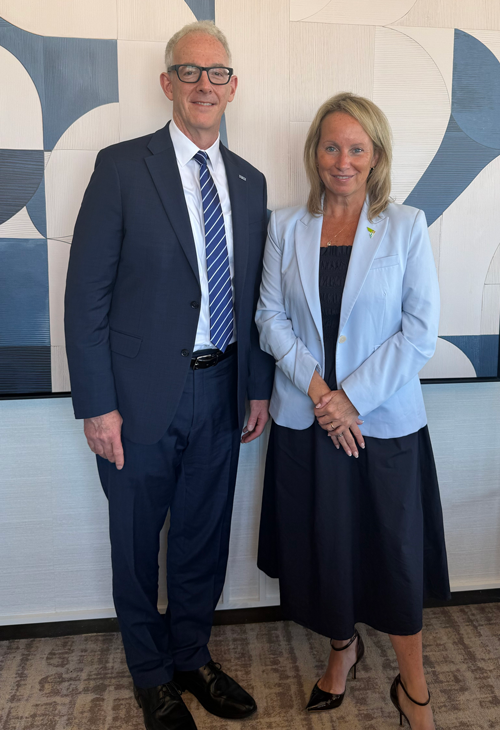
David Steingard (left) and Eileen McAuliffe set aside time at the Annual Meeting of the Academy of Management in Philadelphia to discuss responsible business education.
Question 2: How Should Business Schools Think Differently About Business Education?
[16:11] Eileen McAuliffe: We’re doing great. So let’s turn to question 2 and to why responsible business education, per se, matters, and what it looks like in practice. So we recognize what responsible leadership looks like and that’s one thing, but embedding it meaningfully into the curriculum and institutional culture is quite something else. And as a former dean and a submitter of many SIP [Sharing Information on Progress] reports over the years, I’m well versed with the kind of cultural change that has to go through a business school.
So how do you think business schools should think differently about preparing responsible leaders?
[16:49] David Steingard: Interesting that you use the word culture because the cultural milieu of the business school right now is being challenged. The traditional systems—and we hear this all the time and you know this—that the tenure and promotion system, the way that we reward our faculty for their scholarly pursuits, which is, you know, a major theme in accreditation—Are you doing good quality research? Are you recognizing the community and the pedagogical part of how you’re translating this knowledge to the students and what they’re getting out?—like that loop has been very self-sealed within academia, and in keeping with theme of, there now is a world that’s coming down with the polycrisis and challenging that model.
[17:42] David Steingard: And one of the reasons this is changing is the revenue model, the business model of a business school is no longer, Oh, we’ll have an infinite supply of 18- to 22-year-olds, we can raise tuition 10 percent every year and we will always have a large administration to administer all the services. It’s a different game.
So, again: In a crisis, there’s danger, there’s opportunity. So the challenge will be, can we make fit for purpose the business school for the students who are not the customer or the product, but they are the ones that education is entrusted to provide the skills, the leadership, and the wherewithal so that they can address these issues in the next generation.
[18:34] David Steingard: And a word about students: One of our sort of hubs, if you will, is students, and we have an innovation accelerator, it’s called the Innovation Studio, where teams of students from universities, business schools all over the world basically compete in a benevolent Shark Tank-like environment. And they are usually focused on one or two SDGs in their local area to solve problems through private sector—through business and a for-profit model.
And at our annual Global Forum for PRME, with RME Week, where we were really happy AACSB and our other partners were participating, I had the privilege of being one of the judges for the competition and also giving out the awards, and we even had a little seed capital for some of the projects. And I looked out at the 150 students who were there from all over and it hit me sort of like an epiphany.
[19:34] David Steingard: I said, “Everything we’re doing in responsible management education should be to prepare you for the world that you’re already in.” It’s not like you wait 20 years for a generation.
So I think in terms of changing the business school, having a student focus—not as a customer, but actually as the ones we are supposed to gift this knowledge to so they can be prepared—once that changes, then I think it’s easier to say what kind of research are we doing, what are the courses we need to teach? And, oh, we want our best faculty, we want our best research faculty in front of those students. That is going to take a long time, but it is inevitably going to happen because students will not attend schools where they’re feeling ill-prepared for the future.
[20:23] Eileen McAuliffe: I mean, everything you’ve said is absolutely resonating. But I think there’s this notion that long-standing curricular, long standing models are perfectly fine. Whereas, as you’ve said, the expectations or the needs of students is significantly different these days. And I also think we have a duty, a stewardship duty, if you like, or governance duty around the next generation and the generations that come beyond us to provide a management education that is fit for purpose and fit for the world.
So it’s, what I’m really interested in is this notion of, do we listen to students enough about shaping the future curricula, about shaping their role in business and society? So insofar as possible, how far are students shaping the conversation about their role in business and society?
[21:21] David Steingard: In the conversations, the “business as a force for good ecosystem”—we’re trying to find a less clunky name for it, but it is all of the professional organizations, accrediting bodies, deans councils—when they gather and they talk about the future of management education, there is a conspicuous absence of students.
And one of the things—and I appreciate on a podcast you can kind of do forward thinking, that’s the point—it occurs to me, Eileen, in this conversation, and there’s been some rumbling, we need more student representation in these conversations. Think of it like a German workers council where you have representatives from all levels of the company.
All of the professional organizations, accrediting bodies, deans councils—when they gather and they talk about the future of management education, there is a conspicuous absence of students.
[22:12] David Steingard: We don’t actually engage the students, and I think PRME is in a good position to do that because we actually have a PRME function called PRME Students. And our faculty in PRME are typically the usual suspects who are highly engaged, with the most creative students, the ones who are really pushing the envelope. So this is something we could work on. And I know that AACSB is looking for student input, so maybe this is something we can collaborate on.
[22:47] Eileen McAuliffe: I would wholeheartedly support that. And as a former dean, I only know too well the enriching power that sort of exposure—for the students and what they go on to achieve later in life—is so valuable.
Let me move us on quickly just to one possibly thorny area. AI. Let’s have a chat. AI is omnipresent in everyone’s lives. The frequency with which one chooses to engage is perfectly within one’s gift. But it feels like it’s omnipresent in management education at the moment—through publications, through intercurricular, and how people use it. But how should schools ensure that it strengthens rather than weakening students’ ethical judgment and critical decision-making?
[23:38] David Steingard: Well, before I became the head of PRME less than a year ago, I was a business ethics professor at the Haub School of business. Solid 26 years there and was responsible for our assurance of learning of business ethics and how students process the ethical kind of norms and take those into decisions and communicate those. So I’ve been.
[24:04] Eileen McAuliffe: So that was 26 years of that.
[24:06] David Steingard: Twenty-six years of this experience of doing this. And then at the tail end, of course, the AI came in. And I can tell you from my own experience—and it’s kind of resonating in the business ethics kind of faculty community—the goal is to be able to present a thorny issue, that’s real, for students, and have the tools that they can reason through it, make reasonable recommendations that are defensible with moral principles. This has always been the case. So what has changed with AI is, you don’t have to think for yourself anymore. And the paradox of how this can be useful or detrimental is that the ethical reasoning that can come out of a well-trained human-in-the-loop AI around ethics is genius.
[24:59] David Steingard: So what I’ve experimented with, and what I’m hearing now, is that you can’t beat down the AI, you can’t keep it out. That is sort of not possible. So how do you work with it? So what I’m seeing faculty doing, if the goal is, of education, is for the student to embody the ability to analyze, to think critically, then they need to perform that skill as opposed to deliver a product of that skill—a paper or an exam. So AI is being used freely in the business ethics circles because it’s very good. It can tell you exactly what points are important, and it can train you.
You cannot really talk about responsible management education without understanding and engaging the power of AI.
[25:43] David Steingard: And then at the end of the semester—I experimented with this—is, sit down with a student, almost in a Socratic kind of dialogue, and you’ve had a whole semester of cases and theories and applications, and now it’s your turn. So you ask the AI, based on the kinds of things we’ve been doing in class, Can you generate a case for the student to analyze? So you have a live case on the spot and then you engage in dialogue with the student. And you learn very quickly if a student has internalized that thinking.
So I think there are creative ways to use the AI. I am also still astonished at the resistance to it. And that is something that PRME is working on because you cannot really talk about responsible management education without understanding and engaging the power of AI.
[26:37] Eileen McAuliffe: Completely agree. And I loved your example around this sort of oral examination piece, which kind of does really bring it to life. So thank you for that.
Question 3: What Role Do Business Schools Have in Informing Public Policy?
[26:47] Eileen McAuliffe: Moving on to our third question—and this is our final big question. So looking at another role of business schools—generating knowledge that extends beyond the classroom. You know, many of our challenges today we’ve already discussed around climate change, sustainability, AI governance, they depend on thoughtful public policy.
So what responsibility do business schools have to contribute to research that informs those conversations?
[27:19] David Steingard: So in the polycrisis, one of the dimensions is the geopolitical tumult, as we say, and how that affects corporate policy, regulation, academic quality, student flows from international—that’s been a big issue. It’s funny that you mentioned that on the policy because, going back to the scholar-to-scholar—or scholar-to-society; in the scholar-to-scholar model there was never a consideration of, Is my paper or my genius scholarship actually impacting society?
And some of that was, the pressure to perform on that was not as exigent, and now it is both exigent and there are more tools. And I want to applaud AACSB for the Research Impact Task Force. Putting together the thought leadership and tools and actions to create a little ecosystem that would, actually, no pun intended, echo the manifestation of research into the public sphere. And public policy can be a very specific one.
[28:28] David Steingard: So one of the orchestrations that I’ve been privileged to be able to do is a white paper that—where you are one of the authors—coming up from Sage, and it will take perspectives of Academy of Management, CABS [Chartered Association of Business Schools], a lot of our different contributors, and ask the question of how research is affecting the public, the polis, through public policy.
And now there is a tool—this is one of the benefits of AI—there is a tool that can track, from Overton, a research publication and give you a map of where in the world in policy, down to like a community municipality, of how it impacts. So we, for the first time, in the holy grail quest for impact, we are now able to see where scholarship hits and influences policy.
[29:23] David Steingard: And I think once the community of scholars understands that, they can teach the test and say, Oh, if I write articles in this topic area, I can influence this policy in this sector. So that is very exciting as one dimension of seeing the impact and the influence on public policy.
[29:45] Eileen McAuliffe: Yeah, and you mentioned the Research Impact Task Force and the framework that has emanated from that work. So let’s have a few more questions here.
So let’s talk about faculty, not necessarily promotion and tenure, because we talk about that in a very frustrated kind of way. So how do you think business schools should prepare faculty, and students to a less degree, to engage in those public policy discussions? Do we think we push our faculty out there enough in terms of their research that could inform public policy, do you think?
[30:22] David Steingard: So in terms of the engaging in the kind of public dialogue around policy and being experts at congressional hearings and things like that, again, it does come back to the incentive system. Being a public intellectual based on your research is a rarefied position in academia because most of the time, the faculty are very focused on a narrow set of deliverables. So if we can make those public engagements around evidence-based, rigorous research more valued in the scholarly consideration, it will be easy to get faculty out there and speaking.
[31:11] David Steingard: And as far as like the political dimension of academic freedom and research and speech, I think we need to double down on our scientific method, on our evidence, on our peer review because you cannot allow, we cannot allow our discourse of academia, which has been honed, to its credit, you know, since Trinity College or Oxford—I forget which one was the first—but this has been going on for a long time, and we need to maintain those academic standards but find a way to communicate them.
If we can make those public engagements around evidence-based, rigorous research more valued in the scholarly consideration, it will be easy to get faculty out there and speaking.
[31:50] Eileen McAuliffe: You will be relieved, pleased, delighted that you can embark on the rest of your day because those are the three big questions for you. So thank you so much. I have got one more for you. And this is a little bit of a sneak question now. So you’ve been at the helm of PRME now for what, six months?
[32:07] David Steingard: Since January 5th.
[32:08] Eileen McAuliffe: Since January, yeah. And as you look to the future, can you tell our audience what your highest priorities are and what you hope the organization and its community will achieve over the next five to 10 years?
[32:21] David Steingard: So the first thing I would say is, we must do our contribution in collaboration, synergy with all of the other partners. We are seeing a kind of convergence around three themes that are really important to transforming the ecosystem. One is around the research. Research has to be more relevant and still remain credible.
My goal is to take those teaching, research, and engagement priorities of PRME and then calibrate them and synergize them with the rest of the community.
So then the teaching part, which is something that PRME has still, I think, a unique contribution, the creative pedagogy. We have an Arts for Impact group, which is looking at alternative methodologies of teaching that involve like the whole person. And this is ultimately necessary in the age of AI.
And then the third one is the corporate connection to business schools, and that, we are very fortunate in the Global Compact, we now have more access to these 20,000 companies.
[33:17] David Steingard: So my goal is to take those teaching, research, and engagement priorities of PRME and then calibrate them and synergize them with the rest of the community. Because this will take all of us—from individual students, faculties, deans, our associations—working together in a more orchestrated, coordinated way to put our strengths together and kind of move some of these collective action system transformations that we all desire.
[33:47] Eileen McAuliffe: Wonderful. And we will be together on this journey. I’m looking forward to it. David, thank you. This has been such a thoughtful conversation about the evolving role of business schools, and not only in preparing responsible leaders but also in helping to address some of society’s most pressing challenges.
So, thank you for taking up your new role. I mean, you’re exactly the right person for this role. Your energy and your contributions to everything that we work in together is very valuable. So thank you for joining us today and sharing your perspectives. I look forward to seeing the positive impact that you will make in your new role.
[34:22] David Steingard: Thank you, Eileen. That was very kind, and you’ve set the bar very high. So we will continue to collaborate. Thank you, I appreciate that.
[34:29] Eileen McAuliffe: Indeed. And to our listeners, if you enjoyed this conversation, be sure to follow AACSB Pulse on AACSB Insights, Apple, Podbean, or Spotify. We have got so many great episodes coming up on the biggest issues shaping global business education today.
About AACSB Pulse
A podcast produced by AACSB International, AACSB Pulse explores current topics impacting global business education—three questions at a time—with business school deans, industry leaders, and other big thinkers of today.
To receive new episodes, make sure to sign up for AACSB’s email newsletter, LINK, or subscribe to AACSB Pulse on Apple Podcasts, Podbean, or Spotify.
 Article
 Video
Video