



Beyond Accreditation: Creating the Global Standards
 Podcast
Join host Eileen McAuliffe, AACSB’s executive vice president, chief thought leadership officer, and managing director of EMEA, in a discussion with two of the people behind the work to shape AACSB’s Global Standards for Business Education™: chief accreditation officer Stephanie Bryant and task force member Frank Buckless. They explore three big questions:
- What was the broader vision behind developing these standards, particularly in terms of how AACSB sees its role in shaping business education worldwide?
- How did you ensure you received broad feedback, and how did the task force structure its discussions around the large volume of input?
- Looking ahead, how do you see these new standards influencing how business schools operate, innovate, and demonstrate impact in their communities?
Transcript
[00:00] Intro: Welcome to AACSB Pulse, the podcast that tackles critical topics in global business education today, three questions at a time. We talk with deans, industry leaders, and other big thinkers about the trends reshaping education, leadership, and the future of work. AACSB Pulse brings these topics and more into sharp focus. AACSB Pulse: Three big questions. Bold answers. Better Business schools.
[00:29] Eileen McAuliffe: Welcome to AACSB Pulse. Today we have a very exciting episode on a topic that is likely to be at the top of everyone’s mind, especially our AACSB members, and that is the Global Standards for Business Education. I’m delighted to report that the Global Standards just received a passing vote here at ICAM. Woohoo. With me today are two guests who are going to share the journey to create these refreshed standards.
[00:52] Eileen McAuliffe: Stephanie Bryant, AACSB’s chief accreditation officer, and Frank Buckless, dean of North Carolina State University’s Poole College of Management and a member of the Standards Task Force that helped shape the inaugural set of Global Standards.
Stephanie and Frank, I am honored to be sitting here today with you. Welcome to AACSB Pulse.
[01:14] Stephanie Bryant: Thank you. The privilege is ours.
[01:15] Frank Buckless: Thank you.
[01:16] Eileen McAuliffe: Okay, so as you probably know, we structure our conversations here at AACSB Pulse around three big questions. So let’s get started with the first one.
Question 1
[01:26] Eileen McAuliffe: What was the broader vision that you had around developing these standards, particularly in terms of how AACSB sees its role in shaping business education worldwide and particularly in today’s climate?
[01:43] Stephanie Bryant: Here’s what really I think about when I think about the vision for the Global Standards. AACSB is really thought of today as an accreditor. Everyone thinks of, you know, us as an accrediting body and, of course, the gold standard in that.
But we only serve through our accreditation about 10 percent of the business schools in the world. What about the other 90 percent? Who did they look to for quality? So the vision, I think, was, could the standards be repositioned—which is an intriguing thought—could they be repositioned in such a way that they could serve two purposes?
So they could be for the accreditation purposes, but also they could be for schools who were not accredited. Maybe they’re not interested in being accredited, but they need somewhere to look for quality. So that’s what this set of standards are.
We only serve through our accreditation about 10 percent of the business schools in the world. What about the other 90 percent? —Stephanie Bryant
[02:34] Stephanie Bryant: And that’s why even the word accreditation is not in the title. It’s called the Global Standards for Business Education. So, you see, the word accreditation is just one of the purposes. So that’s, I think, what we were going for. Frank, do you think we got it? Yeah.
[02:49] Eileen McAuliffe: So, Frank, I mean, I just think that absolute global reach is critical for today. But Frank, I’d love to hear what you had to take on this, particularly in your role in the project as a dean.
[03:01] Frank Buckless: Sure, sure. I mean, honestly, when I was first approached, I said, boy, this is a big task. But then I started thinking, our world, the dynamic nature of our world today—the way technology, AI, and really the questions and value of higher education and business education—I thought it was a really important time to address that.
And back to Stephanie’s point, I’m really proud that we were able to extend the reach to broader than just accredited schools because we all need to make sure we’re driving quality education across the globe, and this will help us do that. And you know, the other thing was, I really was concerned that, because of the dynamic nature, we need to make it so this can live. And I feel like we did a pretty good job there, too.
[03:48] Frank Buckless: So schools could be flexible and adjust to the dynamic nature of today, which I think is really critical.
[03:55] Eileen McAuliffe: I love the word you used there. The standards are alive, you know, they live and breathe, and that helps us put oxygen into them depending on what’s happening in our region or in our particular ecosystem. So thank you for that.
So Stephanie, when you’re designing something like this, rigor plays a big role, right? Just following up on vision. You know, the standards are rigorous, and they are worldwide known for that. But how did you make them accessible as well as balancing the rigor?
[04:26] Stephanie Bryant: I think the answer to that has to do with the principles-based nature of the standards. So, for many years, AACSB standards—and I’m really speaking for the first 50 years or so—were very, very rules-based. So I actually learned this in my job as chief accreditation officer over the years, some of the history of, how did we get where we are today? And it’s really an interesting journey. They used to be very prescriptive. So how many students could be in a class, who could you admit, what sort of grades they had to have. So we actually had very rules-based standards. Starting in 2020, we really embraced a principles-based nature.
[05:10] Stephanie Bryant: And as Frank talked about, the living, breathing organism, if you will, the only way you can have standards that do apply, that can apply worldwide, no matter where you are, no matter what size school you are—that’s another element we have to think about—no matter what mission a school has, the only way that works is a principles-based set of standards.
So the trick, then, is rigor with a principles-based set of standards. And I think our task force was very focused on that. So we had a task force of nine deans, and they represented people from all over the world. And I would call them our guardians of rigor.
[05:54] Stephanie Bryant: So, I think the way we were able to do it is, every change we contemplated, we always weighed the principles-based nature and the rigor to make sure we weren’t sacrificing one for the other.
[06:05] Eileen McAuliffe: I think with the huge amount of feedback that you had when you released the exposure, I think you did a really great job of keeping that rigor balance with principles, and at the same time respecting regional differences and being allowed to interpret that.
Frank, you were involved more from the accounting standards. I mean, as an accountant myself over the years—and Stephanie, of course, as well—you know, we draw upon these standards in our professional capacity, preparing students that go into the professions. How do you feel about how the accounting standards have turned out?
[06:45] Frank Buckless: I mean, I feel they turned out really very strong. And you know, to me, the key issues were, and things that we heard or I heard, were people wanted it to fit better with the business standards. And I think we did a great job of doing that. We heard that in the accounting world, digital agility is really important. And I think we did a great job there as well. And so I think we’re really kind of moving them forward.
We weren’t going to help organizations and accounting programs really deal with the dynamics of our world today if we had it too prescriptive. —Frank Buckless
You know, and there’s always a tension, I think, because between kind of this principle base—and you know, we did hear about clarity. People wanted clarity because a lot of times when you have rules, it makes it clear what you have to do.
[07:29] Eileen McAuliffe: And, of course, accountants love rules, right?
[07:32] Frank Buckless: They do. But we weren’t going to help organizations and accounting programs really deal with the dynamics of our world today if we had it too prescriptive. You know, there’s a tension there, but I felt like we did a pretty good job of addressing that in a real positive way.
And as Stephanie said, it is a global organization, and we want to drive business for good around the globe. And you can’t do that if you make it prescriptive. I mean, we definitely learned from feedback, there are distinct differences across the globe. And if we don’t make it that way, we’re not going to achieve the goals we’re trying to achieve.
Question 2
[08:03] Eileen McAuliffe: Exactly. I mean, we’ve talked and touched on a little bit around the global nature of the feedback, but when it came to ensuring balance in feedback, how did you ensure broad and diverse participation, and how did the task force structure its discussions?
[08:23] Stephanie Bryant: Yeah, so I actually think this was a historic amount of feedback that we received.
[08:29] Eileen McAuliffe: And it was a huge volume.
[08:31] Stephanie Bryant: It was. I mean, it was an unbelievable amount.
[08:33] Eileen McAuliffe: Incredible, right?
[08:34] Stephanie Bryant: Which I think says something, right? There’s a signal there. If you put something out like an exposure draft and you don’t get any response, nobody’s interested. So I took that as a very positive sign that we had so much feedback. How do you ensure that you get global response?
Well, first of all, we had 32 listening sessions, each were at least one hour, and those were with the membership, broadly speaking. So those were all over the world, every nook and cranny of the world, every conference that any of us were at, were able to get time on the agenda. So when I say listening session, if we’re at a conference, you might have hundreds of people in the room, so it’s hard to gauge, like, if you tried to put a number on it. It wasn’t hard to get people to participate.
[09:20] Stephanie Bryant: That wasn’t hard at all. They showed up. Even the two webinars that we had, we did a webinar right after the exposure draft, and we did one when we posted the final standards. Each of those had upwards of 900 people that signed up, which is pretty amazing when you think about that. So it wasn’t hard to get the feedback.
How do you make sense of the feedback, and then you asked about the task force. The task force actually met six times, so imagine trying to get nine deans, plus the number of staff, together six times over a period of about six months. The task force met first to find out where they stood on issues. And then we started with the listening sessions, and then we circled back and folded everything together.
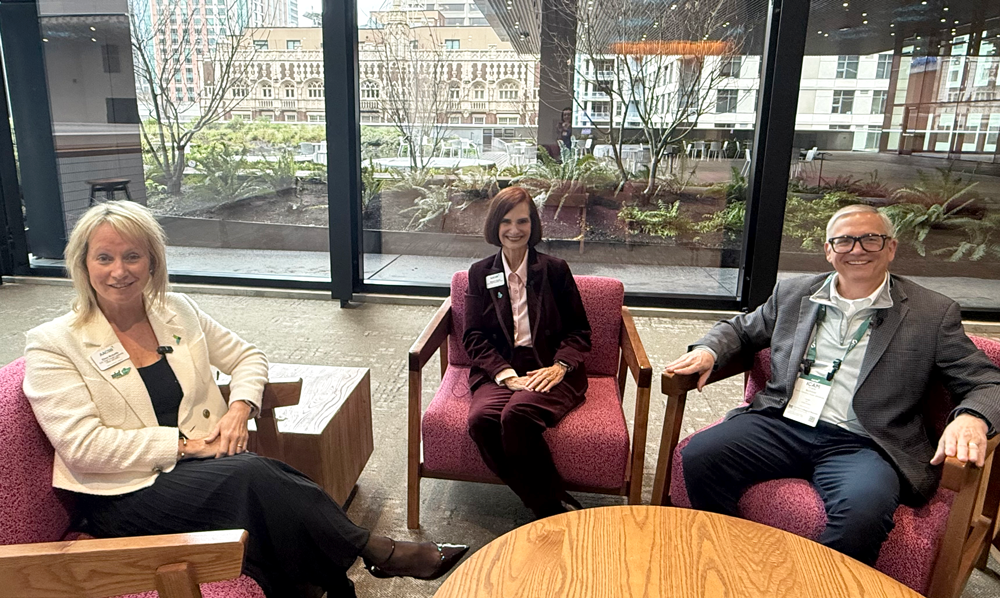
Eileen McAuliffe, Stephanie Bryant, and Frank Buckless discuss the standards development at the Seattle Convention Center during ICAM.
[10:05] Eileen McAuliffe: So it was quite an iterative process, really. I remember you coming to EMEA [Europe, Middle East, and Africa] and visiting with me, my schools, went out on the road, you came to at least, I think, one, two conferences. So you did a lot in EMEA, and I’m sure you replicated that across the globe. I know you went to South Korea as well.
[10:23] Stephanie Bryant: Yeah, we’ve been all over. And then the Asia Pacific, listening, in-person listening was done by our colleague Geoff Perry, who was in that, you know, doing the conferences there.
[10:34] Eileen McAuliffe: So, Frank, let’s spin this around. From a task force member position—what a responsibility, isn’t it? What was it like representing the voice of schools in those conversations? Because you have to kind of take your institutional school hat off and be a representative of deans more collectively.
[10:55] Frank Buckless: You do, and, you know, and I want to first just say, one of the comments Stephanie made, what made me feel really good was the amount of engagement from our community. The passion was clearly there, and I think that is critical for us to drive, you know, positive impact moving forward. So that really energized me.
But then, honestly, from my perspective, I’m going, I really have to listen, but I also have to think from a deep lens, and, can we do this? I really went in with it, I do not want to preconceive what we should be doing, but really listen and listen to everybody, and then try to figure out what we could do to make it better.
[11:35] Frank Buckless: And honestly, we got great feedback, and it was a bit overwhelming, but, you know, you’re always looking for, where are the patterns, right? What’s the consistency? What do we all agree on? And there was a lot of consistency, and I think, as Stephanie has said before, a lot of good convergence. And that’s what helped to make us move in a really great direction in the end.
What made me feel really good was the amount of engagement from our community. The passion was clearly there, and I think that is critical for us to drive positive impact moving forward. —Frank Buckless
[11:57] Eileen McAuliffe: Yeah, I heard, Stephanie, you said there was a lot of convergence around the feedback. But here’s a killer question for you both: Were there any ideas or approaches that didn’t make it into the final version?
[12:08] Stephanie Bryant: Yes.
[12:08] Eileen McAuliffe: Okay. Are you happy to share one or two examples?
[12:11] Stephanie Bryant: Sure, sure. There were actually, I would say, two big ones that didn’t make it in that I wish we could have gotten it in, in a way. But you really do have to listen to the, you know, the schools and what they’re telling you. Because AACSB accreditation is voluntary. Our standards are owned by them. So we always have to keep that in mind.
I would say the two things—and Frank, you can tell me if you agree with these—one was in Standard 7, which is on teaching effectiveness. I really was hoping that we could have an instrument, such as a survey, for example, that would be heavily validated, that everyone would use to ask the students, are you getting effective teaching?
[12:56] Stephanie Bryant: Because if you ask the professors, they’re going to say, sure, yes, we’re effective teachers, you know, because we have a vested interest in being seen in a positive light. Well, really, I want to know from the students, do you think you got effective teaching. So, originally, we had in the exposure draft that there would be a survey that would be a uniform survey on core questions, and the schools could add questions to it if they wanted.
And the idea was to have a standardization that we could compare across, you know, across the world. That did not make it into the final version. And the reason it didn’t was actually quite surprising to me. I learned, I did not know there were so many constraints from different parts of the world.
[13:41] Stephanie Bryant: So different countries actually have regulations and rules and laws about what you can and can’t go to market with. I did not know that. We had to come about getting that feedback in a different way. And what we did on that was say, OK, you must have feedback from the students, but we didn’t specify it had to be through a survey.
The other was the, we really wanted—in Standard 3, around faculty qualifications—we really wanted more around industry engagement and more of a, I hate to use the word mandate because that sounds prescriptive, but to build in that all faculty are supposed to be engaging with the professional community.
That also had heavy resistance—not because they resisted the idea and principle, but because in application, many professors, depending on their roles, that wasn’t natural to their role and responsibility.
[14:36] Stephanie Bryant: So we ended up putting it into each of the categories of whatever type of faculty role they play. But they get to tell their story, and we didn’t make it required for every faculty; that was actually in the exposure draft.
Question 3
[14:50] Eileen McAuliffe: Right, good. So you’ve given us a great look at how much care went into shaping the standards. And that is a perfect segue into this last question. And looking ahead, how do you see these standards shaping business schools and business education in terms of operations, in terms of innovation, in terms of—the big key one is demonstrating impact in our communities. Frank, do you want to get started on this?
[15:21] Frank Buckless: Sure. And you know, to that impact question, I feel that is one of the most important and critical things we need to be doing. And I really didn’t know how this would all play out. You know, we were very process-oriented, and I feel like we’ve now moved to more impact-oriented, and I think these standards are doing that, which I think is going to be good for all of us.
And I totally agree with Stephanie that we tried to push on the teaching effectiveness side. We really did try to push on the industry engagement side. And I think both of those things are really critical for our long-term success. In the accounting side, I felt like we did push a little more on the industry engagement side.
[16:02] Frank Buckless: We were able to push more with the final standards, but we still are helping people to move in that direction. So I feel good. And we’re giving them flexibility because it was clear flexibility was really important. And in retrospect, I think giving that flexibility is going to help us because I don’t really know all the changes that are going to happen tomorrow. I don’t know how AI is going totally change how we work and how we engage.
So I feel like we ended up at a really good spot, and it goes back to the rigor. I feel the way we can really demonstrate rigor is showing impact. And I feel like we’ve elevated that, and I feel we elevated it across the board. So that excites me.
[16:44] Frank Buckless: And I think we’re going to tell a better story, and help tell a better story about all business schools.
[16:50] Eileen McAuliffe: And it is, it’s about, you know, putting business schools out there and just demonstrating the excellence, be it teaching, research, societal impact, you know, all of these wonderful things.
Stephanie, I’ve got a question that I’m sure our listeners will be interested in, and that is about transition. How will we here at AACSB support schools through the transition process? There are many schools that are just starting. Some are really in deep in process, and some, of course, are accredited already. Do you want to just say a little bit there to support?
[17:21] Stephanie Bryant: Sure. You know, you can see it out in the audience. Like the number one question on their faces is, what does this mean for me? What does this mean for my school? And it doesn’t matter if there are schools that are in the beginning part of the journey of just, you know, initial accreditation, or if their schools have been accredited a long time.
So for schools that are in the initial journey, they will go ahead and transition to the global standards. If they’re really mature and like almost ready for their visit, they would stay under the current standards.
I have the most amazing team at AACSB and all three of our offices who stand ready to assist. —Stephanie Bryant
Now the—we call them the CIR schools, continuous improvement review schools, those are schools that are already accredited—for them, they have a visit every six years. There’s a one-year period before they’re effective. So 27–28 is when these standards come into play.
[18:04] Stephanie Bryant: And schools that have visits—we do over 200 visits a year—they will be under the Global Standards and the accounting standards, if they have accounting accreditation, 27–28.
And, of course, how will we support them? I have the most amazing team at AACSB and all three of our offices who stand ready to assist. We don’t wait for schools to come to us. We anticipate what their needs are, and we put that out in the market.
[18:32] Eileen McAuliffe: Yeah, and I’m guessing we’ll be doing quite a lot of webinars, seminar training sessions, and we’re really happy to go and support schools if they feel they need on-campus support in their region. It’s completely fine.
I’ve got one question. Take your heads out of the task force. What have you learned personally from this process? Frank, over to you.
[18:56] Frank Buckless: You know, well, I mean probably the biggest thing is there’s a lot of great leaders across business schools, and that really refreshes me. I think it’s critical that business has to be for good and be good for the whole society.
And so I feel like there’s a great group of leaders that can help move us forward. So that was really exciting to me. You know, and, like, if you had told me at the beginning we would focus on students and the effectiveness of our teaching, that was not in my head at all, but I’m really glad we did. That was a blind spot that we had and that we needed to really work on.
I think it’s critical that business has to be for good and be good for the whole society. —Frank Buckless
[19:39] Eileen McAuliffe: So it really opened your heart and mind, from the sounds of how you’re describing this process, it’s wonderful, from your own view. Stephanie, what about you? You’ve done this before. So what was different?
[19:50] Stephanie Bryant: This is my third set of standards, if you count the 2018 accounting standards, then the 2020, and now the Global Standards.
[19:58] Eileen McAuliffe: You’re an old hand at this.
[19:59] Stephanie Bryant: But you know, it’s different every time.
[20:01] Eileen McAuliffe: Indeed.
[20:01] Stephanie Bryant: Because I think about where the world was in 2018 and where the world is today.
[20:05] Eileen McAuliffe: Technology, for example.
[20:07] Stephanie Bryant: Technology. Yeah, it’s a very different world. What have I learned? I would say something was reinforced in my soul and in my spirit, and that is—I say this all the time because I really believe it—it’s a saying by Albert Pi[k]e, which is, What we do for ourselves dies with us. What we do for others and the world remains and is immortal. And I’ve long held that in my heart.
And through this project, I am even more committed to that. Business education can change the world. These Global Standards will change the world. So I am excited to see what’s next.
Business education can change the world. These Global Standards will change the world. —Stephanie Bryant
[20:47] Eileen McAuliffe: Stephanie, as always, you put things so beautifully, and I know our listeners will take inspiration from these words. Stephanie, Frank, it has been a huge privilege to have you here today. I’ve enjoyed listening to your firsthand perspectives on this important evolution for AACSB.
Thank you so much, Frank, for your hard work. And thank you, Stephanie, for leading such a wonderful project. And thank you both for sharing your insights here with everyone on AACSB Pulse.
[21:19] Stephanie Bryant: It was a pleasure to be here. Thank you, Eileen.
[21:21] Frank Buckless: It was a pleasure and honor to be here.
[21:23] Eileen McAuliffe: Always my pleasure. And to our listeners, if you’ve enjoyed this conversation, be sure to follow AACSB Pulse on AACSB Insights, Apple, Podbean, or Spotify. We’ve got more great episodes coming up on the biggest issues shaping global business education today.
About AACSB Pulse
A podcast produced by AACSB International, AACSB Pulse explores current topics impacting global business education—three questions at a time—with business school deans, industry leaders, and other big thinkers of today.
To receive new episodes, make sure to sign up for AACSB’s email newsletter, LINK, or subscribe to AACSB Pulse on Apple Podcasts or Spotify.
 Article
 Video
Video