





From Firm Value to Societal Impact
 Article
- Value creation for today’s businesses increasingly emerges from interactions across networks of stakeholders, rather than from firms operating in isolation.
- Micro-level decisions about pricing, risk, and resource allocation can scale into macro-level economic, social, and environmental outcomes.
- When business schools integrate systems thinking and a sustainability mindset into their curricula, they show executives how business decisions shape markets, institutions, and society over time.
“Price is what you pay. Value is what you get.”
This maxim from Warren Buffett has special resonance in today’s business world, where “value” is measured by far more than the result on one company’s balance sheet. Business schools therefore face a dual challenge: They must prepare executives to compete successfully in markets, while equipping them to understand how value is created beyond firm boundaries.
Increasingly, this value does not emerge within individual organizations alone. Rather, it originates across networks of actors, including governments, investors, institutions, and communities. It stems from decisions that carry long-term economic, social, and sustainability implications that are far broader than what appears in a single quarterly report.
This shift is captured in a concept introduced by Don Tapscott and Anthony D. Williams in their 2010 book, Macrowikinomics: Rebooting Business and the World. Tapscott and Williams define Macrowikinomics as a combination of forces that shape modern economic activity, including large-scale collaboration, openness, and interdependence.
Yet much of business education continues to focus on strategy, pricing, and competition at the firm level. Our curricula often overlook how micro-level decisions interact within broader systems.
Understanding value at a system level, however, requires a corresponding shift in our approaches. It requires us to move beyond short-term optimization to consider stakeholder interdependence and the wider long-term consequences of executive decisions. In this view, value is about more than efficiency or profit; it also encompasses inclusivity, resilience, and responsible outcomes.
If today’s business schools fail to make this shift, they risk producing graduates who can optimize firm-level performance but are ill-equipped to navigate the broader economic, social, and environmental consequences of their decisions. That’s why schools must ensure that executives understand how value is created, coordinated, and sustained across interconnected systems.
One way to do this is by drawing on Macrowikinomics, a form of systems thinking that emphasizes how value emerges through large-scale collaboration, openness, and interdependence. By integrating this concept into executive learning, we can help students see how micro-level decisions can scale into far-reaching economic and societal impact.
From Firm-Level Decisions to System-Level Value
I address this gap between how business is often taught and how it operates in real-world settings in my executive MBA classroom at the SP Jain School of Global Management, which has campuses in Mumbai, Dubai, Singapore, and Sydney. I structure discussions around value creation as a layered process, so that students begin with familiar firm-level concepts such as pricing, cost structures, and competitive positioning, but are then encouraged to extend their thinking beyond these concepts.
The key question shifts from “How does the firm create value?” to “How do firm-level decisions shape systems, markets, and society?”
At the firm level, value is often analyzed in terms of benefits to customers, returns to investors, and operational efficiencies that improve the company. However, these factors are shaped by deeper design choices: how risk is allocated, how incentives are structured, and how resources are coordinated.
Understanding value requires us to move beyond short-term optimization to consider stakeholder interdependence and the wider long-term consequences of executive decisions.
A firm that appears efficient and value-generating on its own terms might be engaging in activities that have broader environmental consequences, such as increasing emissions or depleting resources. Evaluating these consequences purely at the firm level risks overlooking these wider effects.
The micro-level decisions a firm’s leaders make do not operate in isolation. When embedded within broader networks, these decisions influence how capital flows, how institutions develop, and how markets evolve.
Bringing Systems Thinking Into the Classroom
To make the idea of systems-based value creation tangible, I incorporate real-world examples that illustrate how micro-level decisions scale into broader impact. One example comes from a classroom discussion in which students examined the Private Infrastructure Development Group (PIDG), a multidonor infrastructure development and finance organization that operates and shares its insights across a broad set of stakeholders in emerging markets.
PIDG’s model combines blended finance, guarantees, technical assistance, and project development support to mobilize private investment into infrastructure sectors such as energy, water, and transport. Rather than acting as a standalone investor, PIDG operates within a collaborative ecosystem. Governments provide policy frameworks, donors contribute concessional capital, private investors supply funding, and local institutions execute projects. Through this structure, risk is reduced, incentives are aligned, and investment becomes viable in contexts where it would otherwise be too uncertain.
This example reinforces how firm-level value creation, when embedded in collaborative systems, shapes both economic outcomes and environmental impact. An exploration of collaborative strategies set the stage for understanding how micro-level design choices scale into system-level effects.
From a microeconomic perspective, PIDG’s approach reflects familiar principles, including the importance of improving access for users, creating leverage for investors, and building capability among local partners. However, the broader impact emerges when these design choices are aggregated, as illustrated in the graphic below.
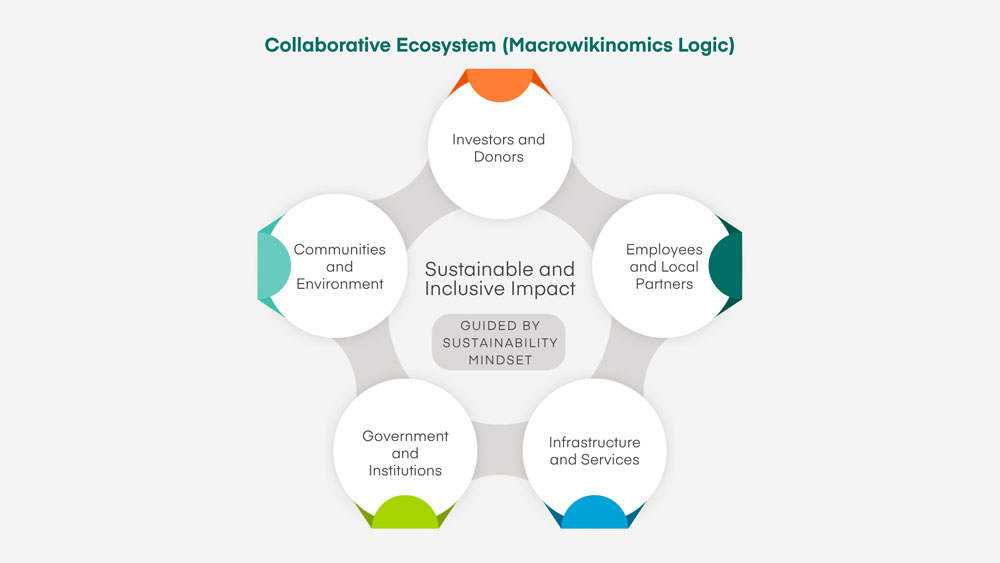
Infrastructure investments improve people’s quality of life and expand their economic participation. De-risked financing encourages capital to flow into underserved regions. Over time, repeated project success strengthens institutional capacity and reduces barriers to future investment.
What appears to be a technical decision, such as structuring a guarantee or providing early-stage support, can therefore act as a lever for large-scale economic activity.
Embedding a Sustainability Mindset
Understanding systems is only part of the shift executives must make to view their decisions in a broader, more interconnected context. They must also develop a sustainability mindset to evaluate the impact of their decisions within these systems. This mindset encourages leaders to ask broader questions:
- Who benefits from this decision?
- Whose risks are being reduced or transferred?
- What long-term capabilities are being created?
- How will this affect future economic and social outcomes?
These questions move the objective of decision-making beyond short-term financial metrics toward long-term value creation.
When we promote Macrowikinomics in business curricula, executives learn to consider economic value and societal impact together, rather than in isolation.
Importantly, promoting this mindset in business curricula does not require adding a separate course on sustainability. Instead, it becomes part of how decisions are framed and evaluated across disciplines. Executives learn to consider economic value and societal impact together, rather than in isolation.
Lessons for Executives
Managers who learn to appreciate collaborative value creation gain several insights. They understand, for example, that:
- Competing on value is more sustainable than competing on price. A clear demonstration of impact, reliability, and long-term benefit strengthens a firm’s competitive position.
- Design matters. Small choices in how actions are structured, financed, and coordinated across networks can have disproportionately large long-term effects.
- Collaboration is increasingly central. In many contexts, true societal value cannot be created by a single firm alone.
- Society is not a peripheral stakeholder—it is the central stakeholder. Firms are increasingly expected to demonstrate how their activities contribute to broader economic and societal impact.
Implications for Business Education
Business education must evolve to reflect how value is created in today’s interconnected world. Only then can we ensure that executives understand how micro-level decisions interact within systems and how those systems shape markets, institutions, and society.
We can drive this evolution by integrating the concepts described above into executive education. Doing so will have several implications for our classrooms:
- We will shift the focus from competition alone to collaboration and system design. Students learn that value often emerges through coordination among multiple actors.
- We will connect theory with practice. Concepts such as risk-sharing, incentives, and capital allocation become more meaningful when viewed within real-world institutional contexts.
- We will align our teaching with AACSB’s emphasis on responsible leadership, ethical awareness, and societal impact. Students consider not only how to succeed within markets, but also how their decisions shape those markets.
By teaching Macrowikinomics, we encourage executives to evaluate value in terms of not only its economic impact, but also its broader social and long-term impact. As business leaders move beyond firm-level thinking toward this more expansive understanding of value, they will be primed to connect business success with societal progress.
This article is adapted from an EMBA group assignment in Business Economics at the SP Jain School of Global Management. It was written with contributions from students Sarthak Gupta, Harshal Wani, Sudeshna Podder, Punya Hingwala, Huong Giang Vu, Guruprasad Raghavendran, Shivangi Aggarwal, Pankaj Bajaj, Avadhut Sawant, and Suryanarayan Rajendrababu.
 Report