





AI Kills Learning by Being ‘Good Enough’
 Article
- Students who use AI thoughtlessly might produce flawless outputs, but they will not gain the insights that emerge only through friction—the struggle to solve problems with no simple answers.
- Educators can counter AI’s “easy answer” lure by designing assignments that require students to grapple with uncertainty, exercise human judgment, and reflect on what they learn.
- Classroom experiences that require students to think, explore, and reflect will open the door for discoveries that students might otherwise miss when they use AI tools with little thought.
AI isn’t making students smarter. While the technology might make their work look better, they are thinking much less. They are using AI tools to meet the general goal of assignments without capturing the specific nuance of the learning objectives. Producing adequate work is enough to make people stop thinking and move on to the next task.
The problem is that friction—the struggle that often arises from the creative process—is exactly where the learning happens. With AI on everyone’s phone, offering to improve our sentences and “beautify” our slides, it has become a friction-killing machine.
This past academic year, we set out to reintroduce the friction. We wanted to counter the negative impact that AI use can have on our students’ critical thinking. So, naturally, we asked our undergraduate business students to make art.
At first glance, there is no logical reason to give business students an art assignment, but we saw immediate value in this activity. The act of making something that doesn’t optimize, that has no business utility, unlocks something essential in our students’ thought processes. It forces them to work with uncertainty, trust their intuitions, and bring their whole selves to a problem.
The nature of our students’ creations ranged from deeply personal to unexpectedly profound. One student painted an image called “Dreams” that was a twist on Banksy’s Girl with Balloon, with someone pulling the girl away as she reaches for it. Another created an image titled “Tear of Acceptance,” which depicted a girl with her head laid on a table as her tears pool beneath her; two clocks and the sounds of their ticking swirl above her head.
Provoking discomfort with the ambiguity of the assignment and inspiring personal reflection was the point, and their work showed it.
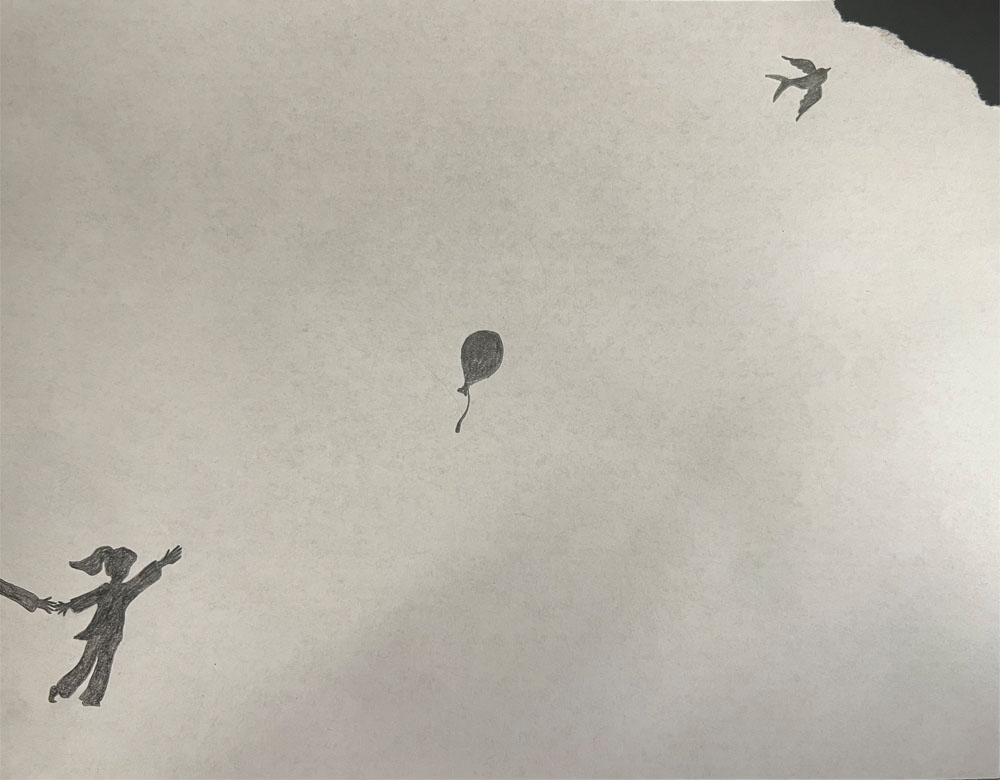
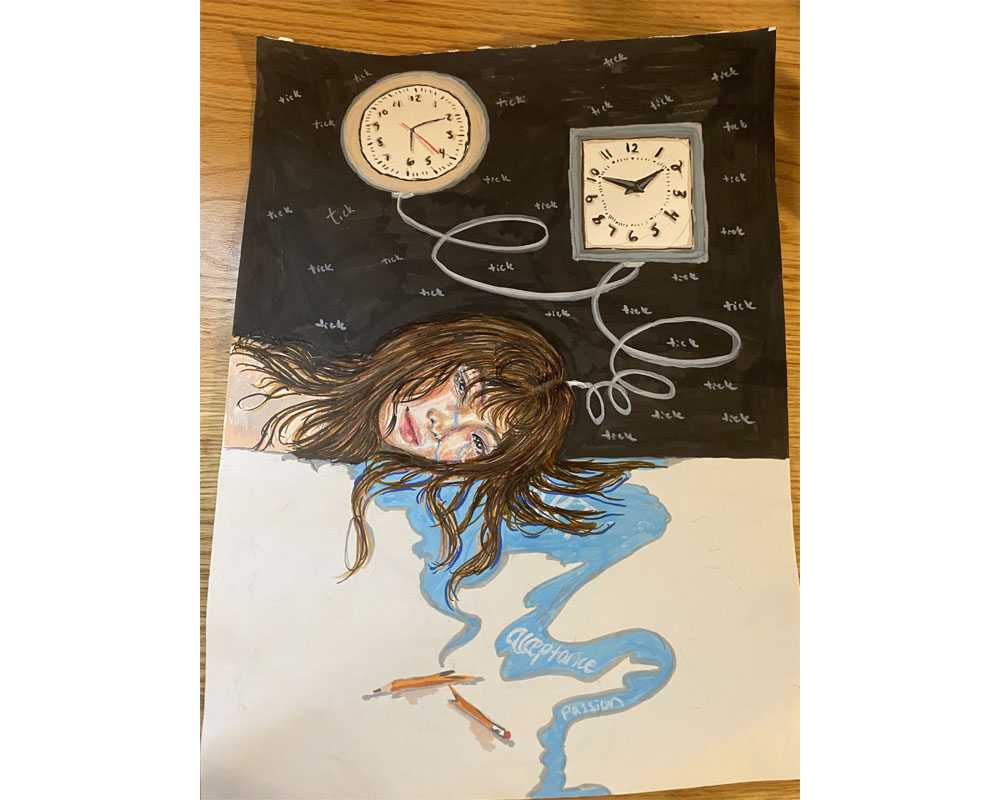
The students who created the two artworks above, titled “Dreams” (top) and “Tears of Acceptance” (bottom), chose to do so without the help of AI tools.
At the same time, some students used artificial intelligence to generate their pieces. The differences inherent in the art produced by both groups revealed a great deal about each student’s thinking. While the AI-generated art was technically complete, it seemed flat and lacked any indication of personal reflection.
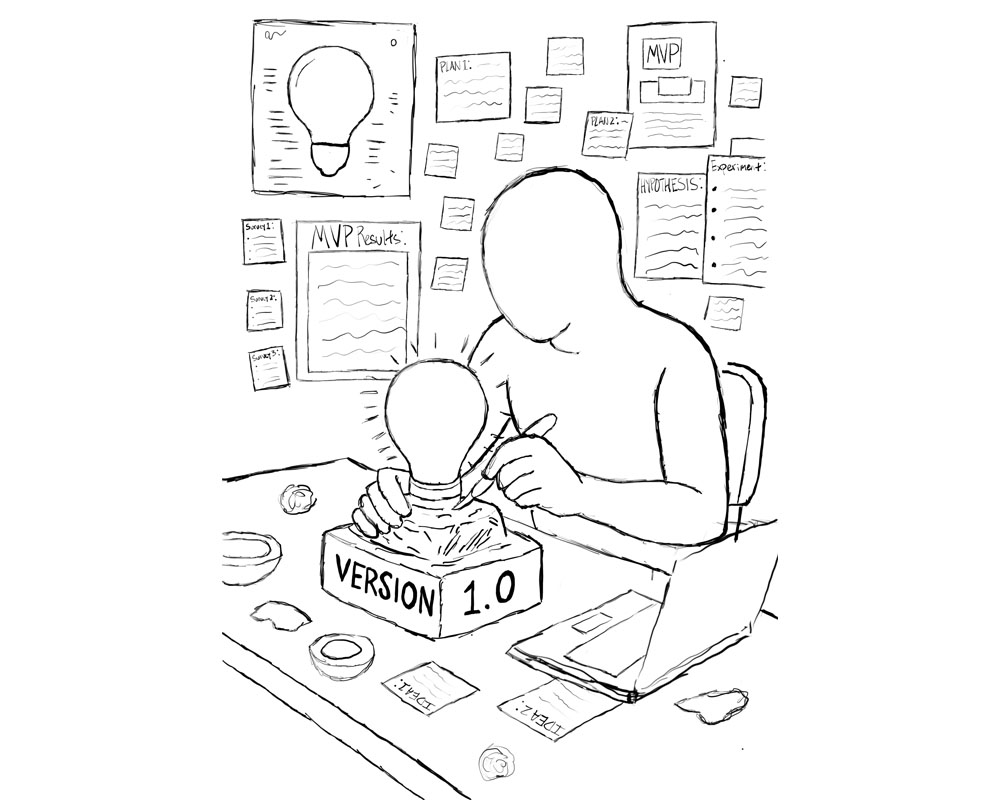
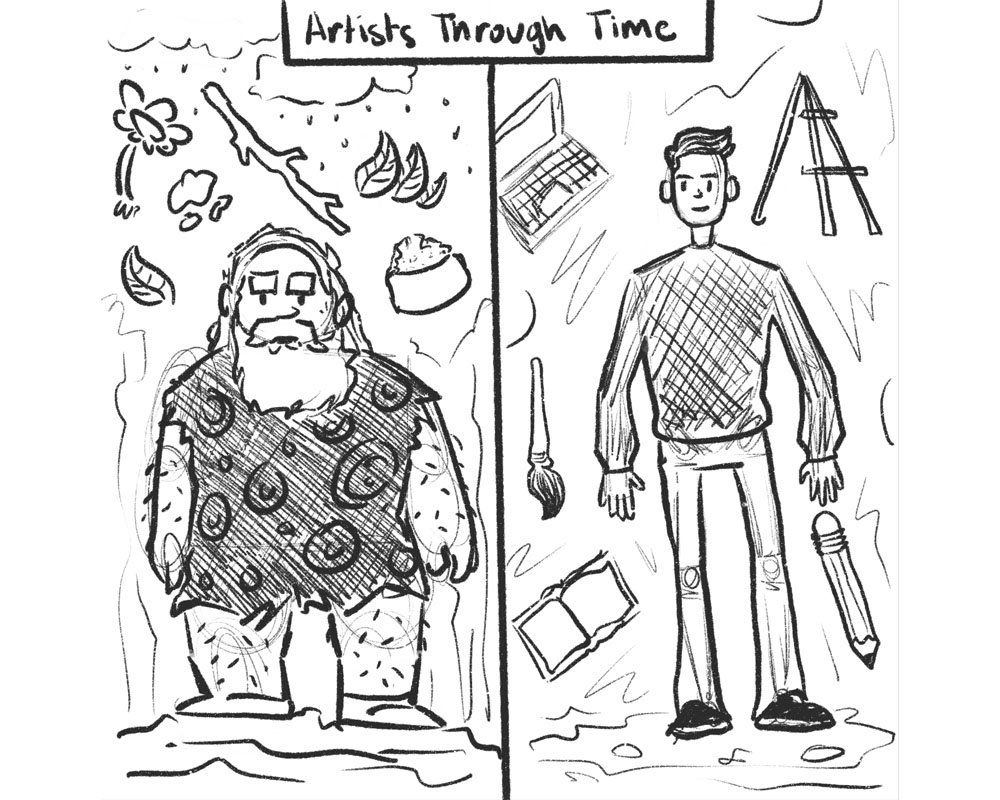
“Sculpting Ideas” (top) and “Artists Through Time” (bottom) were created by students who relied more heavily on AI’s assistance.
As educators who are adapting to this new world, we reflect on three key observations we made during this assignment. We also share strategies that we have used to keep learning at the center of the classroom.
1. If There’s No Friction, There’s No Learning
Learning is inherently social and deeply imperfect. But with AI, students can sidestep imperfection—they can copy and paste the outputs, often without carefully reviewing them. For instance, a student sent us an email this semester with the field “[Your Name]” still in place of his intended sign-off. When we asked him about it, he responded with humor, writing, “You would think this technology would know my name by now, haha.”
In a report from McKinsey & Company, 73 percent of organizations admit that their employees don’t review all AI-generated outputs. Nobody flags this as a problem because the outputs look fine. When we shared this data point, among others, with our MBA students, one person stated that she worried that AI “was replacing part of my brain.” Another expressed a sense that, because AI tools produced “good enough” outputs quickly, it was making her “impatient with answers.”
That response to emerging technologies is not uncommon. Modern digital society is now defined by increasing efficiency. We turn to apps such as Uber or DoorDash to make our lives more convenient. But in the classroom, inefficiency introduces that friction, which leads to learning. By asking students to solve a business challenge that doesn’t have a clear answer, or to complete exercises that push them to use their imaginations (such as creating artwork), we retain deeply human learning moments.
In the Khubani Business, Technology, and Entrepreneurship (BTE) program, an undergraduate program at the New York University Stern School of Business, we host an annual BTE Design Sprint. For this event, we partner with early-stage startups that, by definition, are navigating high levels of ambiguity and uncertainty.
This year, students worked on a consulting project with ArtsWrk, a hiring platform for artists. Their task was to rethink how the platform could capture value for studios and artists. Since ArtsWrk operated in a newer segment of the gig economy, there were no clear answers on what this product should look like, which meant that AI couldn’t provide quick recommendations.
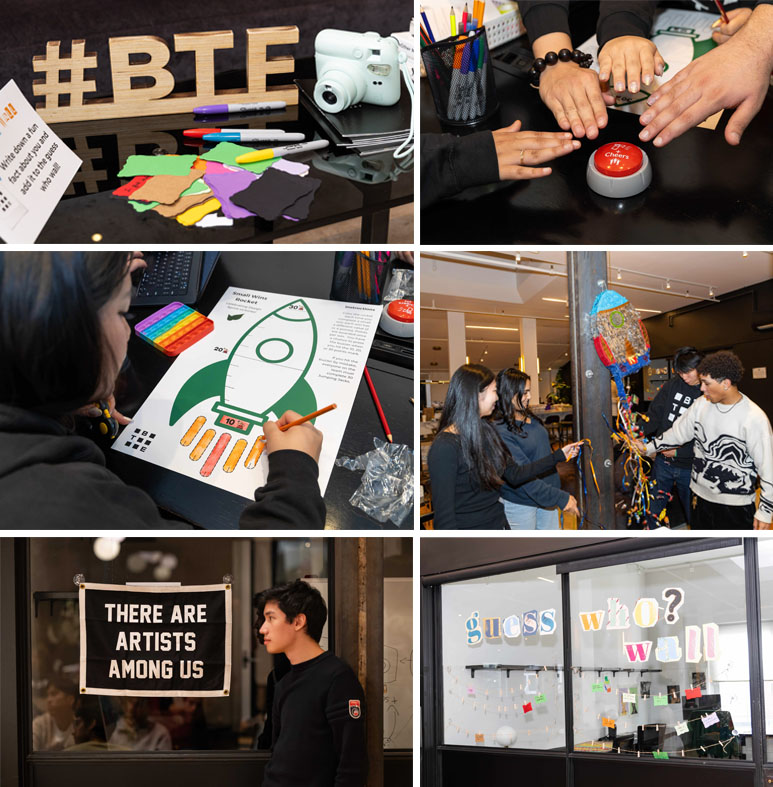
Moments from the 2025 Khubani BTE Design Sprint
The design sprint forced student teams to navigate a fast-paced, ambiguous problem with no clear solution. To make progress, they had to reach out to users in New York City, sit in awkward silences during interviews, and admit to themselves they didn’t know the answers. Only when students engaged with the problem through real-life testing, feedback, and iteration did those answers become clear.
After the project was complete, a student reflected on the experience. “I had to reach out to people, hold space for silence, and admit that I did not know [what to do] yet,” the student shared. “That felt uncomfortable, and it also woke me up. I noticed that my first instinct was to polish ideas before testing them.”
At the core of this design thinking process is the act of synthesis that forces students away from having polished solutions upfront. Such hands-on experiences help students realize that many truths can coexist in uncertainty, which results in real learning.
2. AI Can Reinforce Inequities
As educators adapt to the AI age, they are quickly realizing that asking students to engage in rote memorization is no longer effective practice (if it ever was). Their natural response is to move toward experiential learning—partnering with companies and throwing students into real challenges. But experiential education reveals inequities that do not go away on their own, and AI makes them worse.
With a textbook, the knowledge is on the page. With a company partnership, the experience is in the curriculum, and everyone has a different starting point when engaging with it. Research on experiential learning programs found that students from low-income backgrounds reported feelings of anxiety and inhibition that their peers did not, even when given the same preparation.
The more AI pushes us to emphasize experiential learning, the more important it is that we work to mitigate this anxiety. We must create environments where all students feel safe to participate. For example, at Stern, we have taken several steps toward this goal, including:
Integrating professional development into the curriculum. We have observed that some students see conversations with business professionals only from an academic perspective. They struggle to detect opportunities for networking and career development. As a result, they do not gain the same benefits from these relationships as peers from higher-income backgrounds do.
Once we realized this discrepancy, we started designing for it. For instance, we began incorporating dedicated sessions on how to engage with professionals, run meetings, and navigate professional interactions.
Accounting for financial disparities. Some students might decide to meet at cafés or restaurants for study sessions without realizing that this could present a financial hardship for peers who cannot afford to participate. To avoid this outcome, we began giving coffee gift cards and pre-paid cards for public transportation to students. This way, everyone can attend team meetings without having to reveal whether they can afford it.
Creating human learning environments. With the potential of technology to distract from learning, educators must work harder to keep our students’ attention in the room. For this reason, we purposefully design our events to take place in dynamic spaces; and we incorporate structured team check-ins, reflection sessions, and shared moments that bring energy and cohesion to the group.
Even small interventions can have a large impact. For example, we introduced a “Small Wins” game in which teams celebrate incremental progress such as unlocking a key insight from a customer interview or building a low-fidelity prototype. We have students break a piñata and take and share Polaroid pictures.
We have created shared rituals and moments of surprise that bring the student teams together. We want to create moments that humanize their experiences.
At one event, the partner that provided the venue had a giant dinosaur as part of its office decor. As students began taking selfies with it, we realized that it had quickly become something that resonated with them as part of the program. So, we purchased the dinosaur. We now bring it to all of our events as a fun tradition; we have even incorporated it into some of our “Small Wins” challenges. It has become our unofficial program mascot.
We have taken all of these steps with the purpose of creating shared rituals and moments of surprise that bring the student teams together. We want to create moments that humanize their experiences.
3. AI Can Replace Reflection—If You Let It
Every meaningful experience—whether it takes place during a classroom discussion, on a client project, or in a leadership exercise—is based on more than what happened during an activity. It encompasses how students make sense of what happened. We have all had conversations that we have replayed later, only to realize that we could have phrased something differently or that we missed an important insight in that moment. Learning lives in that important gap.
AI will erase that gap if we let it. That’s why, in our own classroom, we build structured moments for reflection throughout the semester directly into our classroom. Rather than assigning these moments after class, where students may rely on AI to generate responses, we ask students to use the last five minutes of class to write about what they have learned.
Our prompts are open-ended. For example, we might ask students to explore questions such as “What are your key takeaways and practical insights from today’s session?” or “What reactions or questions do you have regarding today’s activity?” These memos, along with journal entries, are designed to develop their intuition and entrepreneurial mindsets; the students’ responses in both the memos and their journals represent 10 percent of their grades.
We assess student reflections across five criteria (clarity, relevance, analysis, interconnections, and self-criticism). These are the criteria that help them become “reflective practitioners.”
As our students engaged in the art assignment, it became clear why reflection matters. One student who made her piece without AI wrote, “I really wanted to throw the piece away and restart, but for some reason I just felt like that I would be giving up on myself, so I went through with it.”
She didn’t just complete an assignment. She experienced the discomfort of staying in it when the colors didn’t mix right and the result didn’t match her vision. That miserable process was exactly what made it invaluable. The struggle of making something new pulled something out of her that a cleaner process never would have.
Another student who used AI reflected differently. “The vast majority of your art won’t matter for any other reason besides helping you learn how to make better art,” he wrote. “You simply have to trust the process and believe that you are learning from each creation.”
Only when humans do the hard work of engaging with the experience can they make sense of the experience. This effort leads to transformation, learning, and growth.
While this sentiment isn’t wrong, the second student showed no personal connection to the process. The friction of self-questioning was missing, so there was no moment where anything changed.
In other words, the second student merely summarized that he was not reflective. The first student engaged in true reflection. Only when humans do the hard work of engaging with the experience can they make sense of the experience. This effort leads to transformation, learning, and growth.
The student we mentioned earlier, who created the artwork titled “Dreams,” captured this truth simply, noting that “part of what makes for a successful leader is being willing to take risks” without being worried about failure.
This student was not prompted to learn about leadership. He was asked to make art. But the insight about leadership found him anyway, in the friction and engagement of the process.
Through this assignment, he and many of his classmates came to exactly the conclusion we had hoped they would: AI can complete the task, make the artifact, and even produce the reflection. But AI cannot inspire the personal transformation that only comes through engaging with the work.
 Video
Video