





How Experiential Learning Signals Career Readiness
 Article
- Experiential learning activities that strongly signal career readiness are those in which students must manage ambiguity, respond to feedback, and produce deliverables that external stakeholders can evaluate or deploy.
- Activities that send weaker signals are those in which students produce hypothetical deliverables that mirror typical company initiatives but that will not be implemented in practice.
- AI tools can amplify strong experiential designs, but they can mask shallow ones. Faculty must build guardrails that hold learners accountable for reasoning and decisions, not just tool use.
Today’s business schools prepare students for successful careers through experiential learning activities such as internships, consulting projects, simulations, case competitions, and applied coursework. Yet while institutions often treat these activities as interchangeable, employers quietly differentiate among them.
Hiring managers care less about the effort, prestige, or intent behind these activities. They focus on signal strength, or how clearly an experience demonstrates a graduate’s ability to perform in real-world organizational environments. In the age of artificial intelligence (AI), this distinction has become more important than ever.
The idea of education as a signal emerged in the 1970s, when Nobel Prize-winning economist Michael Spence introduced signaling theory to explain why employers value college degrees even when formal education may not directly increase productivity. In his framework, the degree itself indicates underlying qualities such as ability, discipline, and persistence.
Today, the question facing business schools is no longer whether a college degree signals quality, but what activities within the educational experience carry the strongest signals. The question becomes even more urgent as experiential learning and AI reshape curricula.
I write as a clinical faculty member with more than 20 years of experience in management and high-technology environments, including recruiting, hiring, and onboarding early-career talent. Over the past five years, I have taught a broad portfolio of marketing courses, with an emphasis on employer-facing experiential projects, across multiple learner populations. These experiences have reinforced a central insight for me: Experiential learning is not a label. It is a signal.
Experience as a Signal, Not a Slogan
Employers rarely ask candidates whether they participated in experiential learning. Instead, they pose behavioral questions designed to surface evidence of execution:
- What did you deliver?
- Who used it?
- What constraints did you face?
- What happened when your first attempt failed?
Because employers must infer future performance from limited information, they look for experiences that mirror real work—complete with ambiguity, iteration, and accountability. Such experiences send stronger, more predictive signals than those that emphasize polished presentations or hypothetical reasoning.
The signal strength of a particular assignment is strongest when it includes these four characteristics:
- It places students in proximity to real execution.
- It exposes them to ambiguity and failure.
- It requires them to be accountable for outcomes.
- It makes it difficult for them to fake competence.
As experiences approach real operational or market execution, they send stronger and clearer signals. In fact, experiential learning is best understood as a ladder of signal strength (see illustration below).
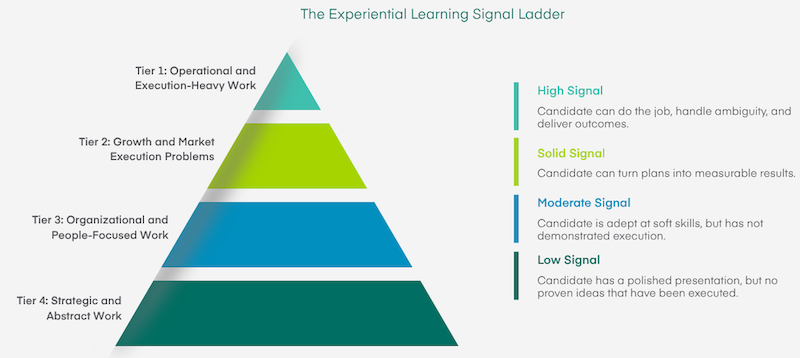
Signal strength increases as experiential learning moves closer to real execution and measurable outcomes.
Signal strength is shaped by instructional design choices, including group size, role clarity, and accountability mechanisms. Smaller teams reduce free-riding and make individual contributions visible. Clear articulation of each student’s role helps employers distinguish what was learned from what was merely observed.
Each of the four tiers described below has value, but each sends a distinct message to employers.
Tier 1: Execution-Heavy, Outcome-Driven Work
In the top tier, students complete consulting projects with external organizations that have been screened and vetted by the school. Faculty draft clear consulting challenges for students and outline objectives, constraints, and expectations.
Students conduct structured discoveries, build and execute plans, gather stakeholder feedback, revise their work, and deliver final outputs. Deliverables include usable artifacts such as reports, simulations, workflows, or decision-support tools that organizations can immediately evaluate or deploy.
Why this is a strong signal: In these projects, student performance is visible and hard to fake. Students must manage ambiguity, respond to feedback, and deliver results under real constraints. Top performers distinguish themselves through sustained execution, while those who have gaps in their reasoning or adaptive abilities are easy to spot.
A critical caveat: When these projects incorporate AI-enabled tools, faculty must scaffold the work to ensure students rely on problem decomposition and structured reasoning rather than superficial tool use.
Tier 2: Growth and Market Execution Problems
For Tier 2 experiences, faculty identify industry-recognized deliverables that closely align with course objectives and common professional practice. These deliverables may be drawn from a faculty member’s own industry experience, established professional or advisory relationships, widely used industry templates, or publicly available practitioner resources. The emphasis is on hands-on execution rather than hypothetical discussion, even though the work does not involve direct accountability to an external customer.
For example, in a new product development course, students might be required to produce design-thinking creative briefs or stage-gate plans. In a sales course, students might have to devise sales plans or go-to-market strategies. These deliverables mirror industry artifacts and require students to make assumptions, evaluate trade-offs, and work with metrics.
Students complete these assignments through structured analysis, iteration, and feedback. They can include their final outputs in professional portfolios or share them publicly over platforms such as LinkedIn to show evidence of capability and personal brand development. In some cases, students might produce short videos that articulate their reasoning, decisions, and results.
Unless a program offers a dedicated experiential course designed to support Tier 1 consulting-grade work, Tier 2 projects can be the most effective way to integrate experiential learning into standard courses. Such assignments enable students to engage in hands-on execution, produce industry-standard deliverables, and generate credible employability signals without the structural and resource demands of external client accountability.
Why this is a solid signal: Tier 2 experiences enable employers to evaluate how candidates think, build, and iterate using professional-grade artifacts. Because the deliverables are recognizable and interpretable, they provide concrete evidence of skills that are difficult to assess through credentials alone.
Tier 3: Organizational and People-Focused Work
Assignments in this tier often mirror typical internally focused company initiatives such as change management plans, training or enablement frameworks, governance proposals, culture assessments, or organizational alignment recommendations. Faculty might ask students to produce implementation roadmaps, communication plans, or capability-building frameworks.
For these assignments, students typically do not interact with the external stakeholders who would adopt and measure the work. Feedback is primarily academic rather than operational, and implementation is often outside the course’s scope.
Tier 3 assignments often mirror typical company initiatives such as change management plans, training frameworks, governance proposals, or organizational alignment recommendations.
As a result, students’ recommendations might be thoughtful yet unrealistic, incomplete, or disconnected from how change actually occurs. It’s worth noting that MBA students with deeper industry experience might be better than undergraduates at identifying gaps or impractical assumptions in these proposals.
Why this is a moderate signal: From an employer’s perspective, Tier 3 work is difficult to evaluate. These experiences tend to indicate organizational awareness, communication skills, and familiarity with internal processes, but they give few clues about a student’s execution capability. However, these signals are stronger when students have opportunities to revise their recommendations based on stakeholder input or when their recommendations are tied to observable outcomes rather than presented as standalone plans.
Tier 4: Strategic and Abstract Work
In this tier, student teams typically work under time-constrained or just-in-time conditions to address predefined challenges, produce simplified deliverables, and make short persuasive presentations. Common activities include case competitions, vision decks, hypothetical strategy pitches, and corporate site visits that emphasize exposure over execution.
Students often prefer these experiences because they require less time and provide quick closure. Success is measured by presentation quality rather than sustained execution.
Why this is a weak signal: Tier 4 experiences emphasize storytelling and polish over outcomes. They are easy to assign, administer, and judge, even when faculty or reviewers lack deep industry context. Competitions produce winners and losers, creating a strong sense of achievement. However, this structure does not translate well to professional work, where value often emerges slowly, and excellent recommendations initially might face resistance.
When I am invited to judge competitions, I ask if students or judges have been trained in the relevant context, such as how to build a business or a marketing plan. The answer is often no. This highlights a common tension between designing activities that generate engagement and designing experiences that reliably build capability.
Professional sales tracks are an important exception. Because persuasion itself is the core execution task in many sales roles, these activities can provide meaningful signals when evaluated against clear performance criteria.
Why AI Raises the Stakes
Artificial intelligence has amplified the signaling problem, particularly for learners outside the STEM fields of science, technology, engineering, and math. As AI tools become embedded into marketing, operations, finance, and strategy functions, faculty increasingly incorporate AI-enabled analysis and decision support into experiential learning projects. At times, the mere presence of AI tools in a classroom assignment can be mistaken for rigor. Yet, those tools can obscure experiential signals.
The presence of AI does not change the fact that students need to cultivate careful reasoning skills, practice structured decision-making, and learn to interpret outputs critically. It’s up to faculty to provide guardrails such as requiring students to document their assumptions before using AI tools, defend their reasoning in oral evaluations, and demonstrate how they decomposed the problem independently of the tool’s output.
The mere presence of AI tools in a classroom assignment can be mistaken for rigor. Yet, those tools can obscure experiential signals.
Unless faculty institute these guardrails, provide support, and find ways to motivate learners, students might rely on superficial AI tools to complete projects. As a result, students will not build skills in deconstructing or reasoning through problems, nor will they understand the assumptions underlying AI tools. In such cases, the experience weakens the strength of the educational signal. Labeling projects as AI-enabled without redesigning for rigor is not an innovation—it’s AI washing.
Rather than asking themselves whether AI should be part of an assignment, educators should ask whether an experience requires problem decomposition, exposes assumptions, forces iteration, and holds learners accountable for the decisions they make rather than the tools they use. When the answer is yes, AI strengthens the signal. When it is not, AI becomes a veneer that masks a shallow learning environment.
Designing Assignments for Stronger Signals
In my own teaching, experiential learning assignments have evolved through trial and error. My early projects emphasized presentation quality. Over time, I shifted toward more conversational, interview-style evaluations focused on reasoning, trade-offs, and execution decisions. I have found that six design principles consistently strengthen signal value:
- Requiring deliverables that an external stakeholder would actually use.
- Building in iteration after feedback.
- Tying work to a metric, even if it’s imperfect.
- Making constraints explicit.
- Requiring documentation of assumptions and learning.
- Teaching problem decomposition before tool use.
These elements allow me to shift experiential learning from simulated success to demonstrated capability.
My goal is to ensure that students are not merely collecting experiences, but converting them into credible signals of execution that they can share with employers. Toward this end, I have found that a practical approach is to anchor in Tier 1 or Tier 2 work, selectively layer in Tier 3 experiences, and use Tier 4 for framing and communication.
When learners can clearly articulate what they delivered, what changed, and what they learned under constraints, experiential learning becomes legible to employers.
A Call for Thoughtful Collaboration
Employer advisory boards and industry partners play critical roles in the educational ecosystem. By helping define usable outputs, realistic constraints, and evaluation criteria, these collaborators enable business schools to design experiences that benefit learners and employers alike.
Because employers cannot directly observe competence before hiring, they rely on signals that reduce uncertainty and differentiate candidates. In that sense, this approach revisits signaling theory with a modern lens. If the college degree once served as a broad indication of potential, experiential learning now offers a set of finer-grained signals that reveal how graduates reason, adapt, and execute in an AI-enabled world.
Experiential learning remains one of business education’s greatest strengths—when it is designed to make those signals visible.
 Video
Video