



5 Ways a Small School Can Boost Revenue Streams
 Article
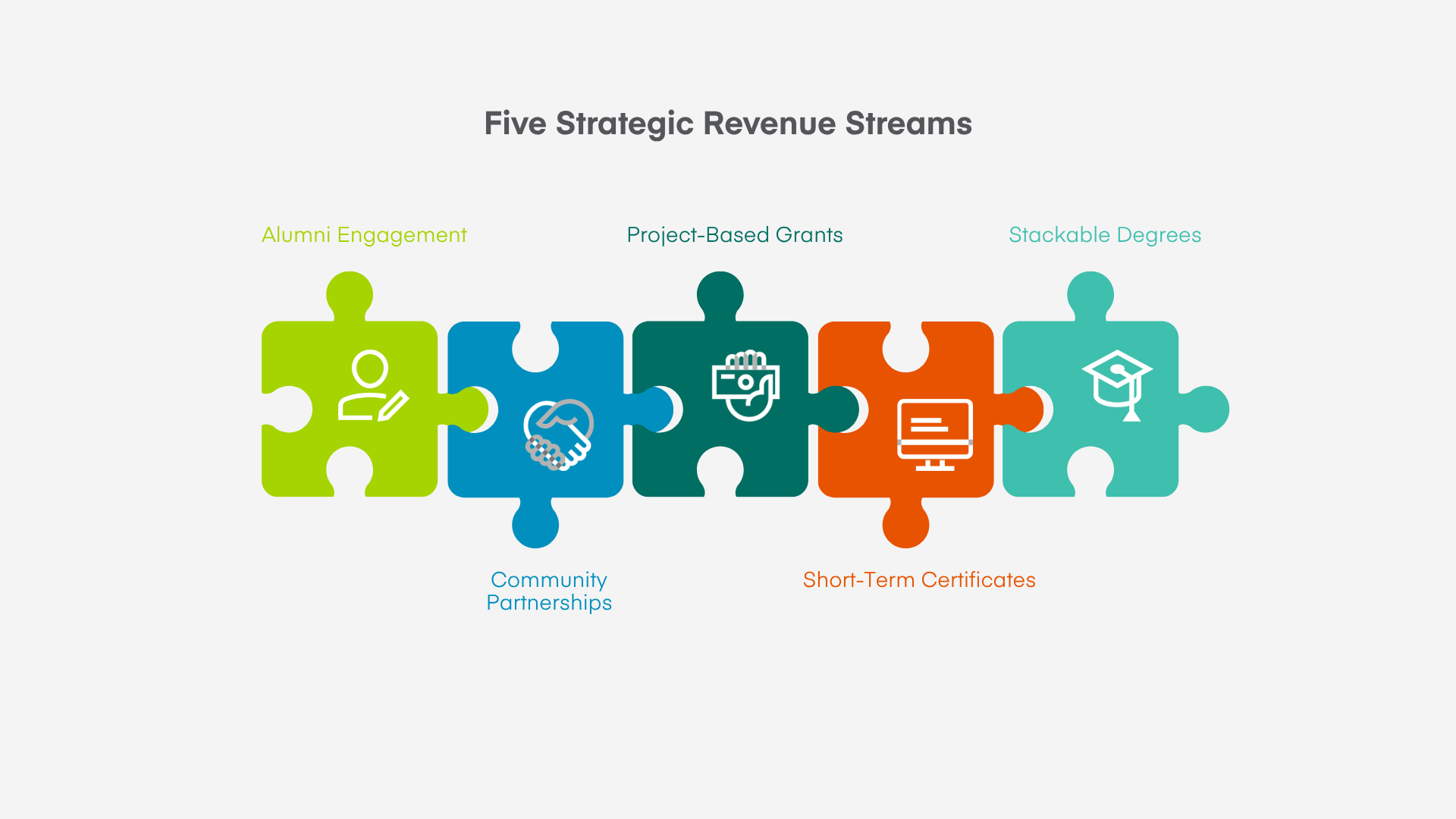
- Schools can cultivate alumni as resources by expanding targeted programming, soliciting input, and inviting them onto advisory boards.
- By engaging with community organizations, schools drive their enrollments, enhance their reputations, boost local economies, and earn goodwill.
- Schools can offer certificate programs and stackable degrees to appeal to working professionals who don’t have the time to follow traditional educational pathways.
The financial pressures confronting business schools today are neither new nor trivial. As public funding erodes and competition from alternative education providers intensifies, business schools—particularly smaller, regional institutions—are compelled to reimagine their revenue architectures.
AACSB’s 2025 State of Business Education Report shows that, between the 2018–19 and 2023–24 academic years, the average operating budget for accredited schools increased by 19 percent, yet expenditures grew by 21 percent. That trajectory is simply unsustainable unless school leaders bring fresh thinking to revenue streams. In fact, the same report shows that 76 percent of academic leaders surveyed by AACSB agree that their schools must adopt new financial models to ensure future viability.
For schools navigating institutional mergers, these pressures are amplified by the costs of transition, the uncertainties around accreditation, and the need to maintain faculty morale and student trust simultaneously. Yet a merger can also force a school to articulate its unique value, mobilize its community, and reimagine what it can offer.
That’s the situation for my institution, Woodbury University in Los Angeles, which recently completed a merger with the University of Redlands and will continue operations as the University of Redlands, Los Angeles. In the process, we have been quietly building interconnected revenue and enrollment streams. Through these actions, we believe we have learned five lessons that will resonate with peer institutions facing similar crossroads.
1. Treat Alumni as a Strategic Asset
Alumni are often invoked as a resource but inconsistently cultivated as one. We set out to change that relationship. One way we did this was by expanding our alumni programming to include up to five dedicated events annually.
We also have formed an Alumni Advisory Council composed predominantly of mid-career graduates, who occupy a strategic sweet spot: They have sufficient standing to open doors and make introductions, yet they remain close enough to their student experiences to feel an affective pull toward the institution. The council focuses on increasing engagement with the school and profiling alumni accomplishments. We gauge the council’s impact by tracking how involved members are in recurring networking events and what kinds of mentoring contributions they make to current students.
The council complements our longer-standing Advisory Board, which consists of alumni and non-alumni from diverse industries. These seasoned professionals participate in school activities such as webinars, student networking events, and our rotating executive-in-residence program. They also provide school leaders with perspectives on students’ career preparedness and the school’s strategic planning and fundraising efforts. In addition, they collaborate with the Alumni Advisory Council on the annual reunion.
To consistently cultivate our graduates as a resource, we expanded programming and formed an Alumni Advisory Council.
A school’s investment in alumni relations pays off in numerous ways. When graduates join advisory councils where their insights are genuinely solicited, they strengthen referral pipelines into degree and executive programs. Research shows that they also increase their direct giving.
We have set benchmarks to measure the success of our efforts. We aim to grow attendance at alumni events by 15 percent to 20 percent every year and to increase alumni-referred enrollments to at least 10 percent of new student intake within three years. We also are tracking the mentoring engagements initiated through the Alumni Advisory Council, and we hope to expand the Advisory Board’s fundraising contributions to offset a meaningful share of discretionary program costs.
2. Use Partnerships to Drive Enrollment
Too often, business schools treat community engagement as a revenue-generating strategy. We have repositioned it as a deliberate enrollment pipeline.
Working with local organizations, we have established cohort agreements that allow employees of partner organizations to enroll in our programs at preferential rates. The partnership model generates community investment and shared accountability, which can be a meaningful driver of enrollment momentum. When local employers are genuine stakeholders in a program, they become recruitment intermediaries for the school, even when that is not explicitly part of the agreement.
But because we recognize that working adults navigate variable professional and personal schedules, we do not require cohort members to take courses simultaneously. Research underscores that flexibility is a structural necessity, not a convenience feature, for adult learners who must juggle work, family, and community obligations. Our approach ensures that timing pressures do not derail employee participation before it begins.
Currently, we are working to formalize agreements with at least five partner organizations within the next academic year, with a near-term enrollment target of 15 to 20 cohort participants per cycle. A longer-range objective is to convert 10 percent to 15 percent of cohort participants into full degree-seeking students. This will establish the partnership pipeline as a sustainable enrollment feeder.
3. Enhance Outreach Through Grants and Programs
We look for opportunities to connect with the community through projects that boost economic development and appeal to local donors. We know that small donors, properly cultivated around a tangible civic purpose, can collectively fund programming that returns dividends in enrollment, visibility, and goodwill many times over.
For instance, we have launched an eight-week entrepreneurship boot camp, open to both students and community members, that culminates in a certificate of completion. The boot camp not only teaches skills to local entrepreneurs, but also expands awareness of our school and positions it as a civic anchor for economic development.
We look for opportunities to connect with the community through projects that boost economic development and appeal to local donors.
It also gives us a way to approach potential local donors, especially those who have personal connections to the institution. When the University Advancement Officer and I researched potential supporters of the boot camp, we found an organization that awards grants of between 10,000 USD and 20,000 USD to fund initiatives that cultivate entrepreneurship projects in the community.
We approached the alumnus involved with the organization, who visited our campus, interviewed us about our purpose, and deliberated with his board before awarding us the grant, which enables us to offer this program to participants nearly for free. We subsequently invited the alum to become part of our Advisory Board, and he now regularly participates in several of our student-focused projects.
This community-focused model has precedents. The Southeast Ohio Community Entrepreneurship Program at Ohio University offers boot-camp-style training to community members at no cost. Made possible through donor and partner support, the program functions simultaneously as a community service, educational offering, and reputational driver. In two similar instances, Saint Louis University has leveraged alumni donations to fund an entrepreneurship accelerator open to students and recent graduates, and Patrick & Henry Community College in Virginia offers an eight-week boot camp for regional startups.
In our case, the immediate goal is to deliver the boot camp to an inaugural cohort of 22 participants drawn from both the student body and the broader community. Beyond this first cycle, we aim to secure at least one recurring grant renewal and to track whether boot camp alumni express interest in enrolling in certificate or degree programs. This will allow us to establish a direct line between community outreach and enrollment growth.
4. Offer Short-Term Certificate Programs
One of the most important shifts in business education has been the demand for shorter, credential-bearing learning experiences, particularly in tech-related fields. For example, the digital marketing sector alone was valued at approximately 363 billion USD in 2024 and is projected to grow at over 13 percent annually through 2034. To serve this market, established institutions such as Harvard and Northwestern are expanding certificates in AI literacy.
While my own institution has temporarily suspended certificate programs, we plan to resume them once our merger is finalized. When we created these programs two years ago, we wanted them to function as both standalone credential opportunities and entry points into longer-form degree pathways. We chose topics by first brainstorming with our Advisory Board to identify local needs and then holding extended meetings with executives in our targeted fields. Ultimately, we created programs in digital marketing, production accounting, and inclusive leadership.
These initial certificate programs consisted of five courses each, offered in seven-week formats one evening per week over two semesters. They were originally only held in-person but will be available synchronously online when we offer them again.
One of the most important shifts in business education has been the demand for shorter, credential-bearing learning experiences, particularly in tech-related fields.
When we launched the certificate programs, we decided that credits for two of the five courses could be transferred over if candidates later decided to enroll in degree programs. In the future, we may decide to allow all of these courses to become part of stackable degrees (see below).
When we start offering these certificate programs again, our objectives will be to expand the program by at least two additional topics within the next 18 months, achieve a completion rate of 75 percent or higher per cohort, and track how many of those who complete certificates subsequently enroll in degree programs. Our goal is to reach and sustain a conversion rate of 20 percent or above.
5. Investigate the Benefits of Stackable Degrees
Our most forward-looking initiative is currently in conceptual development: a stackable degree portfolio. This model will allow learners to enroll in 15-unit certificate clusters, accumulating credentials over time at their own pace. When learners reach 120 or more units in certificate credits, they can earn bachelor’s degrees in business in the area most represented by their course compilations.
This vision honors the reality of nonlinear learners, who enter and exit education repeatedly across a lifespan, building credentials incrementally rather than committing wholesale to multiyear degrees. Schools such as the University of Illinois and Pennsylvania State already have robust microcredential programs that provide pathways into graduate degree programs.
We plan to extend this model to bachelor’s programs in response to increased competition and dwindling student populations in traditional education formats. While we have not yet implemented our programs, we envision a number of advantages:
- Increased student retention and reduced recruitment costs, as students are inspired by their sense of accomplishment to enroll in more courses.
- Greater appeal for working professionals, who tend to prefer certificate options to degree programs.
- Better utilization of course offerings and faculty as classes are filled with students from different programs.
- An enhanced program portfolio that requires no significant investment as the school expands its offerings without creating entirely new degrees.
- More corporate partnerships as employers are more willing to sponsor employees in short certificate programs than in longer traditional programs.
- Increased alumni reentry as graduates earn additional certificates.
- Improved enrollment stability because certificate programs are more practical, less expensive, and quicker to complete than traditional programs, and therefore they remain attractive to students.
Our objective is to launch the stackable degree framework within two years, beginning with three or four certificate clusters aligned to our existing strengths. We will measure success two ways. First, we will look at the number of learners who complete more than one certificate cluster, which we consider a leading indicator of eventual degree attainment. Second, we will gauge the extent to which the model attracts working professionals who would not have enrolled in a four-year degree program.
Thinking Beyond Traditional Avenues
Today’s business schools are facing real financial pressures—and in our case, the merger adds complexity to the situation. However, we have responded by finding creative ways to diversify revenue and capitalize on the advantages that smaller schools have over larger institutions.
At Woodbury, we strive to remain agile enough to cultivate genuine alumni relationships, close enough to our community to build authentic partnerships, and entrepreneurial enough to design innovative credential pathways.
The five streams described here are not silver bullets; they are thoughtful bets we have made in alignment with our institutional identity and community context. By sharing our strategies, we invite other schools to think beyond traditional revenue lines and recognize that the most sustainable path forward is often built on the relationships closest to home.
 Video
Video