




Helping Students Translate Degrees Into Careers
 Article
- Because today’s employers are relying on skills-based hiring, students must be able to show how classroom learning connects to job readiness.
- Two business schools have designed for-credit and noncredit programs in which faculty, career services staff, and industry partners collaborate to provide students with real-world experiences that develop professional competencies.
- Schools can adopt a circular employability framework in which classroom content integrates professional development activities and employer feedback, ensuring that students are prepared for the workplace.
To be hired in today’s competitive economy, business school graduates need to prove they have the skills employers value most. That’s especially true in the current labor market, which is described as only “fair” or “poor” by 51 percent of respondents to a recent survey conducted by the National Association of Colleges and Employers (NACE).
In such a market, according to another report from NACE, the majority of employers rely on skills-based hiring. In particular, they look for graduates who can demonstrate competency, leadership, responsible AI literacy, and industry experience. Soft skills are also critical, causing many schools to put a greater emphasis on communication, collaboration, critical thinking, and leadership.
But students cannot simply attend the classes or accumulate the experiences that promote these skills. They must be able to speak confidently about their experiences, connecting classroom learning to signals employers can recognize. As more employers use artificial intelligence to screen applicants, students also must be able to use AI tools to present themselves authentically and professionally.
On their own, students might have difficulty articulating and showcasing how their classroom learning translates into marketable skills. That’s why administrators, faculty, and career services professionals need to work together to ensure that career preparation is systematically embedded in curriculum design. When school leaders and industry partners develop shared goals and follow the same framework, business graduates will be able to demonstrate why they are right for today’s jobs.
Curriculum and Career Services in Parallel
One challenge is that faculty, career services professionals, and employers historically have all used different languages to indicate competency. This has left students to guess how classwork might map to employable skills.
For example, a faculty member might describe an assignment as “a team-based market analysis and presentation,” complete with case analysis, literature reviews, and project deliverables. A career services professional might describe the same assignment as an activity in which students demonstrate skills such as “data literacy, client communication, collaboration, and problem-solving while completing a professional presentation under deadline pressure.” But in their hiring interviews, employers might emphasize that they’re looking for students with skills such as “stakeholder communication, adaptability, and execution.”
What’s needed is intentional coordination among faculty, career services, and employers, in which they all share the same competency framework. When consistent language applies across course rubrics, experiential reflections, soft skills training, and career preparation activities, students can build personal experiences that align with skills-based hiring practices.
What Integration Looks Like in Practice
Strategies adopted by two AACSB-accredited business programs illustrate how students can benefit when faculty and career services professionals intentionally collaborate.
At the University of Delaware’s Lerner College of Business and Economics in Newark, Delaware, professional development is embedded in several credit-granting courses throughout the four-year degree. For instance, during a first-year seminar, students update their résumés and LinkedIn profiles based on employer standards, watch and reflect on videos where alumni discuss career paths and offer advice for freshmen, attend networking events with alumni and employers, and work in consulting teams on real-world case studies.
When consistent language applies across rubrics, reflections, soft skills training, and career preparation activities, students build experiences that align with skills-based hiring practices.
Employers and mentors, many of whom also attend networking and recruitment events, enter the classroom as clients and present business research projects to students. Faculty and employers work with students to ensure that research and strategic recommendations are appropriate to the client’s needs. At the end of the semester, students present their research and recommendations to clients.
This embedded curriculum model reduces the translation burden on students. When employer expectations appear in course rubrics, when applied deliverables are critiqued for audience and clarity, and when students routinely connect projects to professional narratives, employability activities become part of ordinary academic work rather than optional extras.
The University of North Carolina at Pembroke (UNCP) takes a different approach. At the Thomas College of Business and Economics (TCoBE), employability is reinforced through the Passport to Professional Success, a noncredit requirement for all undergraduate business students. The program was designed more than a decade ago to build competencies emphasized by NACE, such as professionalism, communication, and leadership. It is managed through the university’s learning management system.
Through the six phases of the Passport program, students participate in a range of activities such as résumé and career workshops; professional presentations and dinners; networking and speaker events; and civic engagements, internships, and study abroad opportunities. Culminating events include career fairs, mock interviews, and exit interviews that support the college’s assurance of learning assessment.
Recently, UNCP began administering the Passport program through an online gamification platform, which awards students points for completing different requirements and adds elements such as badges and leaderboards. The platform also offers videos of alumni talking about the value of the Passport program post-graduation, along with short clips from employers who discuss industry topics and current job opportunities. These videos reinforce faculty course content; they also make the experience of learning career skills more fun and immersive for students.
Through their different approaches, both TCoBE and the Lerner College have created ways for students to connect their career preparation activities to examples and stories they can use in résumés, in interviews, and at networking events as they launch their careers.
Real-World Interactions and Events
Both schools make their employability efforts even stronger by providing opportunities for students to connect with alumni and industry partners.
For instance, the University of Delaware offers the Lerner Edge Connect program, which matches students with alumni who have graduated within the past three to 10 years. During micro-mentoring sessions, alumni provide students with targeted, practical guidance. To prompt such alumni engagement, some faculty embed Edge Connect assignments directly into their courses, while others recommend the program to students preparing for job or internship interviews. The Edge Connect program reflects a coordinated model in which faculty identify developmental needs, career services professionals activate structured resources, and alumni contribute industry expertise. Together, they produce measurable gains in student readiness and career outcomes.
Business schools make their employability efforts even stronger by providing opportunities for students to connect with alumni and industry partners.
Lerner Career Services manages Edge Connect, as well as initiatives such as executive mentoring, co-op, and job shadowing programs. Similarly, University of Delaware Horn Entrepreneurship offers programs such as “Free Lunch Fridays” to bring together students, alumni, faculty, staff, and community members. These initiatives create a continuous pipeline that keeps graduates connected to both current students and the college community.
Similarly, UNCP helps bridge the gap between academic preparation and professional success by providing multiple ways for students to engage with external stakeholders. In addition to participating in the Passport program, alumni and employers serve on the Dean’s Advisory Board, visit classes, act as guest speakers, and support career workshops.
UNCP also provides students with hands-on opportunities to strengthen real-world skills. As an example, students are encouraged to compete in the Global 100 competitions organized by the Collegiate Entrepreneurs’ Organization. Students who participate in these events sharpen their presentation skills and improve their strategic thinking abilities. In some courses, students partner with startups at the university’s Thomas Entrepreneurship Hub, helping local businesses set up QuickBooks systems or develop social media content. Students even have opportunities to launch and manage their own e-commerce businesses through the Student-Made Store, a university affiliate.
Both universities provide additional opportunities for students to participate in professional experiences that demystify workplace expectations. These include student-run trading labs; innovation centers for starting businesses; and the Volunteer Income Tax Assistance (VITA) program, where students help low-income individuals prepare tax returns.
Such programs create a continuous loop between coursework and experiential learning that keeps faculty, employer partners, and career services aligned with workforce expectations, while engaging mentors and alumni in the learning process.
A Framework for Integration
Drawing on insights from both business schools, we have designed a circular framework that views student employability as a reinforcing cycle, not a checklist (see Figure 1 below).
In this framework, business school administrators, faculty, and career services personnel collaborate to create professional development initiatives and workshops. Students hone their abilities by participating in curricular and noncurricular learning activities. Employers and alumni provide feedback on these activities and offer real-world work opportunities, which then strengthen the overall program.
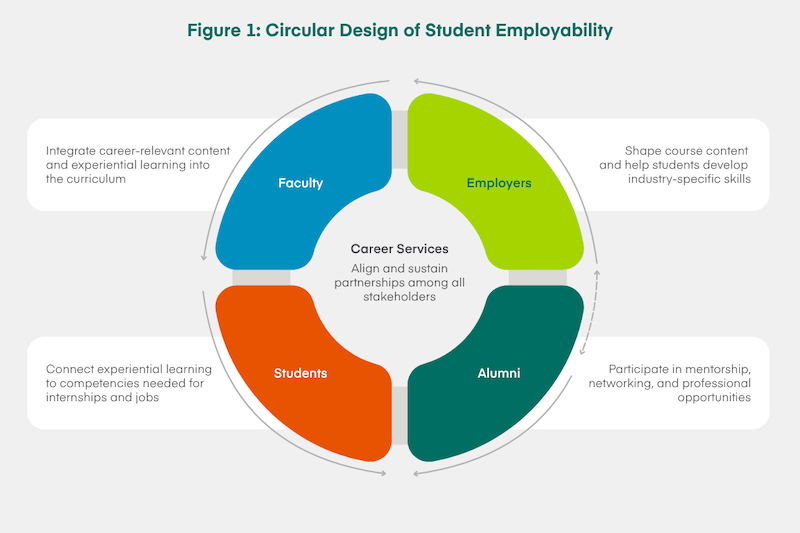
Schools can take six steps to integrate this framework into their programs:
- Make professional development experiences a graduation requirement, whether these are for-credit courses or noncredit activities.
- Embed career readiness into the classroom by bringing in industry partners to provide feedback on deliverables and engage in recruiting-style conversations.
- Teach technical skills shaped by current employer and industry expectations.
- Create structured connections that match students with alumni, mentors, and employers.
- Provide experiential learning through internships, co-ops, consulting projects, student-run clubs, professional certifications, and applied projects.
- Activate alumni as mentors, speakers, and hiring partners, maintaining a cycle where today’s students become tomorrow’s supporters.
As this cycle takes hold, students will learn to translate their academic experiences into competency-based narratives they can use when seeking jobs. For example, a student might complete a team-based social media audit and planning project—but describe it merely as a “class presentation” on résumés and job applications. Career services personnel might guide that student to reframe the presentation as a “team-based social media audit” or “data-driven market analysis.” Such language highlights tangible workplace-relevant competencies and enables students to clearly articulate the career value of their learning.
The Cycle Continues
To ensure the employability framework is equitable for all, business schools need to design courses and extracurricular activities with nontraditional students in mind—those who are online, working, older, or have transferred from another school. That means schools must track who participates in and benefits from career preparation requirements, and they must make changes to accommodate different learners. It also means schools might want to customize their career readiness requirements and provide flexible career support delivery formats or targeted coaching to suit all student needs.
Our proposed framework is most effective when it brings together school leaders, faculty, career services staff, alumni, mentors, and employers. While faculty are still responsible for disciplinary content, they will present it in ways that connect learning outcomes to workforce needs, thus enabling students to translate coursework into language employers can recognize. And because career services personnel are involved in program review, alumni outreach, and curricular design, everyone at the business school will be better positioned to view employability through a 360-degree lens.
Ultimately, the employability of graduates depends on how intentionally and equitably schools connect learning to opportunity and outcomes. Schools that normalize this coordination will build stronger bridges between curriculum design and career success for their graduates.
 Video
Video