





Restoring Research Integrity by Rethinking Metrics
 Article
- Recent rankings and assessment frameworks have led to a dramatic increase in publications from Indian institutions, but the growth has been accompanied by academic dishonesty, plagiarism, and deceptive authorship practices.
- The situation in India is mirrored at institutions around the world, where incentives of cash, promotions, and tenure lead researchers to sacrifice rigor and quality in pursuit of speed and volume.
- The higher education community can reduce unethical behavior by reframing faculty evaluation processes, broadening the definition of scholarly contributions, fostering cultures of integrity, and considering integrity as a dimension for accreditation.
In recent decades, higher education institutions in India have achieved an impressive surge in research outputs. This increase was driven largely by three factors: The National Assessment and Accreditation Council began monitoring the quality status of institutions; the National Board of Accreditation initiated building the qualitative competence of educational programs; and the National Institutional Ranking Framework (NIRF) launched a drive to evaluate and accredit institutions, which led to greater competition among schools.
Over the past ten years, these assessment and accreditation frameworks have gradually crystallized into quantifiable metrics to rank institutes. At first, the resulting increase in publications, patents, and citations appears to support a growing research culture in India—but that’s only one side of the coin. Performance metrics also have inadvertently created a high-pressure environment in which faulty and scholars are expected to produce.
Now, every student’s doctoral journey includes publishing papers and attending conferences. Every faculty member’s goal is to win promotions by publishing in disparate fields rather than to build a career by creating long-term value in a focused area.
There is a deep misalignment between the attractive incentives of a metric-driven evaluating system and the nonnegotiable principles of ethical, mission-driven research. The excessive stress on quick research output has promoted a culture of academic misconduct in India—and, indeed, at universities around the world. But it’s not too late for higher education to change course.
The Situation in India
In India, the pressure to publish quickly was intensified after the University Grants Commission (UGC) introduced metric-based Academic Performance Indicators in 2013. This rush to publish led many academics to compromise rigor and ethical standards to achieve speed.
In 2024, a large-scale study analyzed two decades’ worth of retractions involving Indian authors, whose published papers were found to contain errors or be fraudulent. The study established the correlation between metric-driven competition and increased incidences of data falsification, plagiarism, and attraction toward low-quality journals that assure quick publication.
Other researchers have explored how following Western practices of incentivizing scholarship could have negative outcomes in Asia and give rise to tactics such as ghost-writing, honorary authorship, and other forms of misconduct. More research shows that these misaligned incentives also have spurred the rapid flourishing of predatory publishing outlets that accept low-quality articles and assure quick publication.
The situation has been made worse by the fact that many researchers lack adequate training in research ethics, responsible authorship, and editorial standards. A study of plagiarism awareness among Indian faculty demonstrated that when insufficient ethics literacy is combined with perverse incentives, questionable practices become normalized.
Institutional configurations create a broad ecosystem of expectations, norms, structural pressure, and policy-level contradictions that lead to ethical lapses among researchers.
Most of these studies focus on one or two symptoms of the problem—such as predatory publishing, plagiarism, or retractions—rather than considering it on a systemic level. But I believe that institutional configurations create a broad ecosystem of expectations, norms, structural pressure, and policy-level contradictions that lead to ethical lapses among researchers.
While my research and recommendations are grounded in the Indian context, they apply to the global academic community, where metric-based academic performance evaluation can compromise research integrity. Thus, they connect the regionally distinctive experience of India to wider international patterns.
Problems With the System
The current system is driven by the adage that “what gets measured, gets managed.” For instance, the ranking methodology of NIRF attaches significant weight to “research and professional practices” based on how many published articles and patents institutions have produced and the impact factor of the journals where articles have appeared. As a result, institutions have adopted a transactional model of research with a short-term focus on improving rankings and attracting top talents.
A review of the research policies of 25 business schools and institutions with management education departments, conducted in October 2025, discloses a uniform pattern of linking financial and career growth incentives to research output. Not only are faculty offered cash incentives for publishing in top journals, they often receive promotions and offers of tenure based on their h-indexes, the number of papers they’ve published, and the perceived quality of the journals in which they appear.
While a system of incentives is rational, it reduces the complex intellectual process of research to a robotized production line. It treats research as a commodity that can be produced and monetized, not as an activity that can solve real-life problems, create new knowledge, and deliver theoretical contributions.
It also promotes dishonesty. Attracted by the incentives of cash, promotions, and tenure, academics prioritize speed and volume over quality, leading to a breakdown of integrity. Three unethical practices are particularly prevalent:
Self-citations and gift and ghost authorship. The high-pressure environment has spurred academics to artificially inflate the number of papers they’ve written. One way they do this is through “gift authorship.” For instance, two researchers might agree to add each other’s names to their publications, even though the gift author has not made a substantial intellectual contribution. Or researchers might form groups and conceptualize themes for multiple papers; while each paper is led by one researcher, it carries the names of all others in the group. Such a group often resorts to self-citation to create a smoke screen of validation, credibility, and impact.
Researchers can achieve a different sort of inflation through ghost authors—individuals who contributed to the work but are not listed as authors because the academics want to hide the involvement of industry partners or junior researchers.
Predatory journals and paper mills. Predatory journals are fraudulent outlets that exploit the “publish-or-perish” culture by charging exorbitant fees to publish papers without any legitimate peer review. To address the problem, the UGC created an approved list of journals in 2019. The UGC replaced that guidance in 2024 with suggested parameters authors could use when selecting journals, thus empowering academics and institutions to decide which outlets were suitable for publishing their research.
Incentives reduce research to a commodity that can be produced and monetized, not as an activity that can solve real-life problems, create new knowledge, and deliver theoretical contributions.
Paper mills—fraudulent shops that sell fake research papers for a fee—are another alarming development. This phenomenon is underscored by high numbers of recent retractions. While China leads the world in retractions issued, other countries also have high numbers. In fact, between 2017–19 and 2020–22, there was a 2.5-fold increase in retractions of articles originating from India.
Data fabrication. This occurs when researchers simply make up data to support a research position. For a decade, many Chinese institutions offered lucrative cash incentives to academics who increased their research output. But so many academics engaged in fraud and data fabrication, leading to retractions from prestigious journals, that in 2020, China banned cash awards for publication.
Potential Powerful Reforms
The pressures of ranking and accreditation have foregrounded the natural selection of bad research and created a self-reinforcing spiral where unethical behavior becomes the norm. To reverse this trend, the higher education community needs a paradigm shift. Institutions should move from a metric-based counting of outputs toward a holistic qualitative evaluation of intellectual contribution and integrity that considers the health, ethics, and intellectual impact of research.
The recommended way forward integrates four actionable institutional reforms:
Reframing faculty evaluation. When making decisions about promotions and tenure, institutions need to move beyond counting publications. Instead, administrators should review candidates’ scholarly portfolios to assess the significance, originality, and rigor of teaching and research outputs, institution-building activities, and social outreach.
For instance, administrators could determine that a faculty member who produced a single rigorous research report—such as an ethnographic study of the health delivery system for rural populations—had a greater societal impact than a colleague who published multiple low-impact research papers.
Such a shift in faculty evaluation policies might encourage interdisciplinary work, support early career researchers through collaboration, and reduce the incentive for questionable research practices.
Broadening scholarly contribution. Institutions should define and reward a wider array of intellectual outputs, which might include:
- Scholarly practitioner contributions, such as case studies and consultancies.
- Teaching-learning contributions, such as innovative pedagogy, curricular improvements, high-quality learning resources, assessment standards, academic governance guidelines, and mentorship.
- Thought leadership.
- Projects that contribute to the welfare of society.
In such an environment, a professor who develops a high-impact entrepreneurship curriculum that is adopted by peer institutes may be considered on a par with a colleague who creates a new theory development process.
The higher education community needs a paradigm shift toward a holistic qualitative evaluation of intellectual contribution and integrity.
When institutions place pedagogy, community engagement, and the development of practical knowledge on the same pedestal as research, they won’t just leverage the full range of academic talent. They’ll also forge stronger collaborations between industry and academia, prepare workplace-ready graduates, and gain heightened visibility for practice-based scholarship.
Aligning national frameworks. If accrediting bodies and national frameworks made “research integrity” one of their dimensions for evaluating institutions, scholars would have incentives for behaving ethically. Institutions also would have incentives to invest in integrity infrastructure such as ethics offices, transparency protocols, training programs, and mandatory compliance requirements.
To gauge research integrity, accrediting bodies could consider the ethics policy of the institution and its commitment to responsible management. The evaluation system also could consider the authenticity of a school’s collaborations and its level of investment in an ethical infrastructure.
Whole economic ecosystems could benefit from this new emphasis. In India, for example, if institutions had to show verifiable evidence of responsible research, the country as a whole would likely see fewer retractions, higher public trust, and a surge in collaborations with globally renowned institutions.
Fostering a culture of integrity. An institution can make ethical conversations the norm by training researchers in authorship, plagiarism, data integrity, and the perils of predatory publishing. In due course, the institution may observe a noticeable decline in academic dishonesty, a rise in collaborative research, reduced conflicts among supervisors, and an increase in impactful research practices. As the institution becomes known for contribution-based scholarship, it will become a preferred choice for leading faculty, high-caliber learners, and organizations seeking long-term collaboration.
While these four pathways offer a way forward for universities in any country, they might be particularly meaningful for Indian institutions looking to embrace credible and impactful knowledge creation with a long-term focus. Collectively, these pathways enable institutions to choose:
- Quality over quantity by reducing incentives for quick, predatory publishing.
- Relevance over rituals by strengthening industry collaborations and community partnerships.
- Ethics over expediency by lowering retraction rates and increasing global credibility.
- Mission over metrics by aligning academic efforts with national development goals and institutional values.
A Qualitative Approach
Most business schools and management institutes focus on three broad dimensions: teaching, research, and social outreach. They differentiate themselves—and attract students and faculty—by showing their uniqueness in other dimensions. For instance, they might choose to develop expertise in finance, entrepreneurship, nonprofit management, executive development, learner-centric approaches, or innovative program delivery.
The irony is that even these qualitative multidimensional mission components are measured with quantitative metrics such as citation counts, publication counts, and rankings. This misalignment between mission and measurement is the genesis of the integrity problem.
Perhaps a holistic and meaningful qualitative assessment approach may restore order by recognizing teaching, research, community engagement, and institutional citizenship as complex, interdependent, and qualitative domains (see Figure 1 below). Instead of merely quantifying activities, a qualitative orientation evaluates whether activities have significance, exhibit integrity, and align with the school’s mission.
Figure 1 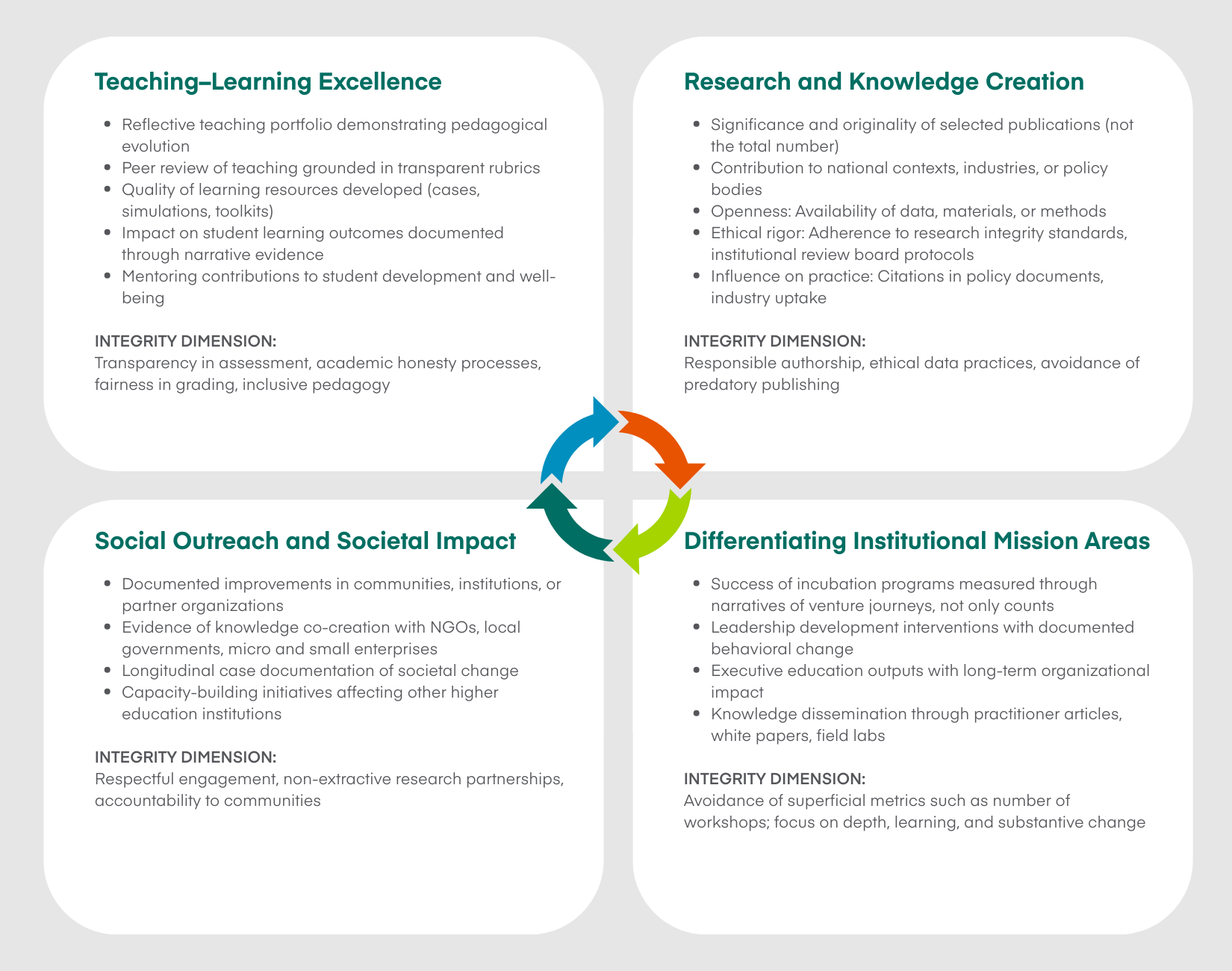
Globally, such shifts already are underway, as exemplified by movements such as the San Francisco Declaration on Research Assessment, the Hong Kong Principles for assessing researchers, and the Leiden Manifesto for determining research metrics. All of these frameworks advocate for research evaluation that considers quality, openness, and responsibility over numerical proxies.
In India, an overemphasis on metrics has created an environment that breeds questionable publishing practices. A qualitative, integrity-anchored approach may help institutions reclaim academic purpose while aligning evaluation with their mission statements.
 Video
Video