




Reimaging the MBA: Three Archetypes for Continued Evolution
The MBA at an Inflection Point
For decades, the MBA has been a defining credential in graduate management education, evolving alongside changes in business, the workplace, and learners’ needs. Today, another period of significant change is underway. Rapid advances in technology, shifting career patterns, changing learner expectations, and emerging employer needs are raising new questions about how the MBA can continue to deliver distinctive value. Further, employers are increasingly seeking to bypass the MBA “career step” by providing equivalent learning opportunities during paid employment.
Against this backdrop, AACSB’s Business Influencer Council (BIC) examined the continued evolution of the MBA and the forces shaping its future. Bringing together perspectives from business and academia, the council considered a broad set of issues —from the MBA’s value proposition and teaching approaches to technology, faculty, governance, and connections with practice. The intent was not to assume that every dimension of the MBA requires change but to identify areas that warrant closer consideration as schools look ahead.
At the center of this exploration was a fundamental question:
The Council’s discussions ultimately focused on three particularly far-reaching forces:
- The rapid advancement of AI and related technologies
- The growing need for continuous learning across longer and less linear careers
- The increasing employer expectations for graduates who can translate knowledge into applied capabilities
While these forces are not the only ones shaping graduate business education, their influence reaches across industries, geographies, and organizational settings.
In response, the BIC developed three archetypes—the AI-Native MBA, the Agile MBA, and the Immersion MBA—each emphasizing a different dimension of potential MBA innovation. These archetypes are not predictions or prescriptions but exploratory models intended to expose possibilities, challenge assumptions, and support strategic discussion. Nor are the models exhaustive or mutually exclusive: Schools may draw on individual elements or combine approaches based on their unique missions, learners, markets, resources, existing strengths, and strategic priorities.
This report examines the forces that informed the archetypes, explores the opportunities and trade-offs associated with each, and considers how they may intersect. It concludes with a series of Decision Canvases designed to help business school leaders determine where their MBAs may benefit from evolution and how ideas from the archetypes can inform that evolution.
Executive Summary
|

The Changing MBA Landscape
From the MBA Origins to Now
The MBA has repeatedly evolved in response to shifts in business, professional careers, and management education itself. Its roots lie in a much longer history of formal management education, including European schools of commerce dating to the 18th century that were established to prepare public administrators and merchants. As industrialization created larger and more complex organizations, demand grew for specialized knowledge in commerce and management, contributing to the emergence of business schools around the turn of the 20th century.
The MBA was one expression of this broader evolution. Harvard Business School established the world’s first MBA program in 1908 and by 1924 had made the case method its primary method of instruction. In 1943, the University of Chicago introduced the world’s first Executive MBA, a two-year evening program for experienced professionals who continued working while they studied. Over the next decades, the MBA expanded across different audiences, geographies, delivery models, and pedagogical approaches.
More recent changes are especially visible in how and where students pursue the degree. Among consistently reporting AACSB-accredited institutions, the share of MBA students enrolled fully online increased from 31 percent in 2021–22 to 38 percent in 2025–26, while fully face-to-face enrollment declined to 47 percent. In 2025–26, about 59 percent of MBA students were enrolled part-time, a proportion that remained broadly stable over the last five years.
Five-Year Trend in MBA Enrollment by Delivery Type

These shifts point to growing diversification rather than a wholesale move away from in-person learning. The Graduate Management Admission Council’s (GMAC) 2026 candidate research shows that full-time, in-person study remained the preferred modality globally in 2025, while preferences for hybrid and flexible learning were broadly stable. Together, the trends suggest that while face-to-face study continues to hold strong appeal, fully online programs are capturing an increasing share of MBA enrollment.
A Changing Context for Graduate Management Education
Today, the MBA operates within a graduate management education landscape being reshaped by changing learner expectations, technological advances, evolving employer needs, longer and less linear careers, and a broader selection of educational options. These shifts do not point to a single direction for the MBA, but they raise important questions about how it can continue to create distinctive value.
Changing learner expectations and definitions of value. Prospective students are increasingly specific about what they expect in return for their investment. GMAC’s 2026 Prospective Students Survey finds greater emphasis on skills, return on investment, and specific career outcomes, while cost, time commitment, and potential career disruption remain important barriers, particularly for candidates earlier in the decision journey.
At the same time, ROI is multidimensional: Among nearly 4,300 prospective students responding to the GMAC survey, 77 percent were motivated to enrich their lives and develop their potential, about three-quarters to gain business knowledge, 62 percent to increase their income, and 58 percent to build wealth. These findings suggest that learners are evaluating graduate business education against a combination of financial, career, educational, and personal outcomes.
Technological change and evolving skill expectations. Demand for AI-related capabilities has risen rapidly. In 2025, half of the prospective students surveyed included skills in using AI tools in their ideal graduate management education (GME) curriculum, up from 17 percent in 2022. Schools are responding: 84 percent of programs in GMAC’s 2025 Application Trends Survey reported some form of AI integration, most commonly through business decision-making, hands-on applications, and strategy development.
Yet candidates and employers continue to rank strategic thinking and problem-solving among the most important capabilities developed through business education, according to the prospective student survey. This suggests that AI-related capabilities are being added to, rather than replacing, broader analytical and managerial skills.
|
17% → 50% Candidates including AI skills in their ideal GME curriculum, 2022 to 2025 |
84% Programs reporting some form of AI integration in 2025 |
AI may also be changing the nature of early-career work itself. PwC’s 2026 Global AI Jobs Barometer found that AI-exposed entry-level roles increasingly require capabilities traditionally associated with more experienced workers, including judgment and leadership. As AI assumes more routine analytical and knowledge tasks, graduates may therefore be expected to demonstrate higher-order capabilities earlier in their careers, raising questions about how they develop the judgment and experience that entry-level roles have traditionally helped build.
Employer expectations are also changing. Skills gaps remain a significant concern. The World Economic Forum’s 2025 Future of Jobs Report reveals that 63 percent of employers view them as a major barrier to business transformation. Employers continue to see considerable value in graduate management education, but the degree itself is increasingly only one signal of graduate readiness. GMAC’s 2026 Corporate Recruiters Survey found that 99 percent of employers remained confident in GME’s ability to prepare graduates for success. The responses also point to evolving expectations: Communication, problem-solving, and adaptability are among the capabilities employers value most, alongside rapidly growing demand for technology, AI, and data-analysis skills.
This reflects a broader shift toward demonstrated capability and experience, rather than solely on degrees as signals of competence. According to the Future of Jobs Report, 81 percent of employers expect to prioritize work experience in assessing candidates’ skills, compared to 43 percent that expect to rely on university degrees. Similarly, in its Job Outlook 2026, the National Association of Colleges and Employers found that 70 percent of employers now use skills-based hiring for entry-level positions, particularly during screening and interviews.
For MBA programs, these trends do not necessarily diminish the value. Rather, they raise expectations for what the degree enables graduates to demonstrate. Research from Cornell University’s SC Johnson College of Business suggests that AI is accelerating this shift: As technology takes on more routine analytical work, MBA graduates may increasingly differentiate themselves by their ability to exercise judgment, critically evaluate information, communicate ideas, persuade stakeholders, manage relationships, and apply technology effectively.
Longer careers and continuous learning. The learning landscape is also expanding beyond a single degree or career stage. Eighty percent of responding business schools in GMAC’s 2025 Application Trends Survey offered at least one type of nondegree credential, including executive and leadership programs, professional certificates or diplomas, and microcredentials. Schools most commonly cited emerging skills and industry needs, corporate partnerships, and alumni lifelong learning as reasons for providing the credentials.
|
80% of responding business schools offered at least one nondegree credential |
A broader and more competitive GME market. The MBA operates within an expanding portfolio of graduate business offerings. In a controlled analysis of AACSB-accredited schools reporting data from 2021–22 to 2025–26, 34 percent reported five-year growth in MBA enrollment, compared to 52 percent reporting growth in specialist master’s enrollment. By 2025–26, specialist programs accounted for over half of total master’s enrollment across MBA, generalist, and specialist master’s programs combined.
Yet, the data do not suggest a simple decline in demand for the MBA. GMAC reported 7 percent growth in total GME applications in 2025, including 2 percent growth for MBAs and 9 percent for business master’s programs, with full-time two-year MBA applications also increasing. Preferences also vary by learner segment: Full-time MBA preference remains strongest among 25–30-year-olds, while younger candidates are more likely to prefer non-MBA business master’s programs. International application patterns are shifting as well, increasing in Europe (outside the United Kingdom) and in Asia, while declining in Canada, the United Kingdom, and the United States.
Together, these trends point to a more segmented market in which schools need to be increasingly clear about who their MBA is for and what distinctive value it provides. They also raise a broader question about the role the MBA should play within an expanding landscape of graduate, executive, and lifelong learning opportunities. These shifts will not unfold uniformly across markets. Learner expectations, definitions of value, workplace norms, career pathways, and the adoption of technologies such as AI will vary across geographic, cultural, and economic contexts.
The Next Evolution of the MBA
The MBA’s history demonstrates its capacity to adapt, but changes in format, delivery, or learning model do not necessarily alter its underlying value proposition. The question, then, is not simply whether the MBA should continue to evolve but where and how that evolution can create greater value for learners, employers, and business schools. Increasingly, that may mean designing experiences that enable students not only to develop relevant capabilities but to apply, integrate, and demonstrate them in contexts that reflect the work they will encounter after graduation.
Against this backdrop, the BIC focused its exploration on three areas where changes in business, work, and learning may have particularly significant implications for the MBA: AI and related technologies, continuous learning across longer and less linear careers, and growing expectations for applied capabilities. These forces informed the development of three MBA archetypes—the AI-Native MBA, the Agile MBA, and the Immersion MBA—explored in the following sections.
Key Questions From the BICAs the environment in which the MBA creates value continues to change, the BIC invites business school leaders to consider these questions: How can the MBA continue to create distinctive value for learners and employers?
|

Forces Shaping Graduate Business Education
The three forces identified by the BIC are reshaping expectations for how, when, and why people learn, and the capabilities they need to succeed. Their implications for the MBA, and how each is reflected in the three archetypes, are outlined below.
From Market Forces to MBA Innovation
|
Market Force |
AI and Technological Transformation |
Continuous and Lifelong Learning |
Workforce Readiness and Employer Expectations |
|
What’s changing |
AI is rapidly reshaping how organizations operate, make decisions, engage teams and customers, and perform knowledge work. |
Longer, less linear careers and accelerating skill needs are making continuous learning a necessary part of working life. |
Employers increasingly expect graduates to apply knowledge, exercise judgment, solve problems, and contribute from day one. |
|
The fundamental shift |
From using technology to working alongside artificial intelligence. |
From education before work to learning throughout work. |
From demonstrating knowledge to demonstrating capability. |
|
What this means for leaders |
Leaders must work effectively alongside AI, evaluate its outputs, exercise human judgment, navigate responsible use, and identify opportunities for AI-enabled innovation. |
Professionals must continually reskill, upskill, and move between periods of work and learning as roles and careers evolve. |
Graduates need to combine business knowledge with applied experience, professional judgment, adaptability, collaboration, and technological fluency. |
|
Implications for the MBA |
Embed AI across disciplines, pedagogy, and assessment; use AI to support learning; strengthen distinctly human capabilities. |
Enable more flexible, modular, stackable, and personalized learning; build longer-term relationships with learners across their careers. |
Expand experiential and work-integrated learning through live business challenges, employer projects, simulations, internships, and other authentic experiences. |
|
MBA innovation archetype |
AI-Native MBA |
Agile MBA |
Immersive MBA |

Three MBA Archetypes

Drawing on the forces outlined above, the BIC developed three MBA archetypes that offer distinct lenses for exploring potential areas of MBA evolution. Each intentionally emphasizes a different dimension of the MBA experience and begins with a different “What if?”
Each archetype begins with a different “What if?”
Archetype Exploration
AI-Native MBA
An AI-Native MBA would treat AI as a foundational capability across the degree rather than as a separate course, elective, or specialization. Students would encounter AI throughout management disciplines, from strategy and finance to marketing, operations, and leadership, and would use it as part of the learning process itself.
At the same time, the model would place greater emphasis on capabilities that become more important as AI takes on more sophisticated tasks and more routine and rule-based work: judgment, critical thinking, ethical reasoning, accountability, empathy, cross-cultural communication, and decision-making under uncertainty. The aim would not simply be to build proficiency with current AI tools but to prepare graduates to work effectively alongside evolving technologies while remaining responsible for their decisions. Graduates would explore how the organization of work is rapidly evolving as AI becomes more embedded in all aspects of organizational processes and systems.
What This Archetype Could Look Like
- AI embedded across the MBA rather than confined to a standalone course or specialization.
- Responsible and ethical AI—including bias, transparency, privacy, accountability, and governance—integrated throughout the curriculum.
- Learning experiences that use AI-supported simulations, feedback, tutoring, and adaptive tools to strengthen engagement and understanding.
- Curriculum that explores how AI can reshape organizational processes, customer experiences, business models, and sources of value.
- Learning experiences that evolve as AI capabilities and business applications change.
How Learning and Assessment Could Change
Learning would place greater emphasis on application, judgment, reasoning, and sense-making rather than on knowledge reproduction alone. Students might regularly question, verify, and stress-test AI-generated outputs against evidence, disciplinary knowledge, alternative perspectives, and their own reasoning. They would also need to determine when AI should contribute to a task or decision, and when it should not.
Assessment could therefore focus particularly on students’ ability to:
- Evaluate and improve AI-generated outputs.
- Exercise judgment when information is incomplete, uncertain, or conflicting.
- Demonstrate effective and responsible human-AI collaboration.
- Identify errors, unsupported assumptions, bias, and limitations in AI outputs.
- Explain how AI informed a decision and where human judgment was applied.
Authentic scenarios and simulations could reflect AI-enabled work environments, while independent knowledge and capabilities would still need to be demonstrated where appropriate.
What Could Change for Faculty and Employers
Faculty would remain central as subject matter experts and as guides in judgment, critical thinking, ethics, and responsible decision-making. Their role would increasingly include helping students contextualize and challenge AI-generated knowledge and work outputs, navigate ambiguity and competing perspectives, and connect emerging technologies with enduring management principles.
Employers could complement this role by bringing authentic problems, emerging AI applications, and perspectives on how management roles and organizational needs are changing. Ongoing engagement with practitioners could help schools keep learning experiences relevant without tying the curriculum too closely to particular tools or platforms.
How the Learner Experience Could Evolve
Learners would regularly make decisions with, and independently of, AI, developing confidence in questioning its content and workflow outputs rather than accepting them passively. AI-enabled tools could provide more personalized feedback and support, while peer and faculty interaction would remain central to developing judgment, ethical reasoning, collaboration, empathy, cross-cultural understanding, and accountability.
Potential Value
The model could help graduates:
- Operate and lead in increasingly AI-enabled workplaces.
- Combine AI fluency with broader business knowledge and leadership capability.
- Build capabilities that remain valuable, even as specific technologies evolve.
- Tool chasing: AI integration could become overly focused on the latest platforms rather than enduring capabilities.
- Managerial fundamentals: Technology could crowd out foundational business knowledge and management competencies.
- Faculty readiness: Faculty will require ongoing professional development as technologies and applications change, including consideration of how AI is reshaping both teaching and research practices.
- Governance and academic integrity: Schools will need clear expectations around acceptable use, transparency, authorship, accountability, and independent student work.
- Privacy and security: AI introduces risks involving student, institutional, employer, and proprietary data.
- Human interaction: AI-enabled learning should not diminish valuable faculty, peer, cohort, and interpersonal experiences.
- Technology investment: Institutions may face recurring technology infrastructure, platform, and support costs.
- Rapid change: Curriculum and institutional processes may struggle to keep pace with technological development.
- Access and equity: Learners and institutions may have unequal access to technologies and AI-enabled learning opportunities.
|
Central Design Tension How can the MBA fully embrace AI as a foundational element of learning and management while strengthening the human judgment, accountability, relationships, and leadership capabilities that become more, not less, important as AI advances? |
Agile MBA
An Agile MBA would be structured around changing learning needs throughout a career rather than primarily as a fixed, one-time educational experience. Learners could engage with the school at different points as they encounter new roles, technologies, industries, responsibilities, or career transitions, with greater flexibility in when, where, and how learning takes place.
The model could combine modular and potentially stackable learning experiences with a clear MBA pathway, allowing learners to build, refresh, and apply knowledge over time. The relationship between the learner and the business school could therefore extend beyond degree completion while preserving the rigor, community, and shared experience that contribute to the value of the MBA.
What This Archetype Could Look Like
- Modular learning experiences that can be combined into structured pathways.
- Multiple points of entry, exit, and re-entry throughout a learner’s career.
- Stackable credentials or learning experiences that build toward or extend beyond the MBA.
- Flexible pacing and delivery that allow learning and work to occur in parallel.
- Greater personalization based on career stage, prior experience, and professional goals.
- Connections across degree programs, executive education, nondegree credentials, and continuing learning opportunities.
How Learning and Assessment Could Change
Learning would be more closely connected to learners’ current professional experiences. Students could bring workplace challenges into the learning environment, apply new ideas within their organizations, and learn alongside peers from different industries, functions, geographies, and career stages. Faculty expertise could be complemented by practitioner perspectives, coaching, mentoring, and structured guidance as learners navigate more flexible pathways.
Assessment could place greater emphasis on the continued development and application of capabilities, using approaches such as:
- Portfolios that demonstrate learning and capability development over time.
- Applied projects connected to authentic organizational challenges.
- Presentations, oral defenses, and other demonstrations of understanding.
- Evidence of workplace application where appropriate.
- Proven progression across modules and learning experiences.
Flexible pathways would still require clear standards, rigorous assessment, and faculty calibration to ensure consistency. Prior learning and professional experience could be recognized where appropriate without compromising program expectations.
What Could Change for Faculty and Employers
Faculty would continue to provide disciplinary expertise while taking on a stronger role in connecting learners’ professional experiences with theory, research, and broader management principles. They could also serve as coaches, facilitators, and mentors, helping learners navigate more individualized pathways while ensuring that separate learning experiences form a coherent whole.
Employers could become more active partners in developing learning and capabilities rather than engaging primarily through recruitment. Their involvement could include identifying emerging workforce needs, providing authentic organizational challenges, contributing practitioner expertise and feedback, and supporting employee learning across different career stages. These partnerships would need to remain consistent with the MBA’s broader educational purpose and academic independence.
How the Learner Experience Could Evolve
Learners could move more fluidly between periods of formal learning and workplace application, returning to the school as their roles, responsibilities, and career goals evolve. Advising and structured guidance would help them navigate more flexible pathways without losing coherence, while continued peer engagement could help preserve professional networks and a sense of community over time.
Potential Value
The model could:
- Make MBA learning more accessible to working and time-constrained professionals.
- Allow learning to respond quicker to changing capability and career needs.
- Strengthen the connection between education and career transitions.
- Build longer-term relationships among schools, learners, alumni, and employers.
It could also broaden the MBA’s relevance to learner segments for whom a conventional, fixed program structure may be less accessible or attractive, including entrepreneurs, career-changers, and professionals pursuing less linear career paths.
- Program coherence: Modularization could fragment the MBA if individual experiences do not build toward a coherent whole.
- Cohort and community: Greater flexibility could weaken relationships, networks, and shared identity.
- Personalization versus common experience: Highly individualized pathways may make it harder to define a common MBA experience.
- Operational complexity: Multiple entry points, pacing options, modules, and pathways create administrative challenges.
- Business model: Modular and personalized delivery may introduce different cost and revenue dynamics.
- Assurance of learning: Schools must demonstrate consistent outcomes across varied learner pathways.
- Credential signaling: Schools must consider how modular components relate to the meaning and recognition of the MBA credential.
- Employer influence: Employer involvement must be balanced against academic independence and durable educational objectives.
- Faculty workload and capabilities: More personalized and flexible learning may require greater coaching, advising, and assessment demands.
- Regulatory and accreditation contexts: Flexible and modular models may encounter different requirements across jurisdictions.
- Choice overload: Greater flexibility can create complexity for learners without effective advising and clear program architecture.
|
Central Design Tension How can the MBA provide greater flexibility, personalization, and continuity of learning across a career while preserving the coherence, rigor, community, and shared experience that contribute to the value of the degree? |
Immersion MBA
An Immersion MBA would make authentic, real-world business practice a central part of the learning model rather than treating it primarily as an internship, capstone, or other supplemental experience. Academic learning and workplace experience would be intentionally integrated throughout the program, allowing students to move repeatedly between theory and practice, test ideas in real workplace settings, and bring insights from practice into their learning.
Learners would develop knowledge and capabilities through cycles of application, feedback, reflection, and refinement. Academic foundations would remain essential, providing the theories, evidence, and frameworks needed to interpret experience and transfer learning across different contexts. The aim would be to reduce the boundary between learning about business and practicing business without turning the MBA into workplace training.
What This Archetype Could Look Like
- Sustained field experiences, co-ops, industry placements, or live organizational projects embedded throughout the program.
- Academic learning intentionally connected to real business challenges and workplace experiences.
- Experiential opportunities that build progressively, allowing learners to apply and refine capabilities in increasingly complex settings.
- Entrepreneurship and venture creation as settings for experimentation and implementation.
- Simulations used where authentic workplace experiences are not feasible.
- Different forms and levels of immersion based on learner experience, career stage, and goals.
How Learning and Assessment Could Change
Learning would be active, applied, and iterative, including opportunities to work on live organizational projects and authentic business challenges. Students could move repeatedly between academic concepts and real-world business settings, bringing workplace experience back into classroom discussions and using theory and evidence to interpret what they encounter in practice. Through structured reflection, learners could move beyond experience itself to deepen technical and management knowledge, develop leadership capabilities, and transfer learning across different organizational and cultural contexts.
Assessment could focus particularly on learners’ ability to:
- Translate management knowledge into action in authentic settings.
- Apply theory and evidence to complex organizational problems.
- Exercise judgment under conditions of ambiguity and competing priorities.
- Collaborate, communicate, negotiate, and lead in real-world environments.
- Learn from feedback, reflection, successes, and failures.
- Transfer insights and capabilities from one experience or context to another.
Evidence of learning could include applied projects, client deliverables, presentations, reflective analysis, portfolios, and performance on real business challenges.
Employer or practitioner feedback could contribute to assessment, while faculty would retain responsibility for academic standards and oversight.
What Could Change for Faculty and Employers
Faculty would play a critical role in ensuring that experience becomes learning rather than simply exposure to practice. They would provide disciplinary expertise, theory, and research; design experiential activities around clear learning outcomes; coach learners through authentic challenges and provide feedback on both technical and leadership capabilities; help students interpret and reflect on their experiences; and assess learning across varied settings.
Employers could become active partners in the learning process by providing authentic challenges, placements, projects, mentoring, and feedback. They would need to collaborate closely with faculty to align organizational value with learner development, ensuring that projects address meaningful business needs while providing experiences grounded in clear pedagogical objectives. The school would remain responsible for academic quality, learning outcomes, and assessment.
How the Learner Experience Could Evolve
Learners would spend a substantial part of the MBA engaging with real business environments, building a portfolio of experiences alongside their academic learning. The form of immersion could vary by learner: Career-switchers might build credibility in a new field; early-career learners could gain greater professional exposure; experienced professionals could apply new perspectives within their organizations; and entrepreneurs could develop ventures while applying management concepts.
Potential Value
The model could:
- Strengthen the connection between management knowledge and its application.
- Develop and demonstrate professional and leadership capabilities through real-world practice.
- Enhance relationships among learners, faculty, schools, employers, and other organizations.
- Offer compelling evidence of what graduates can do in addition to what they know.
This model could be particularly valuable for career-switchers and learners seeking to build applied experience and for schools seeking deeper and more strategic employer partnerships.
- Scalability: High-quality immersive experiences may be difficult to provide consistently to large numbers of learners.
- Employer capacity: Sustained immersion depends on organizations willing and able to provide meaningful experiences, supervision, and feedback.
- Consistency and quality assurance: Experiences will naturally differ across employers, projects, industries, and learners.
- Equitable access: Schools should ensure that all learners can access and benefit from high-quality opportunities, including extended field experiences.
- Academic depth: Immediate workplace application must not displace the theories, evidence, and broader perspectives that distinguish graduate education from workplace training.
- Immediate versus enduring needs: Employer priorities may emphasize current organizational needs rather than capabilities with longer-term value.
- Assessment complexity: Evaluating performance consistently across real-world settings requires rigorous frameworks and faculty judgment.
- Faculty workload and incentives: Sustained supervision, coaching, partnership management, and applied assessment may require different workload models and greater recognition of practice-engaged contributions.
- Operational complexity: Scheduling, placements, advising, supervision, employer coordination, and student support can be resource-intensive.
- Governance: Curriculum processes and institutional policies may need greater flexibility to accommodate external projects and changing business needs.
- Employer dependence: Reliance on external partners can introduce risks when economic conditions, organizational priorities, or partner capacity change.
|
Central Design Tension How can the MBA make authentic business practice a central engine of learning while ensuring that immersive experiences remain rigorous, equitable, scalable, and grounded in the academic depth and transferable knowledge that distinguish graduate management education. |
Side-by-Side Archetype Comparison Across Dimensions
| Dimension | AI-Native | Agile | Immersion |
|---|---|---|---|
|
Fundamental Shift |
Human-AI collaboration |
Learning throughout the career |
Learning through practice |
|
Program Design |
AI integrated throughout |
Modular and flexible |
Field/work-integrated |
|
Learning |
AI-enabled and judgment-driven |
Adaptive and episodic |
Applied and iterative |
|
Capabilities |
Judgment + AI orchestration |
Continuous capability development |
Application + professional judgment |
|
Faculty |
Sense-making and judgment |
Coaching and pathway support |
Integration of theory and practice |
|
Employers |
Emerging AI/work needs |
Ongoing capability partner |
Embedded learning partner |
|
Learner Experience |
AI-supported/ personalized |
Continuous and flexible |
Immersive and experiential |
|
Central Tension |
AI ↔ human judgment |
Flexibility ↔ coherence |
Practice ↔ academic depth |

The Archetypes in Combination
The three archetypes are presented separately to make their distinctive characteristics and underlying logic easier to understand. In practice, however, they should not be viewed as mutually exclusive models. In its MBA innovation, an institution may draw selectively from two or all three archetypes depending on its mission, learners, market, existing strengths, and strategic priorities.
Each archetype brings a different emphasis: The AI-Native MBA explores how AI could reshape learning and leadership; the Agile MBA considers more flexible and continuous learning throughout a career; and the Immersion MBA envisions a deeper integration between academic learning and business practice. Their intersections create additional possibilities.
|
Intersection |
What It Could Enable |
|
AI-Native + Agile |
Personalized and adaptive learning pathways, AI-supported modular learning, and learning experiences that evolve alongside technological advances and changing career and capability needs. |
|
Agile + Immersion |
Flexible movement between learning and workplace application, employer-connected learning at multiple career stages, and experiential opportunities that learners can access over time. |
|
AI-Native + Immersion |
Human-AI collaboration applied to authentic business challenges, AI-enabled simulations and workplace projects, and AI-related leadership capabilities developed through real-world practice. |
|
AI-Native + Agile + Immersion |
Integration of AI-enabled learning, flexible participation across a career, and sustained connection between academic learning and business practice. |
The opportunity is not necessarily to adopt any archetype or combination of archetypes in full. A school might incorporate AI-enabled learning while retaining a largely cohort-based structure, introduce modular learning without fundamentally changing its approach to experiential education, or deepen immersion within an otherwise conventional MBA.
These choices also have different implications. Combining elements across archetypes may affect the program’s economics, faculty roles and capabilities, employer partnerships, technology requirements, governance, and operational complexity. The question for business school leaders is not, Which archetype should we become? but rather, Which elements of these archetypes could strengthen the distinctive value of our MBA, and what would be required to make them work in our context?

From Archetypes to Actions: Decision Canvases
The three MBA archetypes are intended to stimulate exploration rather than prescribe a single pathway for the future. To help leaders translate that exploration into their own institutional contexts, the BIC developed two complementary and exploratory Decision Canvases. The first considers where the current MBA may benefit from evolution, and the second explores how ideas within and across the archetypes could inform that evolution.
The canvases are starting points for discussion and can be adapted to each school’s mission, priorities, and circumstances, as well as refined as the BIC project evolves. They invite schools to consider what creates distinctive value in their MBA today, where targeted enhancements could build on those strengths, and where broader redesign might open new possibilities.
|
STEP 1 → Canvas 1 |
STEP 2 → Canvas 2 |
|
Where should our MBA evolve? |
How could that evolution look? |
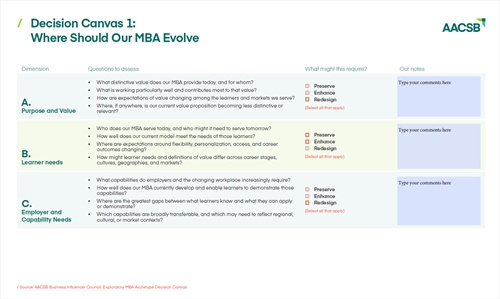
Canvas 1: Where Should Our MBA Evolve?
What should we preserve, enhance, or redesign to ensure our MBA continues to create distinctive value for learners and employers?
Purpose: To help business school leaders assess their current MBA programs and identify where change may or may not be warranted.
The first canvas begins with the existing MBA rather than with the archetypes. It asks leaders to assess six dimensions of the program and determine what should be preserved, enhanced, or redesigned.
The outcome is a clearer view of the areas in which the MBA continues to create distinctive value, where opportunities exist to strengthen that value, and where changes in the external environment may warrant more fundamental redesign.
How to use this canvas: For each dimension, use the questions to assess what is working well today, where needs or expectations are changing, and how well your current approach is positioned to respond. Then identify what should be preserved, enhanced, or redesigned.
These decisions do not need to apply to the dimension as a whole. Different elements within a dimension may warrant different choices. For example, a school may choose to preserve aspects that continue to create distinctive value, enhance others to better respond to changing needs, and redesign those where more fundamental change is warranted. Capture the specific elements and rationale in the notes column.
- Preserve: Elements that continue to create value and remain well aligned with future needs.
- Enhance: Elements that remain valuable but could benefit from targeted improvement or adaptation.
- Redesign: Elements where changing needs or conditions may warrant more fundamental reconsideration.
Click Image to Download
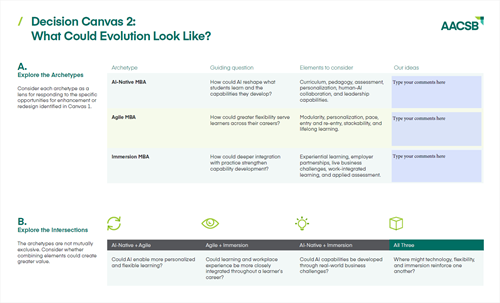
Canvas 2: What Could That Evolution Look Like?
Which ideas within and across the three BIC archetypes could strengthen the distinctive value of our MBA?
Purpose: To help business school leaders use the three BIC archetypes as lenses for exploring potential responses to the priorities identified through the first canvas.
Rather than asking schools to select one archetype, the second canvas invites leaders to consider which elements of the AI-Native, Agile, and Immersion MBA could address the opportunities or challenges identified in Canvas 1, including ideas that combine elements across archetypes.
Promising ideas can then be assessed against the institutional mission and context, including strategic fit, learner and employer value, feasibility, and potential trade-offs.
How to use this canvas: Start with the specific elements identified for enhancement or redesign in Canvas 1. Consider how ideas from each archetype could respond to those opportunities, then explore whether combining elements across archetypes could create a stronger response. Finally, evaluate the most promising ideas against strategic fit, learner and employer value, feasibility, and potential trade-offs, and decide whether to adopt, adapt, explore further, or deprioritize them.
Click Image to Download

Continuing the Evolution of the MBA
The forces reshaping business and careers create new possibilities for what the MBA can become. AI and technological transformation, longer and less linear careers, changing expectations for applied capabilities, and employer-provided learning all challenge traditional assumptions about when, where, and how management education delivers value.
Responding to these shifts may involve incremental change in some areas and more fundamental reconsideration in others. The opportunity is not to change for its own sake but to make intentional choices about what should be preserved, what could be enhanced, and what may warrant redesign.
The AI-Native, Agile, and Immersion MBA archetypes offer three lenses for exploring those choices. Schools may draw selectively from each, combine elements across them, or pursue different approaches based on their missions, learners, employers, markets, and institutional strengths. Across these possibilities, distinctly human capabilities—including judgment, ethical reasoning, empathy, cross-cultural communication, adaptability, collaboration, and leadership—remain critical alongside technological fluency, continuous learning, and the ability to translate knowledge into action.
A single MBA model is unlikely to accommodate the next era of graduate management education. The more important task is for each business school to be deliberate about the distinctive value its MBA creates, for whom, and how that value may need to evolve. The BIC archetypes and Decision Canvases provide a starting point for making those choices and shaping the MBA’s continued evolution.
About the Business Influencer CouncilAACSB’s Business Influencer Council fosters collaboration and an ongoing exchange between the business community and business schools. Its members bring perspectives from business and academia to strengthen connections between management education and practice and advance excellence across both communities. The Council is co-chaired by Roy Mathew, principal at Deloitte Higher Education, and Holly Raider, dean of the School of Business at Quinnipiac University, for the 2026–27 term. It includes business school deans and faculty, as well as leaders representing the private, public, and social sectors. |