




What Business Schools Can Learn From Medicine
 Podcast
Host Eileen McAuliffe, AACSB’s executive vice president of EMEA and chief thought leadership officer, has a conversation with David Henshall, director of FutureNeuro at RCSI University of Medicine and Health Sciences, about the systems and culture that enable the medical field to translate knowledge into meaningful societal impact—and what business schools can take from that experience. They explore three big questions:
- Can you tell us about FutureNeuro—how it operates within RCSI, the kinds of initiatives it leads, and how it has shaped your understanding of research impact?
- What can business schools learn from the way medicine develops practitioners—not just experts?
- What lessons does your field offer for bringing different disciplines together to solve complex problems?
Transcript
[00:00] Intro: Welcome to AACSB Pulse, the podcast that tackles critical topics in global business education today, three questions at a time. We talk with deans, industry leaders, and other big thinkers about the trends reshaping education, leadership, and the future of work. AACSB Pulse brings these topics and more into sharp focus. AACSB Pulse: Three big questions. Bold answers. Better business schools.
[00:26] Eileen McAuliffe: Welcome to AACSB’s Pulse podcast. Our guest today is David Henshall, director of FutureNeuro at RCSI University of Medicine and Health Sciences in Dublin. I was fortunate enough to meet David as a panelist at our inaugural Research Impact Conference recently held in Dublin. David, it’s my enormous pleasure to welcome you here to the episode.
[00:51] David Henshall: Thank you very much, Eileen. And it’s a pleasure to be on the podcast. Thank you for the invitation.
[00:56] Eileen McAuliffe: Wonderful. So at the research conference, the Research Impact Conference that we held towards the end of May, you spoke very interestingly about some of the ways that medicine builds very strong connections between research and practice. And that seems like a great place to start our conversation.
Question 1: What Is FutureNeuro, and How Do You Assess Impact?
[01:15] Eileen McAuliffe: And if we can begin with the first of our three big questions, could you, would you please tell us a little bit more about FutureNeuro, how it operates within the RCSI, the kinds of initiatives that you lead, and how it’s shaped your understanding of research impacts. There’s a lot in there, but go for it.
[01:35] David Henshall: So thanks. Thanks, Eileen. So FutureNeuro is a research center, and it’s a bit unusual. It is headquartered at RCSI in Dublin, but it’s really a national center. So there are FutureNeuro research teams across many of the universities here in Ireland. The center is a brain research center in its broadest form. And essentially what we’re trying to do in the center is to develop new treatments and new technologies for people living with brain diseases. And in particular, the center’s research focuses on the needs of clinicians and patients.
So the type of research that we try to get involved in and move forward is finding really solutions for doctors to help them do their job better and to address the needs that patients have, their sort of priorities, what they value the most. So the center has now been running for about 10 years.
[02:38] David Henshall: We’re in what’s called the second phase of funding from the Irish government. And so far we’ve been very successful. But of course, from the very beginning, there was a focus both on our funders but also the center itself, to make sure that we were performing research that would lead towards something in and above the discoveries that a scientist is typically expected to make.
[03:07] Eileen McAuliffe: I mean, that’s really interesting. You’ve answered one of my questions already, which is the mechanisms to bridge that gap between medical research and application.
Could you say a little bit more about that? Because one of the challenges that business schools have is making that bridge or developing that bridge into application. So the research comes, but it’s kind of having it disseminated more widely and also having the acceptance or the application. But it feels like in your field that gap between medical research and application is much smaller than in some other disciplines.
[03:47] David Henshall: Yeah, it certainly is. And from the beginning, with the center, we brought together scientists with clinicians. So the, if you like, the board of the FutureNeuro center is clinically active clinicians who are caring for people with brain diseases, as well as quite a diverse multidisciplinary team of scientists.
We began by pulling together the right kind of people that would be very focused from the beginning and throughout on making sure that their research translated.
The scientists that we brought together in the center are people who have, I suppose, always wanted their research to translate into something, be that a device, a new treatment, a drug, a diagnostic test. So we began really by pulling together the right kind of people that would be very focused from the beginning and throughout on making sure that their research translated.
[04:40] Eileen McAuliffe: That’s great. So you’ll remember our recently published research impact framework, alongside the Academy of Management, that we were talking about at the Research Impact Conference. And one of the key things that has emerged from that work is the need to engage external stakeholders throughout the research process. And I’m sure in your field you invite, encourage, or pay future patients to come in to test some of theories that you’re working with.
But more widely, how do you involve patients and other external parties at the very earliest stage of the research, all the way through to the final dissemination? So the successful treatment, the successful drug, perhaps, or whatever. How do you manage that in terms of the research impact life cycle?
[05:33] David Henshall: Great question. We’ve embedded patients and the patient voice in the center from the very beginning. And over the years that has grown and grown. So, if I can tell you how it began, we initially set up a patient advisory panel within the center. So these were people with lived experience, either of a brain condition themselves, or they were caring for a loved one that had a brain disease. And their role initially, I suppose, was more advisory and overseeing the activities of the center.
But actually the direction it’s gone in is to establish many panels of patients around the different disease areas or the particular area of technology that we’re working on developing. So we might have a particular disease area that we’re interested in, and one of those is epilepsy.
[06:28] David Henshall: But we’re also interested in motor neuron disease, Parkinson’s disease, many of the major brain conditions. And so we would, we now operate in a way that we bring together a group of patients and lived experience experts, and then they act within the center across all of the stages of research. So that begins with planning, making sure that the kind of questions we’re asking, the research we’re doing is really grounded in their priorities, and then all the way through the research cycle.
So we would bring them in and discuss actual research findings to hear the feedback that they would have. We would then, as the research progresses, involve them in disseminating discoveries, disseminating findings, shaping how we communicate our research. Because there’s no one better, I think, in my experience, at communicating research than the parents [of children] living with a brain condition.
[07:30] David Henshall: So talking to them about how to communicate discoveries, findings, and advances is really important. And they can also influence the direction that you go into the future. So at the point where we were looking to refund the center, we brought them back in to say, OK, what do you think is the most important questions to make an impact and make a difference in the next few years of funding?
[07:58] Eileen McAuliffe: I mean, it’s so interesting having that on-the-ground, informing kind of agency that really does drive the direction and the next steps of your research, essentially.
So when you get to the end of a research project or particular improvement in quality of lifestyle or treatment, how do you define impact? And the second thing I was going to ask with that in mind is, you’re funded from the Irish government, so how do they evaluate your impact? Two questions there: One is around how you define impact, and how then it’s evaluated by your funders.
[08:41] David Henshall: In fact, the two are quite similar. And actually, if I can sidetrack for a brief moment, the focus on looking at the impact of our research emerged, I feel, about 10 years ago when there was extremely high pressure on government finances here in Ireland because of economic pressures, and essentially the time when you’d be given some research funding to perform a piece of research that really wasn’t enough to justify what then was a very challenging time financially.
So that pushed the government, I suppose, to then push down on us to say, OK, what are we really getting beyond a scientific paper, beyond a discovery? How is this getting further out into the world, you know, how is this making a difference? And at the time, of course, can this ever make a sort of an economic difference?
[09:40] David Henshall: So that mindset has been there for quite a long time. But to get back to the question about how we would assess the impact of work, we look across a number of different categories. So the most traditional for a scientist, of course, is, have you discovered something important? Have you discovered something interesting? Have you learned about, you know, how brain disease develops? Have you discovered a new target could be drugged? Have you found a new gene for a disease?
Those are your sort of traditional things. And that research would be typically published in a journal, and, like in the business field, we’re striving to publish in the highest-impact journals that we can. Beyond that, we would look at whether or not the research has led us a little closer towards developing a medicine or a diagnostic test.
[10:33] David Henshall: That sort of technology development angle, therapy development angle, that’s, of course, a really important impact for us. And there’ll be times where we funded a piece of research within the center where, you know, it hasn’t led to a really important breakthrough, and we may decide not to continue working on that, say, particular gene or drug.
Then we would look at investment. And in terms of investment, what we’re talking about really is attracting either domestic or foreign investment in a piece of research. So, you know, has the discovery that we’ve made in the lab lit up an interest in maybe the biotech or the pharma sector? Are they looking to co-fund a piece of research or even fully fund a piece of research? And so, any funding that flows into the Irish ecosystem from outside is seen as a real impact.
Talent is something that we also consider as an impact. Are we training people that will go on to make important discoveries in the field or maybe found a new company in the future?
[11:31] David Henshall: Linked a little bit to that would be an impact around commercialization; you know, has our research allowed us to file a patent, license a patent, perhaps? Is there a possibility that we could found a new company based around a discovery, you know, a sort of spin out company? That’s something that we as a center are particularly focused on. Perhaps now in the last few years, as the center has been running and has been quite successful, are we developing the type of talent within the center that could one day lead to the establishment of a new company, a new business entity? Talent is something that we also consider as an impact. Are we training people that will go on to make important discoveries in the field or maybe found a new company in the future?
[12:21] David Henshall: We keep track of the people that have come through our labs, people that have finished PhDs in the center. You know, where have they gone next? Have they gone into the private sector? Have they gone abroad? What are they doing abroad? Are they making a difference? Are they making a name for themselves? So, the sort of jobs and training element is something that we track in terms of impact.
And then probably one or two other areas that we focus on: Policy would be something that I think as a center we’ve gotten bigger and bigger. And as we begin to make a difference from a sort of traditional medical side, are we influencing perhaps health policy in Ireland?
[13:04] David Henshall: Are we able to move barriers because of a piece of research that we’ve done or because of the people that we have in the center? So, one of the areas that we’re strongly interested in, in terms of policy is around genomics and genetic testing. Often, the public have a view on this, an opinion on this, and maybe are a little bit uncomfortable about the ideas of genetics and testing.
And we as a center have a job to try to explain that, to talk about that, have a conversation with the public. What are you concerned about? What are the barriers to your child maybe getting genetic tests that could lead to being involved in maybe a clinical trial or something? So we do that piece of work as well in the center.
[13:48] Eileen McAuliffe: David, you’ve just summed up a couple of points. I think the public mistrust in scientific discovery is very complicated, and it sounds like you firstly are acutely aware of how to manage that and what to do.
But what was really interesting from what you’ve just said is entirely in line with our research impact framework, where we are advocating for a multidimensional measurement of impact, not just one simple measurement or one single measurement.
I mean, you talked there around publications and of course they are still very valid, you know, the kind of replicative studies or the new phenomenological research that you are discovering. But also you talked about investment, commercialization, funding. So, there’s a very broad kind of landscape of impacts, which really does resonate with where we are with the research impact framework.
[14:46] Eileen McAuliffe: So, without any prompting, you’ve marvelously kind of just drawn us back into line with where we’re challenged at the moment.
But let’s transition into our next question, if you don’t mind, and focusing on a different aspect of medical education. And it’s something that I think, in the business school world, is acutely ready for reinvention or reconsideration in terms of the way we support and develop our early-career researchers, early-career faculty.
And in business education, we’re increasingly emphasizing the need for experiential learning, getting out into industry or policy or, you know, not-for-profits, to try and understand what it really feels like to, you know, to be in a business environment.
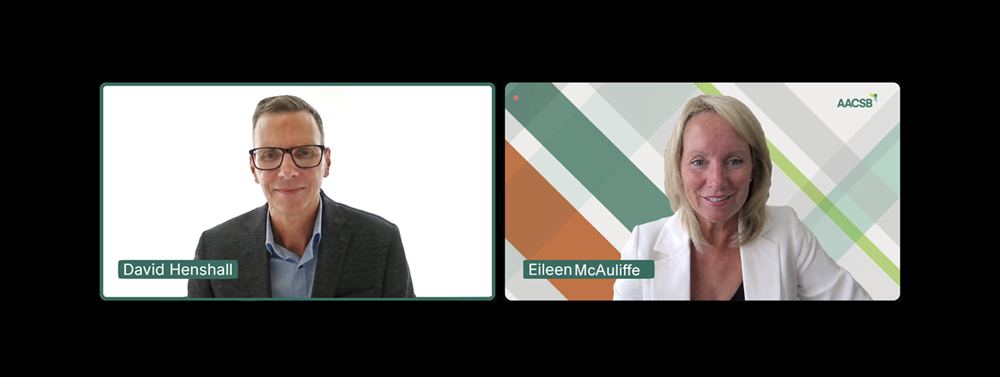
David Henshall (left) talks virtually with Eileen McAuliffe about how the medical field's model drives real-world impact.
Question 2: How Does the Medical Field Prepare and Support Practitioners?
[15:34] Eileen McAuliffe: But in medicine, you’ve long treated hands-on practice as essential, but not only for preparing professionals but for supporting continuous learning throughout the extended career that medics and researchers in this field would have. So what can business schools, do you think, learn from the way medicine develops practitioners?
[15:58] David Henshall: Yeah, great question. And you know, during my career, I’ve seen a transformation in how we go about training people. You know, back when I was a PhD student, essentially day one of your training, you went into a lab, you were shown how to do a particular scientific experiment, and you kept doing that over and over again for that period of your PhD—maybe you learned one or two additional experiments—but essentially that was it. At best, there might have been a module on statistics or something that you had to undertake early on in your training.
It’s absolutely transformed from that model to the modern way that we are training people. And I’ll probably focus most around scientific training, but I can definitely talk a little bit about medical training as well.
[16:47] David Henshall: But talking about how we approach training now, it’s about creating people that have great flexibility when they leave their PhD. So, of course, the backbone of all PhD training is a great research project, and that does take up the majority of their time. But as they’re going through their training program, they would have modules in many different areas: your sort of traditional science, statistics, this sort of thing, but also modules about communication, how to write funding applications, and education public engagement.
For a scientist to be energized and to really see how to translate something that might make a difference in the patient’s life, the best thing to do is to expose them early as possible to the experience of a patient.
And then, of course, commercialization, you know, how to identify, how to protect discoveries that might lead you towards a commercial opportunity in the future. And we also, particularly within our center, recognized the importance of exposing basic scientists to the clinical world as soon as possible in their PhD.
[17:51] David Henshall: And again, if I go back to my own experience as a pharmacologist, I never met a person with the disease that I was doing research on, for years and years. And what we’ve learned is that, for a scientist to be energized and to really see how to translate something that might make a difference in the patient’s life, the best thing to do is to expose them early as possible to the experience of a patient.
So what we’ve done in our center is we rotate students into the hospital. They spend a day or sometimes a week with a clinical team going through all of the patient journey that is experienced when you go into a hospital.
[18:38] David Henshall: And our students will spend a bit of time with those clinicians, seeing that patient experience the in-patient, the out-patient, invasive monitoring, brain imaging, and they see the whole journey. And every one of them comes back changed. And that’s with them from that point onwards.
It’s not the only time that they’ll meet a patient or a doctor, but once they have that grounding, I see the difference that it makes to their work, to their thinking about the research that they’re doing. It really does have an impact.
[19:11] Eileen McAuliffe: Yeah, I mean, I agree with you. When you encourage students to go on a placement year or a block placement, they come back so much more mature and with so much more insight.
But I always wonder, in medical education, how do you assess competencies like communication, teamwork, ethical judgment, alongside the very critical technical expertise that’s needed for them?
[19:39] David Henshall: So in medicine, in the medical school here, there would be very organized, practical, formal assessments by expertise on particular sort of clinical skills or medical skills and your sort of traditional examination process. And we don’t have something quite like that in the scientific field. So I would say that the way that competencies are demonstrated is more of a continuous assessment.
All of our trainees would be regularly presenting either at departmental meetings or smaller group meetings. And they would be getting continuous feedback on how they’re presenting, how they’re communicating their research.
[20:22] David Henshall: At the end of a year, at least for a PhD student, there is a formal process by which they’re evaluated. They would present a report on what they’ve done, they would be assessed by at least two individuals, and then there would be a kind of a pass, go through to the next year, maybe we reassess this in six months if they’re struggling. Or perhaps if they’re doing really poorly or they’re really unhappy, then there is maybe a time to consider an exit from a PhD training program.
[20:53] Eileen McAuliffe: So if I’ve understood you, it’s kind of on a continuum, a journey of their development throughout their training process as part of a PhD program. And so it’s embedded right from day one, by the sounds of it, which is phenomenal, really. And I presume you can see the maturity in things like teamwork and communication—the confidence coming through that program, which is really interesting.
How do students manage, though, when, you know, young people these days, they can use ChatGPT or Claude, and they can pretty much come up with something that convinces them that they’ve got the right answer. Whether we—you and I—agree or disagree at this point doesn’t really matter. But how do you support students to make decisions in the scientific or clinical world when the evidence is incomplete?
[21:44] David Henshall: This is a great question, and there isn’t a simple answer to this. And we talk, we try to talk regularly with our trainees about the changing world because it’s happening so quickly. Back when I was training, of course, you know, you had access to libraries, you had to physically go into a library, you had to pull a journal, a paper journal off a shelf, read it and sort of assimilate the knowledge. You maybe made some notes as you went along, and the knowledge built that way.
If you’re standing at a podium at a conference, giving a talk, you can’t look at your phone, you can’t check ChatGPT for the answer.
That’s unrealistic in the modern world, partly because the sheer volume of information, knowledge, data that’s coming out of the scientific field is almost impossible to keep up with. So I’m not opposed to taking advantage of some of these types of tools to help you manage the amount of information coming.
[22:36] David Henshall: But what I try to tell my students, and I give them this as an example, if you’re standing at a podium at a conference, giving a talk, you can’t look at your phone, you can’t check ChatGPT for the answer. It has to be in your head. And so the best way to get that solid in your head, in my experience, is to read the original material.
So while you can accelerate and maybe find articles in your field quickly with some of the modern tools that we’ve got, maybe I’m old fashioned, but I believe that the way that knowledge gets retained in the brain is from diving deeply into the actual research itself and learning it. And so I say to everybody in my team, you know that part. You can’t fast-track that.
[23:26] David Henshall: If you really want to know your topic deeply, you’re going to have to sit down with these research papers, read them front to back.
[23:34] Eileen McAuliffe: Let me assure you, I’m probably old fashioned then in that case as well, because I totally agree with you. I think AI and these tools are fantastic for getting a feel for the field, perhaps, and who’s written what. But without that underpinning, secure knowledge, I think developing that professional judgment will be quite difficult.
But just let’s talk a little bit about professional judgment and what they’ll need throughout their careers. AI, without a doubt, is here to stay and moving at much faster pace than we are at the moment. But, can you think of other ways that you think it can help develop our younger, early-career colleagues coming through the system at this stage?
[24:21] David Henshall: I think one of the strongest values of something like a ChatGPT or Claude is probably the ability to quickly assimilate the knowledge that is out there in a way that is easily digestible. So, if you, let’s say somebody in the lab has hit upon maybe a new gene that they think could be relevant to the brain disease that we’re working on.
In the past, with a traditional tool such as PubMed, it would take quite a period of time to make your way through that. So for example, you would type in a couple of keywords and maybe you would hit on 250 articles and then you have to start to sift through that, and it’s really a large body of work. With these new AI tools, with a well-crafted query, you can get to an answer fairly quickly.
[25:18] David Henshall: Now, what it doesn’t do is it doesn’t remove the need to go through into the individual research that’s been published on that topic and check through it, fact-check it, sense-check it as well. Is this research of high quality? Is it believable? Do you want to sort of base your next project on that piece of research? Is there enough there? So I think you can’t get around that, but I think it’s a positive that there are tools now that can condense very large amounts of information quickly to a manageable extent.
[25:54] Eileen McAuliffe: But we’re still sure in the thought that the human judgment element needs to remain as to how that collection of work is interpreted, how you use it going forward and so on. So human skills are still essential, really.
[26:11] Eileen McAuliffe: So, David, let’s move on to our third question of our three big questions. We talk about some of the biggest challenges being AI or climate change, food poverty, access to education, public health. Now the trick is that not one single discipline can address, you know, climate change, for example. It takes a range of different disciplines to come together and work together.
Question 3: How Does Your Work Integrate Disciplines?
[26:39] Eileen McAuliffe: What I’ve observed is that medicine has increasingly embraced interdisciplinary research and education. So what lessons does your field offer for bringing different disciplines together to solve complex problems? And perhaps if you could share a few examples for our audience, that would be really interesting.
[26:58] David Henshall: We have a number of interdisciplinary, I suppose, research strands in our center, which we, again, going back in the clock a few years, we would have very much had neuroscientists working in their area, geneticists working in their area, a clinician based at the hospital working in their area.
I think brain diseases, like some of the examples you gave, raise enormous challenges in terms of advancing beyond where we are at the moment. And when it comes to clinical practice and caring for people with those brain diseases, it’s such a lot of different things that a clinician is trying to support their patient on. There isn’t just a single scientific problem. So it could be, you know, There’s a new medicine coming out. How will that change my life? What’s my daily life look like?
[27:55] David Henshall: And I’m always reminded of how infrequently a patient is actually with their doctor. They spend the vast majority of their time on their own, managing their condition themselves, And within the center, when we began our research, we tried to identify three different aspects to concentrate on. And one of those was diagnosis, and this was around integrating the kind of genetic discovery that was happening at quite a pace with the day-to-day practicalities of caring for patients.
When it comes to clinical practice and caring for people with those brain diseases ... there isn’t just a single scientific problem.
You know, Do I send my patient for a genetic test? When the result comes back, what do I do with that information? Is there a way to assess how well my drug is working beyond meeting my patient every six months? So those were some of the challenges that we had. And can those genetic discoveries lead us towards new treatments?
[28:58] David Henshall: And of course, those are some very different areas. So you might have a geneticist that knows about the gene. You might need a pharmacologist or a pharmacist to think about whether we can drug this.
And then you might need somebody completely outside the medical field to say, OK, could we develop a physical device that would allow us to measure this gene in something that the patient could easily give you? So like a finger prick of blood. Is there a genetic signal circulating in a patient that we can non-invasively measure to get an idea about how well the drug’s working? Is it controlling symptoms? Is it making a difference?
[29:39] David Henshall: So in setting up the center, we brought together experts, obviously in the traditional biomedical field, but also chemists, materials scientists, so, people that know how to engineer a device that could be used by a doctor in a hospital setting or a patient, maybe something that they could work with at home.
And we’ve also worked with signal processing and mathematics and computer scientist people to be able to look at large amounts of data, information, be that from recording brain activity or from measuring large amounts of genes, all at the same time. And these disciplines have all fed together. And then maybe there’s a layer of statistics on top of that.
[30:29] David Henshall: And then, the other thing we’re beginning to see in our field in terms of impact—and we haven’t yet, I suppose, incorporated this into our research program, but I see it coming—would be experts in areas such as economics. Are we going in a direction that will produce something that is financially viable? I mean, you see this in the gene therapy field, in particular, and this is an area that we’re very excited about.
It’s looking at arts, humanities, social science, and seeing, What could we learn from them that could make sure that our impact is beyond where it would be just by traditional biomedical scientists?
We are going to be able to develop treatments for traditional genetic conditions, but those treatments could be extremely expensive. So, Should we be investing our research to produce a product no one can afford? Or, If we do the research right, or we do it slightly differently, can we produce a therapy that is affordable, even though it’s in one of these very advanced medicinal products?
[31:26] David Henshall: So, I think that’s the way the center will be beginning to add in further disciplines in the future. It’s looking at arts, humanities, social science, and seeing, What could we learn from them that could make sure that our impact is beyond where it would be just by traditional biomedical scientists?
[31:46] Eileen McAuliffe: And I think you’re absolutely right, and we’ll circle back to what the future looks like. But, in the meantime, where we’ve got a range of interdisciplinary researchers or scientists or other folk from different disciplines working together—so you mentioned material scientists, you mentioned, I think, mathematicians, data modeling, those kinds of people—so when you’re researching together, when it comes to that recognition piece, how does the degree of disciplinary ownership work? Because you’re dividing things in a slightly different way than you had been if it had all been in one field, for example.
[32:27] David Henshall: Yeah, great question. So we haven’t, in my experience, had a lot of problems so far in terms of, you know, authorships, you know, whose ideas are these? And we have had a number of publications where there’s been a mixture of clinicians maybe collecting samples from patients, scientists developing or discovering something, and then material scientists developing a prototype device that could measure that. And so far, it has been very collegial, and I think that comes from bringing everyone together with a common purpose early on so that we’re all sort of on the same page.
But ultimately, yeah, when we have these complex research studies that have many disciplines, we do have to navigate that a little bit, and so far we’ve been fortunate. We haven’t hit any problems, but they could arise.
[33:22] David Henshall: So I think good, clear communication and making sure that the engineers, the scientists that are maybe outside the area of brain disease, that they are committed to it, that they see the value in it and are excited about working in that area. And then you really get their commitment in the long term.
It’s that shared ownership and enthusiasm from the beginning that they are involved in a project that will potentially make a difference to people’s lives.
[33:45] Eileen McAuliffe: Yeah, I think you’re talking to, as well, this notion of shared language amongst researchers for the folks to all kind of be able to work together and achieve the outcomes that you’re desiring.
If we can extend further into kind of leadership approaches, I mean, you’re leading FutureNeuro, but what approaches do you have to, or adjustments, do you have to make when working in an interdisciplinary environment that makes it more likely to succeed?
[34:13] David Henshall: So I think it’s bringing those different disciplines together at the early stage and at the highest level. So we organized an executive committee for our center, and it includes the biomedical scientists and the clinicians, but it also includes some of those experts from outside the field. And one of the people that sits on our executive is a material scientist, and he’s been there from the very beginning.
So I think it’s that shared ownership and enthusiasm from the beginning that they are involved in a project that will potentially make a difference to people’s lives. And if they buy into that, and you support them—and make sure that it’s a two-way street in terms of what we’re getting from them but what we’re giving them as well—and if you get that balance right, then you get fantastic engagement.
[35:10] David Henshall: And if that engagement is at the top level, that will hopefully disseminate out to the teams underneath them, they get bought into the objectives and the vision of the center, and everyone is successful.
[35:26] Eileen McAuliffe: Great. Those are the three big chunky questions. But I’ve got a few more just kind of discussion points if you’d indulge me a little bit longer, because I’m really interested, and it’s been fascinating talking to you describing a system that effectively connects research, education, professional development, and real-world practice to really make a positive societal impact, which is what AACSB really—
[35:53] David Henshall: [laughs]I wish I could capture what you just said, and I’d put that on our website.
Bonus Question: How Can Business Schools Build Stronger Connections?
[35:58] Eileen McAuliffe: [laughs] Oh, fantastic. But it is, truly. What you’ve just described for the last 45 minutes is exactly what AACSB, and particularly through our research impact framework collaboration, is really trying to achieve. And so if you could offer business schools one piece of advice—maybe about leadership or incentives or curriculum or research practice—what do you think would have the greatest impact in creating stronger connections over the next decade?
[36:28] David Henshall: So as I pause and think about that and think a little bit about what has worked for us, I suppose I would say that it is around setting up—if it’s a research center or a business school—setting it up with a very clear vision of what you’re trying to do and who you’re trying to reach, at the beginning, and then building the people around that vision that share that mindset with you.
When I think about the people on the executive that have helped steer us and move us over the years, we all shared a commitment and a vision together for what was missing, at least in Ireland, but I think also internationally, in terms of how brain research was being done.
The advice for the business school would be: What is your vision at the beginning? What are you trying to do differently? What problems are you trying to solve? And try to match that with people that share that.
[37:26] David Henshall: You had these incredible scientists working on how the brain works and how brain disease works, and then you would have these incredible areas of clinical practice, but there wasn’t something sort of bridging that, and there wasn’t something that bridged that whilst keeping the life of the patient center and focus.
So I think the advice for the business school would be, you know, what is your vision at the beginning? What are you trying to do differently? What problems are you trying to solve? And try to match that with people that share that. And if you can find those right people that share that vision and ambition, then it will be more successful than it could otherwise be. That’s a very long-winded answer, I’m sorry.
[38:16] Eileen McAuliffe: No, it’s excellent. Thank you. David, this has been such a wonderful discussion. I hope our listeners can take away some ideas for how they might go on to create more impact in research, in training, in development of early-career researchers, for example, but importantly in education. So, my heartfelt thanks to you for sharing your experience and your thoughts with us today.
[38:40] David Henshall: Thank you Eileen. It’s been terrific talking to you and I’ve really enjoyed the interview. Thank you.
[38:46] Eileen McAuliffe: And to our listeners, if you enjoyed this conversation, be sure to follow AACSB Pulse on AACSB Insights, Apple, PodBean, or Spotify. We’ve got so many great episodes coming up on the biggest issues that shape global business education today.
About AACSB Pulse
A podcast produced by AACSB International, AACSB Pulse explores current topics impacting global business education—three questions at a time—with business school deans, industry leaders, and other big thinkers of today.
To receive new episodes, make sure to sign up for AACSB’s email newsletter, LINK, or subscribe to AACSB Pulse on Apple Podcasts or Spotify.
 Article
 Report