




Engaged Learning in the Age of AI
 Podcast
Host Eileen McAuliffe, AACSB’s executive vice president of EMEA and chief thought leadership officer, speaks with Rebecca Winthrop, senior fellow and director of the Center for Universal Education at the Brookings Institution. They examine the ways AI is shaping how young people learn and what those changes could mean for higher education and the workforce. Their conversation explores three big questions:
- How is AI changing how and what students need to learn?
- As the world of work continues to change, how should higher education rethink the way it engages and prepares students for what comes next?
- As AI reshapes education, could it expand access and opportunity—or create new gaps in who benefits?
Transcript
[00:00] Intro: Welcome to AACSB Pulse, the podcast that tackles critical topics in global business education today, three questions at a time. We talk with deans, industry leaders, and other big thinkers about the trends reshaping education, leadership, and the future of work. AACSB Pulse brings these topics and more into sharp focus. AACSB Pulse: Three big questions. Bold answers. Better business schools.
[0:29] Eileen McAuliffe: Welcome to AACSB Pulse. Our guest here today with me is Rebecca Winthrop, who is a senior fellow and director of the Center for Universal Education at the Brookings Institution. Rebecca writes and researches about global education issues, including access, engagement, emerging technologies, and the skills that younger learners, in particular, need to succeed in work and life.
Rebecca, we are so pleased to have you here on the show and delighted to be able to spend some time with you. Welcome.
[01:03] Rebecca Winthrop: Thank you so much, Eileen. It’s a pleasure to be here.
[01:06] Eileen McAuliffe: As you know, we have three big questions that we tend to focus on. So in this episode, we’re really looking at how AI and education and kind of how that has influenced how education has changed quite dramatically over the last couple of years. But so for the first of our big three questions, why don’t we explore that area a little bit more?
Question 1: How Is AI Changing How and What Students Need to Learn?
[01:32] Eileen McAuliffe: So you lead the Brookings Global Task Force on AI and Education, which is absolutely phenomenal. And I understand that it examines the potential benefits of AI and the risks for students globally, so all around the world, in fact.
So considering some of that work and your own perspectives, how do you think AI is changing the way students learn as well as what they need to learn?
[02:01] Rebecca Winthrop: Well, let’s start with your last question first, which is what they need to learn. So one of the things that I think every student needs to learn is to learn about AI. That is different from using AI to learn things. What I found is that students have a lot of questions, they have a lot of opinions. They want to engage in a conversation about, what is this new technology? What are the ethics behind it? They’re having these debates themselves, and we as educators need to be in there with them.
So I actually think critical AI literacy, holistic AI literacy, conversations about AI, which is not just how to use the tool to prompt, but what is this technology? What is it built on? What does it do? What does it not do?
[02:53] Rebecca Winthrop: Should you write, using ChatGPT, a letter to your grandma, you know, for her birthday? These are the types of questions students are debating and should, what does it do if you use it to write your essays? What are you missing out on? And you can do that starting very young and you can do it without interfacing with a single screen.
I always ask students, you know, what do you think about it? Are you excited? Are you worried? And that just starts a whole conversation. So that’s one piece. Certainly, at the higher education level, we absolutely should introduce this conversation into whatever the core freshman requirement coursework is. You could introduce it into your social science requirement or whatever it may be. So that’s what one—is learning about AI. Another is, what will students need to be able to do?
[03:50] Rebecca Winthrop: And, there, students really need to be able to think critically. They need to have persistence and learn to learn on their own and not rely on AI as a crutch because it develops their cognitive abilities.
Let’s say I’m a high school student and I’m writing an essay, and if I put in some ideas and ChatGPT does the rest, I’ve missed out the actual effortful thinking process of trying to figure out what the evidence is and which side it stacks up on and what my argument is. And that process is almost less important for the outcome of the essay as it is for developing young people’s brains to be able to think critically. So they need that. They also need a lot of agency and interpersonal skills.
[04:39] Rebecca Winthrop: They need to be able to communicate with other human beings, read their faces, understand their perspective, work together. This is something we get a lot of in business schools, but also we certainly hear from employers that young people are less and less able to do that. And part of that is because more and more of their life and their communication with other people is intermediated through a screen.
In our research for The Disengaged Teen, I had one 16-year-old, very sharp, academically inclined boy tell me he was dating a girl in a school, and for several months and they never met. They just talked on text for hours. I was confused. I was like, “Well I thought you said she went to the same school.” He said, “Oh, well she does.”
[05:26] Rebecca Winthrop: “But I don’t initiate and say hi to her because if she responds back to me, I won’t have time to think through what my potential answer is back.” It’ll be in real time. So I’m just giving that short little anecdote to show how intermediate by screens a lot of interpersonal communication is for young people.
[05:47] Eileen McAuliffe: What does it mean for society going forward? Because we are seeing it used as a crutch, and we do see perhaps a deterioration in young people’s confidence communication, you know, their way of connecting is a little more isolated in person-to-person communications.
What do you think about those capabilities? Because when I talk to, particularly to employers, they say, you know, “AI is AI. We have our own AI way of doing in our organization. We want the person. We want the person who can think on their feet, who can talk to me, who can look me in the eye.” So how do we translate that back into the curriculum, back into the experience of a student in, let’s say, a business school for sake?
[06:38] Rebecca Winthrop: Right, right. We see in adolescence, in school, we see in college students, a lot of research emerging which tells us that if students are using AI as a partner to get things done, they are often not remembering what they’ve done, even a couple days later. They’re shortcutting their own creative thinking and critical thinking.
There’s a lot of evidence to show that using AI as a partner for brainstorming ... leads to less creative ideas, even though they might sound good on the surface.
I had this discussion with my colleagues at Brookings saying, “Well, I never use AI to write or to do the final thing, but I use it as a brainstorm partner.” I get that. When you’re a subject matter expert, there’s evidence to show that is helpful. However, for young people who are developing these competencies and capabilities, there’s a lot of evidence to show that using AI as a partner for brainstorming and coming up with ideas leads to less creative ideas, even though they might sound good on the surface.
[07:48] Rebecca Winthrop: So there’s this incredible study, and I did a piece recently on this, an op ed, that showed this natural experiment over eight years. It was students’ high school college application essays. It’s their personal statements. Researchers have been studying students’ creativity in these essays for eight years. Huge differences before and after ChatGPT—students were clearly using ChatGPT—and what happened was this: On the surface, the essays sounded more creative because they used better vocabulary. They had sort of interesting sentence flows. But when they looked at the ideas that the students were expressing, they were all clustered around the same set. So it really reduces creativity when you’re young and still trying to come up with your ideas. So that is worrisome. We don’t want AI to undercut young people’s abilities to think, express themselves, judge, think of different ideas, connect things.
[08:56] Rebecca Winthrop: We want them to develop that on their own, and then when they’re a subject matter expertise in the workplace, partner with AI to let them go further and do things they couldn’t.
[09:05] Eileen McAuliffe: Yeah, I mean, that’s interesting. And you’ve written recently about the risk of what you call cognitive stunting. Is that what you’re referring to here or alluding to or developing into?
[09:16] Rebecca Winthrop: The cognitive stunting idea is just a new way to frame the conversation around cognitive offloading. I think many people in your network, especially higher education folks, faculty—I also teach, not in a business school, but teach one class at Georgetown—and we worry about cognitive offloading, this idea that young people are going to get AI tools to do things that they should do themselves.
The problem I have with that frame is that humans always cognitively offload. It muddies the conversation. So, you know, most people cognitively offload arithmetic to a calculator, and that’s fine. I have no problem. Students learn their multiplication tables and addition before a teacher gives them a calculator, and then they cognitively offload it, but at least they understand it.
[10:08] Rebecca Winthrop: What cognitive stunting is, what I’m worried we’re beginning to see is that young people are not getting these effortful-thinking, deep-learning experiences—learning is hard, it takes determination and struggle—enough of those to actually develop these skills in the first place to cognitively offload.
[10:27] Eileen McAuliffe: Yes.
[10:28] Rebecca Winthrop: Later, when they’re in the workplace, as you said, you talk to employers, they want people who can partner with AI because they want judgment, discernment. They want to pick up a whole bunch of things that AI can’t pick up yet.
[10:41] Eileen McAuliffe: Yeah, absolutely. I mean, it’s interesting. There’s lots of examples, isn’t there, of cognitive offloading? I mean, I was just thinking of one there where, you know, we used to follow a map. If you wanted to get from A to B, you worked with a map. These days it’s Google Maps. But if your data has run out or your battery is not working in your device, then you really have to resort to the basics. And it’s that kind of, it’s that gap, isn’t it, or that emerging gap between those kind of primary skills and what we’re seeing as the offloading piece.
So what do you think this will mean—the impact on young people that arrive in university or business schools over the next five or 10 years?
[11:25] Rebecca Winthrop: My thoughts are the following: Universities have to look inside their own house, first and foremost. Business schools or any institution of higher education is, in my opinion, incredibly important for our society. Higher education is an incredibly important sector. It builds R&D, it trains a skilled labor force, it contributes economically to their communities, and hopefully positively and helps—if done well; I’m not sure everybody does this—you know, builds good citizens and better communities.
One thing that universities I’ve seen do is think about AI and think about back-office use—how to be more efficient, how to tackle cybersecurity. That’s important. And I think there’s huge benefits for back-office use. Faculty use for research, I think that’s hugely beneficial. I have some research tools, AI tools I use, changed my life as a researcher. It’s incredible how you can organize your data. It’s amazing.
What I certainly have been hearing is parents questioning the value of higher education because they worry that their young people are going to “AI” their way through it.
[12:29] Rebecca Winthrop: And then student-facing use. I think higher education does not spend enough time on the faculty use part thinking about pedagogy. And I do think if we as universities do not headlong tackle the pedagogy we are using in our classrooms, then we are going to be cooked. So what I certainly have been hearing is parents questioning the value of higher education because they worry that their young people are going to “AI” their way through it.
I certainly also hear employers tell me, you know, I interviewed somebody or hired somebody with a great credential from a great university, and they said, but they don’t have the skills. University credentials are no longer a proxy because they’re AI’ing their way through.
[13:17] Rebecca Winthrop: So if we do not switch how we teach—that could be a flipped classroom, that could be in-class exams, that could be oral exams. I mean, this is not an easy question, but I feel that a lot of higher ed is avoiding that, and we have got to tackle that.
[13:34] Eileen McAuliffe: From what we see at AACSB, it’s certainly inconsistently dealt with. We see some examples of really good practice, but it’s that—we’ll come on to it—it’s that kind of, are we creating a divide here in our educational experience? Let’s move on, if you don’t mind, to our second of our three big questions.
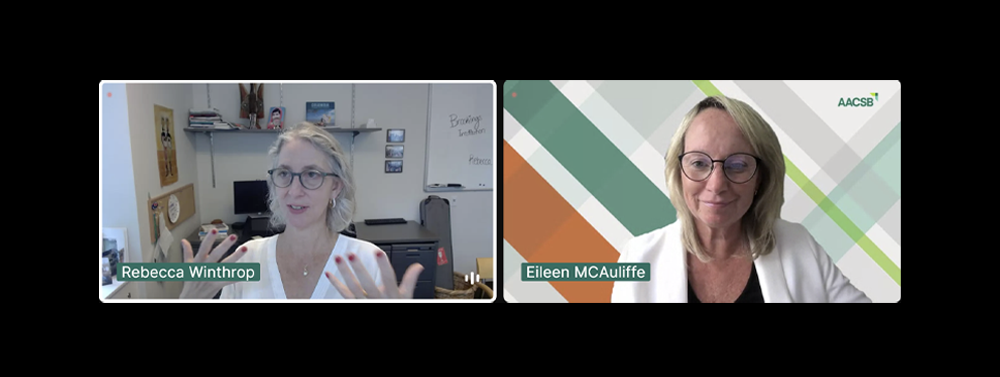
Rebecca Winthrop (left) talks virtually with Eileen McAuliffe about how AI, among other factors, is affecting young students' ability to learn.
Question 2: How Should We Rethink the Way We Prepare Students?
[13:53] Eileen McAuliffe: So your research has aimed to understand what motivates young people to learn. You look at their differing experiences and their expectations and their ways of engaging with their education.
And as we look at the world of work and how that’s continually changing, and it’s changing at pace, how should we in higher education, be it in the business school or in the broader adjacent disciplines, rethink the way we engage and prepare students for what comes next?
[14:22] Rebecca Winthrop: So one of the ways I think about this is, how do young people engage in learning? And my co-author, Jenny, and I, in our book TheDisengaged Teen, which was focused on adolescents, we found kids engaged in four different ways.
Passenger mode—coasting, doing the bare minimum. There, I’m really worried that AI is going to make a lot more passengers. They might like school because it’s fun. They might be getting good grades in school—we’ll talk about secondary school—because they’re not challenged. Or they might be struggling to learn the content and so have sort of given up.
Achiever mode. These are the kids who really want to get good grades, who want to do well, who want to have a good GPA because they believe that’s going to help them in the future. Huge incidence of cheating.
The number one thing students in achiever mode told us they disliked about their school experience was when teachers did not tell them exactly what to do to get an A.
[15:12] Rebecca Winthrop: Good things there: Kids are motivated and organized, usually. But the number one thing students in achiever mode told us they disliked about their school experience was when teachers did not tell them exactly what to do to get an A. Now that hop, skip, and a jump to higher ed, and when we talk to employers and they complain that I have to spoon-feed my new recruits, they don’t think for themselves—that is why. We are training young people in a system to be good followers.
Then you’ve got kids who are resistor mode. This is where people typically think of a disengaged student. They’re avoiding, they’re disrupting, not coming to class, not doing their homework, being, you know, difficult. Usually, they’ve got a whole bunch of things going on—mental health, bullying, or they’re just bored to tears and don’t buy into the system.
[16:03] Rebecca Winthrop: They do end up having a lot of agency, actually. They’re just pointed away from the system.
And then you’ve got kids in explorer mode. And that is actually, to get to your question, where I think we want universities to support students to be.
[16:21] Eileen McAuliffe: I’m exactly at the same point as you. It’s about that notion of discovery, that curiosity, not simply following a process or following a method. It’s encouraging curiosity and learning, really. And I think in The Disengaged Teen, you do lead us to that point.
But I’m curious as to how, how can we reignite curiosity within our learners in the classroom space—from each other, from the wider world, but also from what’s gone before us as well?
[16:54] Rebecca Winthrop: We found in the U.S. that less than 4 percent of junior and senior secondary school students said they were regularly in explorer mode in school. And we also found they can quickly get into explorer mode, and it really depends on the learning task. If they think this task is not relevant, it doesn’t matter, it’s busy work, it’s not meaningful, it’s not connected to the real world, I can just get my answer on AI, ChatGPT can tell me, what’s the point of this? They are not going to get into explorer mode. They’re passenger mode or, you know, achiever mode and just trying to get a good grade.
Kids can get in explorer mode and do when they’re super curious, when there’s high rigor and expectations.
[17:32] Eileen McAuliffe: Right.
[17:32] Rebecca Winthrop: Kids can get in explorer mode and do when they’re super curious, when there’s high rigor and expectations and when there’s not a way for their peers or themselves to bypass the learning. Which is why I say, like, if you’re going to assign a task and students can hack it with AI, do not assign it. Find another way. This is very hard in higher education.
For example, there’s great examples of professors saying, you know, “We’re going to work together to try to solve a cold case.” And the students are like excited, motivated; it’s real. They have to do a podcast about it, they have to interview people. Of course, you have to have rigor, they have to learn. But they need to be tested and demanded that they learn in a way that they can authentically show what they’ve learned.
[18:21] Rebecca Winthrop: And that, at the moment, it’s a lot of going back to blue books and handwritten exams or in-class exams with lock screens, which I think is what you need to do until we figure out how to manage it. I’ve gone to an oral exam in my seminar.
[18:36] Eileen McAuliffe: I was going to say, it almost points us back into the direction of experiential learning and making no assumptions about what the right answer is, but rather, if a student or group of students can justify how they’ve got to where they’ve got to in their decision-making process, that is more of a learning process than getting from A to B, which equals the right answer, whatever the right answer is.
I always think it allows more personality in the learning process, as well, to come out. So I do think we’re moving more towards that.
[19:12] Rebecca Winthrop: Assessing the learning journey becomes equally important as the outcome.
We can’t do one-point-in-time, outcome-oriented assessments.
[19:16] Eileen McAuliffe: Yes.
[19:16] Rebecca Winthrop: And of course we want young people to master their knowledge. They need, you know, we’re not saying that’s not relevant, but we can’t do one-point-in-time, outcome-oriented assessments. If they can be hacked by AI, it will come back to bite us as an entire higher ed sector because we’re going to become irrelevant.
[19:36] Eileen McAuliffe: Just leading on to that whole notion of relevancy, there’s a whole bunch of stakeholders in this ecosystem figuring out what’s happening. And at the end of the day, at the center of this whole change are students.
Can you tell me a little bit about your perspective on student agency? I think the strongest voice in this conversation is the students. A lot of business schools particularly have student councils. Do we have student AI councils? Which I think is an interesting concept. So can you talk a little bit about student agency and how important that is?
[20:12] Rebecca Winthrop: Well, you may be referring to a piece I wrote not long ago recommending that every school should have a student AI council. And this idea came from the students who participated in our task force. I had an author, a high school student who was a co-author with us on our task force report, but we interviewed lots of students around the world, along with teachers and technologists and parents.
And the thing that I took away from students—and I think I’m seeing this reinforced, not changing as new data emerges; it’s a very early field, we’re still early days, we’re all feeling our way—is students care about learning. One of the number one things that they were most worried about AI is becoming dumber. They want to be in contexts where they can learn and they say, Otherwise, why am I here? What am I doing?
[21:06] Rebecca Winthrop: And second, they want to help the adults in the education system curate learning experiences that will let them do that because they are frustrated with having some peers using AI in a group project and maybe, you know, undermining them. Or, I remember talking to a college freshman who was in a very rigorous university, hard to get into Ivy League in the U.S., and she said, you know, “I’m here to learn, and I’m super excited about it”—she had a science class, and she’d come to school, and she said, “But I’m getting a very bad grade, and I’m going to take this bad grade because I know I do my work on my own and I’m learning this stuff, and all my other peers in my class are using AI and getting As.”
[21:51] Rebecca Winthrop: And she said, “But I’m not sure how long I’m going to last because I do want to go to grad school and, I don’t want to, but I think I might have to start using AI eventually.” Students hate this. And this is happening at the high school level, it’s happening at the college level. And so students have said, we want a seat at the table. We want to help you, faculty. We want to help you, administrators. We want to help you, teachers, school leaders, to tell you what types of assignments we can get around because you don’t seem to be with the pace on what we’re doing and what’s out there—AI humanizers, AI typers into Google Docs, I mean, there’s so many workarounds—And we want to beta-test products, we want to look at the privacy agreements of products.It’s our data.
[Students] want to help us navigate the way in the future. They want to learn, and there’s a lot of complicated questions they have.
[22:41] Rebecca Winthrop: So I think we should have AI councils in every institution that shouldn’t be a maybe little short consult with a little token voice. I think that they want to help us navigate the way in the future. They want to learn, and there’s a lot of complicated questions they have.
[22:58] Eileen McAuliffe: Not only can they inform the pedagogical approach, but also they can inform the content, the type of knowledge. So, as you say, you know, there’s some really big questions out there, such as climate change or, you know, regeneration and so on and so forth.
[23:12] Eileen McAuliffe: I think I heard you say just there at the beginning when you were talking about initially with AI councils that you said you heard from quite a broad cross-section of young people or students from around the world.
So, just with that in mind, and a lot of your work, I know, does take on the global view of education, but I’m particularly interested—it’s a personal passion of mine—which is around access and opportunity. You share that particular focus on expanding access opportunities and so on.
Question 3: Does AI Create Opportunity Gaps for Learning?
[23:44] Eileen McAuliffe: But does AI raise a question about who will benefit from these technologies and who might be left behind due to technology poverty, infrastructure poverty, and so on?
So as you see education changing, you know, could we just talk about where we see those gaps emerging, and are we increasing that gap of those that have and those that have not?
[24:11] Rebecca Winthrop: So we found that equity cuts both ways in our research, in our task force research. We’ve been talking a lot about potential risks and yes, there’s these benefits and that benefits. What we are seeing is that narrow AI use—when AI is used for a very specific purpose, vetted content, so an e-book, e-textbook with a chatbot that can help students, particularly neurodivergent students or non-native language speakers of whatever the language of instruction is—narrow AI use can be quite helpful.
What we’re seeing in terms of equity is, narrow AI use can be quite positive for inclusion.
The problem is when we get to wide AI use, which is much more of a tell-me-not-teach-me machine, that is very problematic. And so, what we’re seeing in terms of equity is, narrow AI use can be quite positive for inclusion.
[25:04] Rebecca Winthrop: Things like helping rural students or students who might not have access to workplaces or different communities do virtual field trips. So there is some really interesting work on exposing students to different sets of career opportunities through virtual, embedding in virtual reality AI which is much more personalized and can make it much more real—you spend a day in the life of this, that, or another person—that would not have ever been possible for these students.
Those are all really good equity-promoting things. The example that perhaps most moves me—because I, in my previous life and we continue to here at Brookings, work on gender equality—is in the context of Afghanistan, there’s an organization called SOLAx, which is Afghan diaspora educators who have come together with this network SOLA, which leads girls’ education for Afghanistan and is now in exile.
[26:12] Eileen McAuliffe: Right.
[26:14] Rebecca Winthrop: These educators have come together and taken the Afghan curriculum, secondary school curriculum, and broke it down in tiny little interactive adaptive lessons that can be on WhatsApp. The lessons are disappearing because girls will be using this on their parents’ phone, it’s illegal. And this is enabling many girls in Afghanistan to keep learning. That is incredible, right?
So that narrow use—it’s pedagogy, it’s lessons, they’re not getting answers to anything—so that is great. Pro-equity.
The problem, on the downside, is, I’m a little worried we may be seeing a new equity divide opening up on several dimensions. One dimension is around motivation. The young people, those 4 percent of students who are in explorer mode—there’s a tiny minority of students who have the internal motivation and are engaged in their own learning, these explorers, naturally—who are running with AI.
[27:19] Rebecca Winthrop: And you know, we talked to a high school student who’s getting a cybersecurity master’s through like AI-curated content and online learning, like, so there’s a motivation gap that will be opening up—the explorers going way far, the sort of passengers, I’m really worried about creating a lot more passengers. That’s one.
This is the first time in education technology history that I’m aware of ... that schools have to pay more for more accurate information.
Another gap I think is the educators and faculty who can use AI well and shift their pedagogy so students can really learn well in an AI world—could be shifting assignments, could be integrating AI in helpful ways. When we have teachers and faculty who can do that well and teachers and faculty who don’t shift their pedagogy, kids are not learning well, that’s going to be a new equity dimension.
[28:07] Rebecca Winthrop: And then the other piece I’m worried about is just plain cost. This is the first time in education technology history that I’m aware of—and we did a lot of deep dive on this in our task force research—that schools have to pay more for more accurate information. Premium accounts, which more wealthy schools can afford, have more accurate information—it just is that way—and more powerful tools. And they will eventually become the first free accounts as the next level becomes the expensive accounts. So I do worry about this sort of, yeah, technological knowledge capacity gap.
[28:54] Eileen McAuliffe: Certainly at AACSB, we see the schools that can apply greater resources, for example, to learning developers, to translators, to all kinds of what I would call technology support roles. They are shifting the dial really quickly and building things into their curriculum.
I think my concern is those schools that aren’t as financially wealthy, that don’t have additional wraparound resources as well. So there’s the AI tool per se, but then there’s everything else that goes around it to be supported in learning development. So I think that is something that I think Brookings and AACSB should keep a very close eye on.
[29:35] Rebecca Winthrop: Absolutely.
[29:36] Eileen McAuliffe: Going forward.
[29:36] Rebecca Winthrop: Let’s do it.
[29:37] Eileen McAuliffe: We’ve talked a bit about the biggest barriers to education access, there, and we’ve talked on a global scale. You know, the great example around Afghanistan is just wonderful, and it just, you know, breaks my heart. It’s wonderful. We’ve thought about, you know, the prospect of reaching more learners through AI. We’ve thought about creating more or greater or different support structures.
Is there anything else out there that we should be thinking of? Ethics comes to mind a little bit. Governance. To me, it feels a little bit like everyone’s off the leash and everyone’s doing whatever they want to do at the moment. And at some point, is somebody going to say, actually, that’s really unethical?
[30:20] Rebecca Winthrop: That is the gap that comes to my mind. I think about higher education institutions, I think about schools. And one of our roles as an education sector is to be a good citizen not only to our students, who are our “clients,”—in business schools, they often are directly—but to be good community members. And higher education traditionally has had a very important role in helping shape society and helping develop leaders, in helping, sort of, employ people in their community and being economic generators. But, you know, we will need to, I think, double down a bit more, in schools and in higher education, on our civic role, our civic duties.
We have a lot of people who are incredibly civil, smart, many of them very thoughtful, who are all focused on what can we build—but we have to ask ourselves, what should we build?
[31:12] Rebecca Winthrop: And a piece of that is not just what can we build—we have a lot of people who are incredibly civil, smart, many of them very thoughtful, who are all focused on what can we build—but we have to ask ourselves, what should we build?
[31:29] Eileen McAuliffe: Indeed.
[31:29] Rebecca Winthrop: And higher education brings the humanities and those questions of should. And frankly, everyone in the science, STEM fields, and business schools, in particular, should make sure to ask this question: What should we do?
[31:44] Eileen McAuliffe: Yeah, exactly. We are heavily focused on elevating the quality of business/management education globally. But we also, with fierce vengeance, put forward, everything we do should be for positive societal impact. And that goes from what we do in our classrooms, our research, in supporting every part of our ecosystem. So it’s a really tough question.
Before we end our discussion, I’ve got a quick bonus question.
[32:11] Rebecca Winthrop: OK.
[32:12] Eileen McAuliffe: Just as a closing thought, because you and I are of a certain age, and, you know, we could cast our mind back to how we spent our time in classrooms and so on. But younger generations of learners, they’re not always getting a lot of positive press. If you think about what happens in social media and stuff. And it’s a very difficult time, I think, to be a young person, a lot of pressure.
So, what about the next generation of university students—what makes you feel hopeful about them coming through?
[32:44] Rebecca Winthrop: My opinion, having spent a lot of time in all my research with young people themselves, is, the young people aren’t the problem. They’re great, they’re very logical. You give me an assignment that I could run through a chatbot and then run through an AI humanizer to put some typos in and, you know, make it sound like me, I’m going to do that. They’re creative, they’re logical, they, you know, are going to get around stuff.
So we need to work with them. They’re reacting to a very strange context, and rightly so, and they react in different ways. And so, I actually think this new generation of young people, I worry about our ability to shape learning environments that will help them do what they want, which is to really master some of these core skills. So I think we’re going to have to look out for that, but that’s on us.
[33:45] Rebecca Winthrop: But I also think this young, this new generation is very eyes-wide-open around AI, and they want the conversations. They’re not that super excited by it, even though there should be ways that they are excited, and there’s ways to do it that don’t impact climate—you can have locally run models, small language models, open source models, etc.
We need to bring [students] into the conversation and partner with them. So I think they’ll be great partners if we set it up.
[34:05] Eileen McAuliffe: Yes.
[34:06] Rebecca Winthrop: And we need to bring them into the conversation and partner with them. So I think they’ll be great partners if we set it up.
[34:13] Eileen McAuliffe: I just love that notion of partnership because, I think if you think about humanity, that is the way we flourish. We need that interaction. But that is a great point for us to end on here. So helping them to remain engaged and develop their skills to succeed.
Rebecca, thank you so much. I mean, it’s just been such an insightful conversation on how education is changing and how we can help ensure that students have a meaningful experience and they learn and they stay engaged and they develop the skills they need to succeed.
So thank you very much for joining us today and for sharing your research, which I must say, I’m going to go off and have another look at now because I’ve been absolutely inspired by your perspectives, and it’s been a pleasure speaking with you here today.
[35:04] Rebecca Winthrop: Thank you. Well, it’s been lovely to talk to you, Eileen, and we should absolutely stay in touch on some of these issues you’ve talked about. And any of your listeners can find me on LinkedIn, I do a little weekly newsletter breaking down some of these topics based on our research.
[35:19] Eileen McAuliffe: That is absolutely wonderful. So to our listeners, if you enjoyed this conversation, please be sure to follow AACSB Pulse on AACSB Insights, Apple, Podbean, or Spotify. We’ve got more great episodes coming up on the biggest issues shaping global business education today.
 Video
Video
 Article