




AACSB Pulse: Building Business Education in China
 Podcast
AACSB president and CEO, Lily Bi, guest-hosts this episode of AACSB Pulse featuring Xiongwen Lu, dean of the Fudan University School of Management and an AACSB board member. From the Elevate: Asia Pacific Conference in Hong Kong, Lily and Xiongwen discuss the evolution of business education in China and how Fudan's School of Management built its programs, reputation, and industry connections over 40 years. They center their conversation on three big questions:
- Fudan’s School of Management recently celebrated its 40th anniversary. What do you think has driven that success, and how do you sustain momentum as the school matures?
- Fudan University sits at an intersection of Eastern and Western approaches to business education. What are the biggest differences and similarities between how business schools in China and the West prepare future leaders for a global economy?
- Fudan University has a deep tradition in the humanities and arts, while the School of Management is also investing in areas like AI, data science, and other technologies. How can these diverse disciplines work together with core business disciplines to meet the evolving needs of students, employers, and society?
Transcript
[00:00] Intro: Welcome to AACSB Pulse, the podcast that tackles critical topics in global business education today, three questions at a time. We talk with deans, industry leaders, and other big thinkers about the trends reshaping education, leadership, and the future of work. AACSB Pulse brings these topics and more into sharp focus. AACSB Pulse: Three big questions. Bold answers. Better business schools.
[00:26] Lily Bi: Welcome to this special episode of AACSB’s Pulse. I am Lily Bi, the president and CEO of AACSB International. Today I am actually in Hong Kong and hosting this conversation at AACSB’s Elevate: Asia Pacific Conference. I’m concluding my tour of Asia over the past many weeks and during which I have connected with many AACSB member schools, and one of them that totally stands out from my visit is the School of Management at Fudan University in Shanghai.
It is my pleasure today to welcome the school’s dean, Xiongwen Lu—and Xiongwen is also AACSB’s board member, the long-term support of AACSB—as our esteemed guest today for this episode. Xiongwen, thank you so much for your time to join us today.
[01:25] Xiongwen Lu: Thank you, Lily.
Question 1
[01:26] Lily Bi: Let’s get started with three big questions. I really wanted to start our talk about your journey at Fudan and School of Management because I was part of your celebration, to re-establish of your 40 years of School of Management at Fudan. You hosted many events and invited the global thought leaders from various countries. You have the whole university, from alumni to the leadership to the students—major celebration, very, very impressed.
It is also my understanding you’ve been the dean for 19 years, and it’s really exceptional in China, and you have made a lot of accomplishments. Could you please share a little bit about your journey of 19 years, and maybe the top three to five of your most proud and successful moments.
[02:19] Xiongwen Lu: Thank you, Lily. Actually, firstly I would like to thank you for your coming to Shanghai to join our ceremony, and also you delivered a wonderful speech to all the audience, to the peers from China, from all over the world.
Yes, I have been in my position for 19 years. I’m very happy to join such a long journey with the very fast growth of the business school in China in terms of all the ranks of the research, of the educational programs. We are now also one of the world-class business schools based in China. We have a lot of international collaboration with the leading schools around the world.
[02:56] Xiongwen Lu: We have the partnership with Sloan MIT, with Washington University in St. Louis Olin School, and Hong Kong U School of Economics and Business, and also Norwegian Business School, for all the joint programs. We also have partner programs with the London Business School, with Bocconi, Luiss. So we have such leading schools in different countries as our partners. We are proud of that.
Looking back, how we assess the success, we see it’s kind of a miracle, a big achievement we have made, basically because we have a very fast-growing economy. Without such a fast-growing economy, and now quite large economy, we cannot have enough demand from the market, when we have such a strong demand from the industries, from private sector, from the foreign investment companies, also from the state-owned companies at the very beginning.
[03:50] Xiongwen Lu: So we really can recruit the best students who are eager to learn the advanced knowledge and also the best practices from the industry, from the old world. So then we have the chance of delivering the state-of-the-art curriculum to them. And also we work with the industry to co-develop talents for them.
Internally, I believe we really follow a long-term commitment to developing our school to be world-class, from the very beginning, not only from my tenure. Actually, during the last 40 years, we only have three deans in our school. The first, founding dean actually served the school for over 15 years, and then the second dean served the school for six years. I now have served the school for 19 years as a dean. So all the deans, from the very beginning, actually believe in internationalization.
[04:48] Xiongwen Lu: We want to be the top school around the world. So we should learn from all the, you know, the world-class schools about the teaching, about the research. We also want to compete with them. You know, if you have a chance of competing with the top-tier schools, you also can be the top tier. So that’s our belief. And such an internationalization strategy is a generic element for the success of such a long journey of the school’s development.
And we also are kind of a mission-driven school. So we take the mission to be the top schools because we also try to deliver the best-quality education to the best talents. They not only work for the local economy, they also should work for the global business.
If you have a chance of competing with the top-tier schools, you also can be the top tier.
[05:36] Xiongwen Lu: So in this regard, we have such joint programs, and we really have a lot of alumni working for the top, you know, the global companies. They are the leading companies in each industry, not only for the great China area, but also for the global market. And gradually, you know, and the Chinese private sectors also are growing up. So we also develop a lot of entrepreneurs who, for them when they start their business, they come to school to join some nondegree executive education and gradually they also want to take the degree programs like MBA or EMBA and further, you know, when their companies are growing fast, they also send their top-tier managers to join our EMBA and MBA programs.
[06:22] Xiongwen Lu: So we work with the industry very closely because they believe, their top-tier managers already have such a good experience of learning in my school. So they also would like to send their peers, their colleagues back to my school to get further training. In such a very positive cycle, we can really develop very good talents for the private sector, for the foreign investment companies.
But also back to 1990s, the beginning of this century, a lot of state-owned companies also send their high-level managers to our school to get training. Through such a very long journey of strong commitment of developing the best talents for the industry, our quality of the MBA and EMBA gradually are moving up.
[07:09] Xiongwen Lu: And also, I believe in the leadership. Three deans of the school really shared a lot of the mission, values, and such strategies of internationalization. And we are very consistent to moving the school ahead. We always take the best schools in the region, in the world, as our benchmark. So we use the international criteria to evaluate our teaching quality, to evaluate our success of the developing talents, and also the research, so the research publication.
Through such a very long journey of strong commitment of developing the best talents for the industry, our quality of the MBA and EMBA gradually are moving up.
Also in China, we have done a lot of things very new, very first, very pioneering. As long as we can really—I mentioned to raise the quality of all the research, all the surveys to students, the teaching quality or research quality, we just do it—so we launched a lot of campaigns in China to give the students a lot of help. Like the first CDO—career development office—in China, you know, our, you know, the first PhD program.
[08:22] Xiongwen Lu: Because almost 15 years ago, we required students to get a master’s degree first. Then they can move up to the PhD programs. And then I started just a six-year, you know, from the master’s to connect to PhD, so it’s a whole, the PhD six-year training. We learned this from the American school. So we wanted to develop the real academic people, not only just a degree.
In China, many young people wanted the degree, the doctorate degree, but they don’t care about an academic research career. So I stopped that. Then I recruited the best students from undergraduate programs directly. That’s the very first in China. So we are giving a lot of sponsorship, scholarship, to cover their living costs and also give them extra money to have an enjoyable life on campus.
[09:16] Xiongwen Lu: And we require them to go to the other business schools, the top schools in other countries, for advanced training. They sit in the PhD courses, they have the course supervision from their faculty. In this way, we now have very good quality PhD graduates. They work for many business schools around the world. So that’s very pioneering in China.
[09:40] Lily Bi: Yeah, fascinating. You touched base on so many, the macroeconomy and internal, and the consistent leadership. But you also touched base on a lot of internationalization in terms of the competing and collaboration with the top schools because you wanted to be the top.
You didn’t mention that the building that you built, right, without government money, without any money from the university, any money from—is that five buildings, right? I was mostly in one.
[10:09] Xiongwen Lu: We have three major buildings, and also we have such an attached building. In total, it’s kind of a complex.
[10:19] Lily Bi: OK, so you built a new complex for the SOM and the Fudan University. This is very impressive for a dean that can do that, have that power. I know you have a lot of support from alumni and everything. So I congratulate on that.
Question 2
[10:34] Lily Bi: Let’s move to the second question, the next question. Fudan University sits at a fascinating intersection between the Eastern and Western approaches to business education. You also touch a lot, right. And your continual leadership over the past 40 years, the same direction, that’s more of Eastern philosophy. But you also wanted to adopt all the best things from the Western world.
So from your perspective, what are the biggest differences? I mean, you study and work in the United States and other countries. You know both sides.
[11:10] Lily Bi: What are some of the surprising similarities between how business schools in China and how business schools in the Western world prepare the future leaders for a global economy?
[11:21] Xiongwen Lu: Yeah, this is very interesting. Actually, already a lot of academic scholars have talked about East meets West, West meets East. In general, we share a lot of consensus on how to develop the talents for the global economy. I think the foundation is the same, no matter Chinese scholars, American scholars, European scholars. We actually have a very frequent exchange, and we talk about the joint research, we co-author some research papers, and also we join the same conference, no matter where it is, and share a lot of ideas. So based on that, we develop a curriculum. So we offer almost the same contents of the curriculum to the students—no matter they are the undergraduate students, PhD or MBA, EMBA—all the such rules, such principles of management is almost the same.
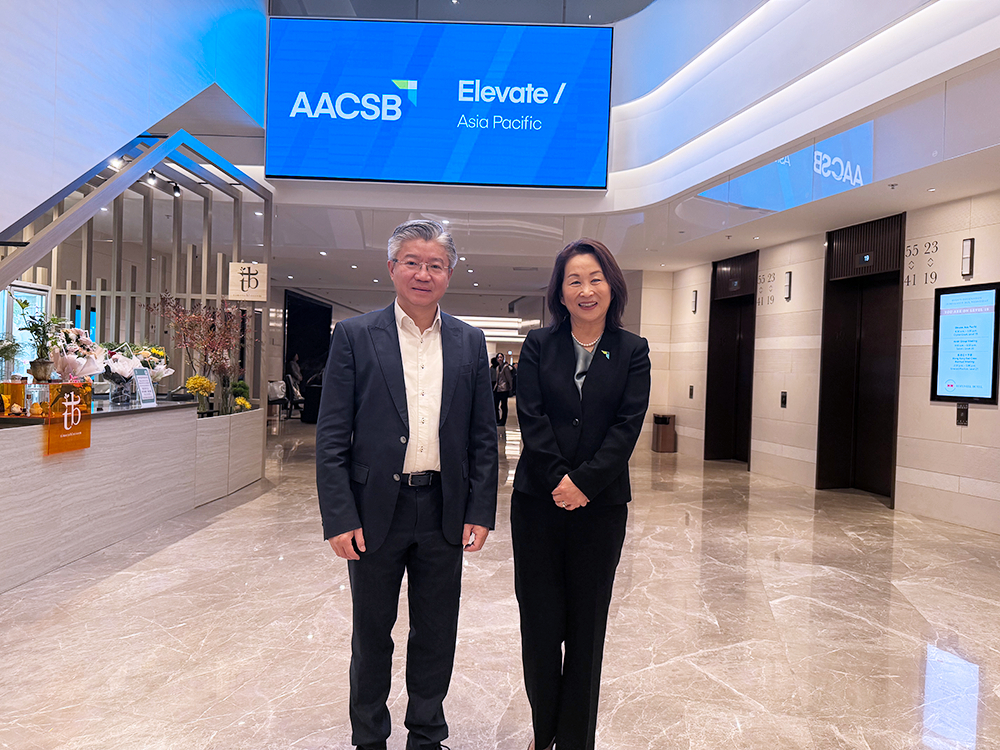
Xiongwen Lu (left) stands next to Lily Bi in the lobby of AACSB's 2025 Elevate: Asia Pacific Conference venue, the Hopewell Hotel in Hong Kong.
[12:22] Xiongwen Lu: However, when we look back 20 years ago, even longer, 30 years ago, when the first generation, second generation of entrepreneurs actually emerging in China, they could not have the chance of going to the business school to have such a very systematic training. How could they be successful? So that’s the interesting question.
I think the foundation is the same, no matter Chinese scholars, American scholars, European scholars.
That’s why a group of my colleagues actually have been working on such a topic. Do we have such a traditional Oriental culture-based management philosophy? What’s their impact on the current business? I think it’s there. I mean, even in the other business schools. For example, in the United States, they translate a very traditional classic book from history in China to English that’s called Sun’s Art of War. It’s a very good strategy for war in history.
[13:21] Xiongwen Lu: And then, a lot of American professors in their strategy courses, they use this book as a kind of must or supplementary textbook for students. Why? Because most such strategies also could be very effectively applied to the business competition. And they will adapt such a philosophy, such a strategy into that real business and also make their business very successful. So then we could see the chance of melting the knowledge from the culture, from the historical culture with the current culture between the West and the East. We put them together.
I’ll give you another example. In this world, we really talk about the stakeholder. Stakeholder means relationship. You must maintain not only just one single customer, one single supplier; you have to care about all stakeholders. But this concept actually is embedded in our history.
[14:23] Xiongwen Lu: When our businesspeople in history did their business, they should care about not only the business relationship, partners, customers, even the government and also the community. Give you some examples, very interesting. When some entrepreneurs from the, originally they were from the village or from the farm, they became very rich, very wealthy. Then they give the houses to their neighbors in the one village, they give them free as long as, you know, they stay in their original village, you know, together. Because they were, you know, sisters, brothers, you know, they grew up together. So as a return, he would like to take care of all the community. This is very classic, traditional Chinese culture. So that’s very different from the American or Western culture, right? So people really take care of all the stakeholders.
[15:23] Xiongwen Lu: I’m a marketing professor, right? So in our marketing textbook, when we use the relationship as a term, many scholars use the G U A N X I. G U A N X I is a Chinese pronunciation. It’s a new word in English.
Why? Because the Western scholars are curious about how the Chinese, Vietnamese people care about such a relationship. It’s not just one single, two partners or just a couple. It’s unlimited. You must take care of all the surrounding partners. So this is about stakeholders. So now you can see not only in mainland China, but in the Southeast Asian countries, a lot of Chinese families are very wealthy family businesses. Yes, they now go to the business school, but also they have very good heritage of the Chinese belief, Chinese culture, Chinese values.
[16:21] Xiongwen Lu: So this I think this is a chance for all the scholars from all over the world to think about how we can really consolidate the knowledge from the Eastern culture and the knowledge from the Western culture, put them together, then we could provide a very broad solution to the current challenge for the business. So that’s what we are doing now also in my school.
This is a chance for all the scholars from all over the world to think about how we can really consolidate the knowledge from the Eastern culture and the knowledge from the Western culture, put them together, then we could provide a very broad solution to the current challenge for the business.
[16:49] Lily Bi: That's wonderful. I think 100 percent agree, the integration between East and West. And sometimes we also use the word “glocal,” and you learn the global best practices and the management principles, but you also want to adapt into the local situation, right? The business world is building in the local culture, the virtues, the philosophy—same for the business education. So having both will ensure the talents we prepare for the world will be actually applicable to the local culture.
Question 3
[17:22] Lily Bi: So I wanted to go to our final big question. I wanted to talk a little bit about your school’s curriculum. And Fudan University has a very deep tradition in the humanities and arts. And while the School of Management is also investing in areas like AI, data science, and other technologies, how can this diverse, very different, diverse disciplines work together with core business disciplines to meet the evolving needs of the students, the employers, and the society?
[17:56] Xiongwen Lu: Yeah, that’s a big challenge we face. not only for my school, also for all the global business schools. We have a lot of discussions on that, you know, through our AACSB Deans Conference, you know, in our board meetings, we also could have such a discussion, a debate. It’s a kind of global challenge, but also, at the same time, in Chinese, we always put a crisis and opportunity together. You know, we definitely should, you know, echo the demand from the industry, from society, because we develop talents for the society.
So that’s why global business schools are working together on such a discussion and also to share a lot of experience on that. But it’s not easy, I have to be very frank to say, so we must as a leader develop a very clear picture for the school’s direction.
[18:51] Xiongwen Lu: So what’s the future of the business school? If you have a clear picture of the business school in 10 years, what kind of business school it should be, then you know how to do that, right? So how to actualize your school’s, you know, blueprint. So that's, I think as a first step, you know, you really have to develop a strategy. You should have a very clear picture of the future business school.
But however, you know, when the leaders have such a clear picture, it’s not enough, you must present this picture to all the faculty, to all the staff, to have a consensus. You should invite all the inputs from faculty, from staff, and then you have a chance of working together. If you don’t have a consensus, you cannot just order your faculty or staff to follow you.
[19:40] Xiongwen Lu: We definitely have such a very strong culture in my school for any strategic action or plan. We must invite all the inputs from the faculty, from staff, to have a lot of discussion, debate. Sometimes it's not easy to have one conclusion immediately, then we give them some time, we repeat such a discussion, we repeat such a debate, and gradually then we can reach the consensus, then we can take the action further.
I think that we should really work with the other schools, other disciplines. For example, AI: you could not simply deliver all the AI courses by the business school. Fortunately, we have Information Management in my school, we have Statistics in my school. So I can have my colleagues deliver some courses, but not enough. We also should invite computer science professors from the Computer Science school.
[20:32] Xiongwen Lu: So we should invite all the scientists, all the professors of the other sciences, other engineering, to come to the school to teach our students. It’s probably much better if they can work with my colleagues to deliver one course—it’s jointly developed courses—to our business students: the AI-based business strategy or business model or marketing strategy.
So we now tried—it’s a kind of pilot project in my school—we are allowed to deliver two bachelor’s degree program. One is the AI plus Marketing, another one is the AI plus Finance. It’s dual-degree programs. So we invite a lot of computer science professors and also our own professors to teach in these two degree programs. The students finish such that in one program, they can get two degrees.
We should invite all the scientists, all the professors of the other sciences, other engineering, to come to the school to teach our students.
[21:28] Xiongwen Lu: It’s a very good chance for them to develop the future skills, to take the opportunity of the future jobs.
I believe it’s not enough. We should have all such technology inputs, AI inputs, into all the different programs. No matter for the undergraduate, MBA, and the PhD, even. For example, in my data science and business analytics program—it’s a master's program—we invited more than one-third lecturers as adjunct professors from industries.
So they not only give such very practical knowledge to the students, they also use their own companies, the real projects, as assignments for the students. They offer a lot of internship jobs to our students, so that when the students finish the whole two-year study, they already have done a lot of real projects for the industry. And also they could be mentored by the business engineers.
[22:26] Xiongwen Lu: So then the students learn very fast, and also when they get jobs after graduation, they immediately can take that very serious responsibility. They don’t need further job training.
So working with the industries is also our strength now. We invite them to give the advice on the curriculum design on the, you know, the courses’ design, we invite them to be part of the lecture of the courses, we also ask them to offer the real projects. We call that the iLab learning projects. So we wanted them to offer some sponsorship, you know, when the students can, you know, have some sponsorship to cover the expenses, then they have the interest and they have some motivation to do the real projects.
[23:11] Xiongwen Lu: And then the industry, the companies, also will have the final presentation, you know, require the students to give the final presentation and to have the defense, and then the students are very serious about such a project. It’s a learning process and also it’s a co-education process.
You mentioned our new campus, right, and when I opened my new campus, I also doubted myself. I tell myself, why do I need such a big campus, right? But, fortunately, we don’t have the fence or bars or walls around my campus. It’s open to the society, to the community. And also in our mindset, we also should believe, we don’t need any boundary for our campus. The education is boundaryless. And we should invite industry people to come into campus, to talk to the students, to give them a coach, give them a lecture.
[24:02] Xiongwen Lu: At the same time, we should encourage our students to go out of the campus, to work in the industries. We should create a real environment of learning by doing, doing by learning. For business schools, it’s a must. If you can create such an environment, then the students have a very big opportunity to work everywhere or learn everywhere, and also upon the working and the learning simultaneously happen, then you can really create the future businesspeople or future leaders for the business.
We don’t need any boundary for our campus. The education is boundaryless. And we should invite industry people to come into campus, to talk to the students.
[24:35] Lily Bi: Yeah, it’s actually very unique that your new campus, I saw, very unique in China. Yes, you have a wall, building wall, but there’s really no boundary. It’s a part of the society, part of the world, part of business.
So Xiongwen, thank you so much. It has been such a fascinating conversation. Thank you for sharing what you’ve been doing.
[24:56] Xiongwen Lu: Thank you, Lily.
[24:57] Lily Bi: To our listeners. If you enjoyed this conversation, be sure to follow AACSB Pulse on AACSB Insights, Apple, PodBean, or Spotify. We have got so many great episodes coming up on big topics, big issues, shaping business school today and in the future.
About AACSB Pulse
A podcast produced by AACSB International, AACSB Pulse explores current topics impacting global business education—three questions at a time—with business school deans, industry leaders, and other big thinkers of today.
To receive new episodes, make sure to sign up for AACSB’s email newsletter, LINK, or subscribe to AACSB Pulse on Apple Podcasts or Spotify.
 Article
 Video
Video