




Entrepreneurship: Not Just for Future Founders
 Article
- In the University of Richmond’s Bench Top Innovations program, students from all disciplines come together to launch a functioning company built around a food-related item.
- In the first semester, student teams develop potential products that are taste-tested by the public and judged by experts. In the second semester, the teams evolve into one company where students manufacture and sell the winning product.
- Students make all decisions for the company. Faculty do not approve campaigns, products, prices, retailers, or strategies, and they don’t solve operational problems.
Five years ago, when the University of Richmond in Virginia launched an unconventional entrepreneurship program, I believed we were building an experiential program that would help students understand how businesses are created, from idea to commercialization. But after watching students create products, navigate uncertainty, and learn from mistakes, I have come to believe entrepreneurship programs represent a much larger opportunity for higher education.
Over the last several decades, universities have made extraordinary investments in entrepreneurship education through a combination of majors, innovation centers, startup incubators and accelerators, venture competitions, and seed funding. With these initiatives, schools have created opportunities for students who want to take risks, pursue their ideas, and build functioning businesses. However, I am convinced that these opportunities also can be valuable to a much larger population of students—especially those who do not see themselves as entrepreneurs.
My perspective is personal. I studied political science and urban planning, and I did not see entrepreneurship as part of my identity. Yet, early in my career, I participated in three startups, and I also led innovation environments at large organizations. I have now spent years teaching entrepreneurship.
Many students, regardless of their undergraduate fields of study, will go on similar journeys. Like me, they will not consider themselves entrepreneurs, but they will want to create value with their work. Most of them ultimately will find themselves inside organizations that increasingly will be defined by ambiguity, complexity, and rapid change. These organizations will need employees and managers with capabilities that extend beyond functional knowledge.
To help all students prepare for these environments—and many other aspects of life—higher education can teach them the value of creativity, innovation, and an entrepreneurial mindset. That’s what we have set out to do with our Bench Top Innovations program.
Creating the Program
Several years ago, I suggested that the University of Richmond’s Robins School of Business establish a program where students could create actual revenue-generating businesses. The dean at the time, Mickey Quiñones, connected me with our entrepreneur-in-residence, Shane Emmett, so we could develop a comprehensive proposal for a program that mimicked the real world as much as possible.
Emmett brought extensive practical experience to the process. He is the co-founder and former CEO of Health Warrior, which was acquired by PepsiCo several years after it launched. Together, he and I designed a program in which students would create a company that would design, produce, and market a different food product in the span of two semesters. We chose food for two reasons: It is universally accessible, which lowers the intimidation barrier often associated with entrepreneurship. And it is something that everyone has lived experience with, which makes the program approachable to everyone.
We believed that if our true goal was to prepare students for modern organizational life, the program could not belong exclusively to business students. Crucially, Quiñones championed the decision to make the program accessible to rising seniors across disciplines and majors. We knew that once our business students graduated, they would be working alongside—and learning from—professionals who had majored in English, chemistry, health science, mathematics, and leadership studies. So why not have our program reflect that reality?
We believed that if our true goal was to prepare students for modern organizational life, the program could not belong exclusively to business students.
Leadership across campus provided ample support for our vision. The provost provided funding, the executive chef of the university agreed to allow our students to operate in our catering kitchen, and the general counsel identified a legal structure that would protect the university while allowing students to truly operate a commercial entity. Because the program was open to students across the university, deans from all three undergraduate schools—business, leadership, and arts and sciences—were invited to sit on the student company’s board of directors to provide monthly oversight and guidance on key issues facing the students.
Everyone involved operated from a “get to yes” mentality. This meant that the institution made decisions quickly and efficiently—just as we ask students to do in experiential learning courses when they are learning in real time.
Leading Innovation
Bench Top Innovations is a formal, two-semester program where students earn a full unit of academic credit for each semester. Depending on students’ majors and their specific roles within the student-run company, they often can apply these credits toward elective requirements within their majors.
In the first semester, students focus on opportunity development. We give them a broad food product category, such as salad dressings or energy drinks, and provide them with modest resources. They conduct customer discovery surveys, analyze market opportunities, test assumptions, and develop products inside the university’s catering kitchen.
This semester culminates in “The Great Bake Off,” which is held in our admissions building and three adjoining ballrooms. Teams provide samples of their products to hundreds of visitors, including university leaders, staff and faculty, students, alumni, and members of the local business and government community. Additionally, nearly a thousand other people—parents, family, friends, and prospective students—attend via Zoom.
Teams also deliver eight-minute “Shark Tank”-style pitches to a panel of external experts with experience in that year’s product. For example, when the category was a canned coffee beverage, one of the judges was David Blanchard, an alumnus of the university and owner of Blanchard’s Coffee. The winners are determined by the judges, who consider factors such as taste, pitch quality, brand, and market opportunity.
The team that wins “The Great Bake Off” determines the specific product that the whole class will manufacture and sell in the second semester, when students shift from concept development to execution. The 16 students in the class organize themselves into a functioning company with leadership and operational roles spanning marketing, finance, sales, operations, and technology.
All students are allowed to seek any position. Those who are interested in becoming CEO present five-minute overviews about their candidacy and vision. Students elect the CEO, who then interviews and selects individuals to lead the other departments. Students who do not seek or receive leadership positions identify which departments they would like to work in, and Emmett and I make the final decisions.
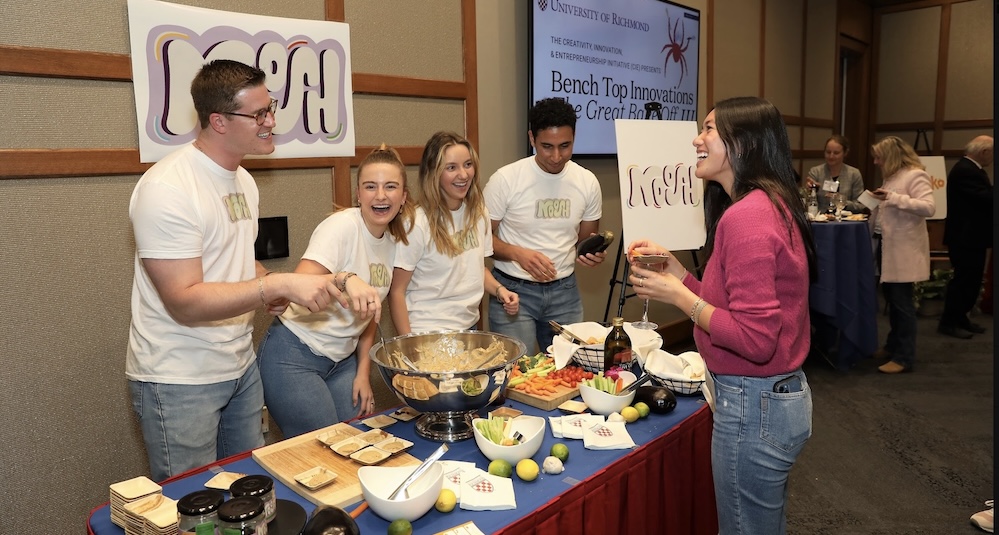 During the Bench Top Innovations Great Bake Off event, the NOOSH team of students offer visitors to their booth a taste of their baba ghanoush dip. (Photo by the University of Richmond, Communications)
Every Monday during class, the student CEO leads reviews of company operations. On Wednesdays, students engage with industry leaders who discuss topics such as branding, packaging, legal issues, and consumer behavior. These industry insights help students as they take on the tasks of running the business—securing retail accounts, managing inventory, launching campaigns, and solving operational problems.
While every student is a member of a functional team, we have an essential axiom: Everyone sells. The sales team secures and manages retail accounts across the greater Richmond area. But everyone is responsible for attending product demos, going to farmers markets, and taking any opportunity to present the product, get real-time consumer feedback, and potentially establish a new client. Students learn the value of perseverance. They find they can be told “no” hundreds of times and yet still desire to win over new customers.
Becoming Decision-Makers
Over the course of the second semester, students make all decisions for the company. Faculty do not approve campaigns, determine products or pricing structures, select retailers, resolve operational problems, or dictate strategy. In fact, in the very first class, instructors share that the strongest advice we will ever give them will be: “Why don’t you sleep on that idea?”
The structure of the program intentionally mirrors the ambiguity, interdependence, and rapid decision-making that define organizational life, and students quickly learn that organizations rarely behave according to plan.
For instance, during one production run at a manufacturing facility, students discovered the product coming off the line did not taste like the version they had developed in the kitchen. Late that night, a student leader called me near tears, hoping for an answer. Instead, I asked, “What are you going to do?” By morning, the team had worked with the manufacturer to adjust the formulation. Ultimately, students transformed the setback into two separate product variations for different retail audiences.
Students must manage competing priorities, time constraints, and uncertainty. They must learn to make judgments without complete information, adjust course quickly when assumptions prove wrong, and recognize that agility often matters as much as precision.
Students also learn that intuition alone is insufficient. They use analytics to evaluate performance, identify patterns, challenge assumptions, and refine strategy based on evidence rather than instinct. They discover that leadership requires ownership, resilience, and the ability to move forward despite ambiguity.
Through these efforts, students build something larger than entrepreneurial capability. They develop decision-making skills, confidence, and professional judgment that will serve them regardless of whatever industry, function, or career path they choose. As Maeve McCormick, a student from the first year of the program, said, “I learned that I am capable of doing far more than I thought I was able to.”
Launching New Products
Over the past five years, students in the program have successfully manufactured and commercialized Absurd Snacks (a nut-free snack mix), TwinTail Brews (a highly caffeinated tea beverage with L-theanine), NOOSH (a modern take on baba ghanoush dip), ENVEE (a salad dressing combining pesto and Caesar flavors), and RALI (a canned coffee beverage fortified with protein and electrolytes).
While we did not create the program to generate startups, we want our students to be prepared if they ever choose that path. For that reason, students in all four teams of the fall semester retain ownership of the intellectual property they create, including recipes and branding elements. Students in the winning team also own their rights, but they have the added advantage of having had a chance to bring their product to market.
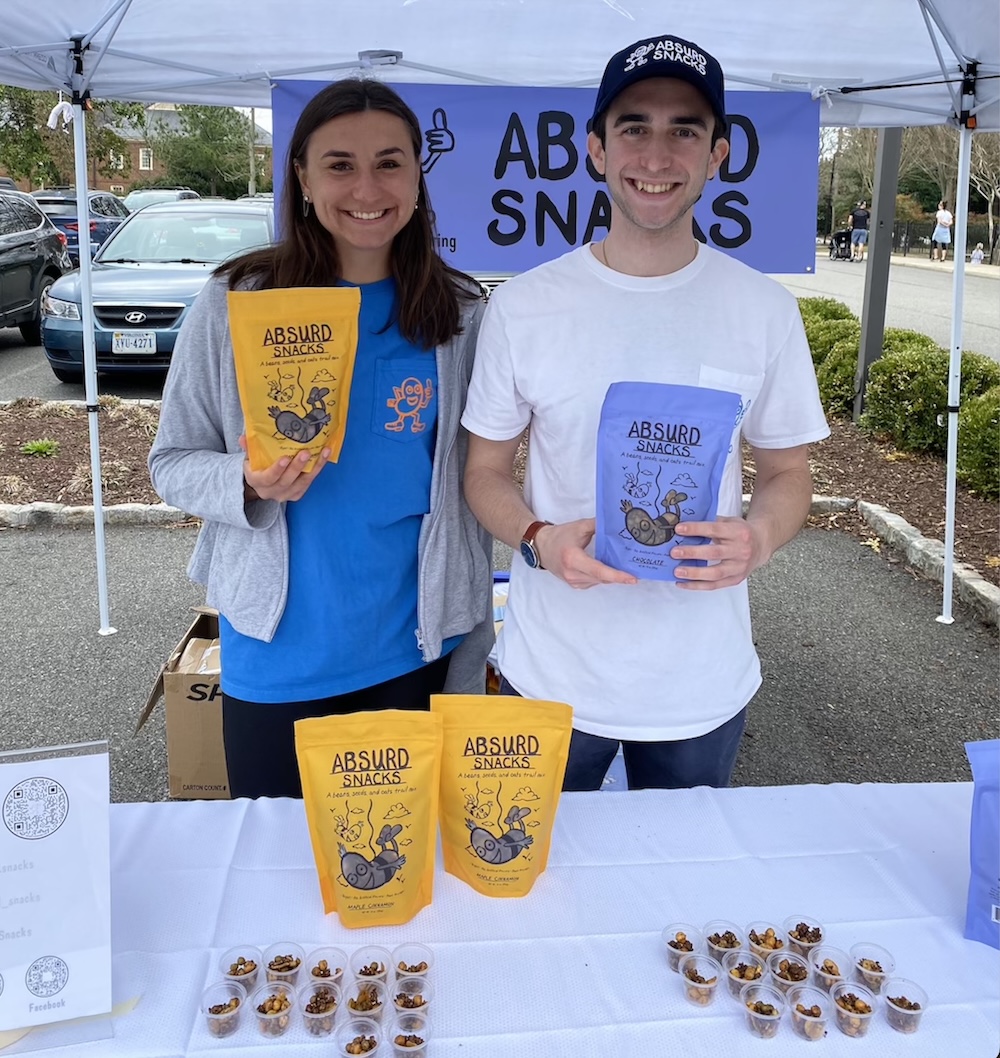 Absurd Snacks, a nut-free snack mix that was created by a student team, is now commercially for sale around the U.S. (Photo by Joel Mier)
At the end of the school year, those who own the rights to the winning product discuss their next steps. Do any of the original team members want to continue? Do students who were not from the original team want to join them? The original members of the winning team decide if, how, and with whom to continue.
So far, only Absurd Snacks has expanded beyond its classroom origins. Its CEO is Grace Mittl, one of the original four team members; the COO is Eli Bank, who served as COO during the class even though he was not one of the first four team members. Grace negotiated with her three other teammates about ownership and equity before starting the new operation with Eli. Absurd Snacks now reaches consumers across the country through more than 2,500 retail locations.
Measuring Success
Because Bench Top Innovations relies on experiential learning, assessment requires moving beyond traditional exams. We evaluate students on both their processes and their outcomes.
For the first semester, we look at metrics such as the quality and depth of secondary research on food markets, execution of user feedback sessions, demonstrated use of design thinking principles, and thoughtful reflections on insights shared by our guest speakers. During the second semester, we focus more on how well students perform in their functional roles and how they navigate unexpected operational challenges.
Students also participate in structured peer review processes, giving candid assessments about teammates across functions and receiving assessments in turn. This replicates the collaborative accountability found in high-performing organizations and reinforces the idea that self-awareness and the ability to act on peer feedback are essential professional skills.
Looking Ahead
Interest in the program has grown significantly since its launch, though it remains intentionally unconventional. Most recently, we received more than 80 applications for the 16 available spots.
While we expect that every student accepted into the program will develop a capacity for creativity, entrepreneurial thinking, and innovation, we know that most of them will not start companies. But many will discover entirely new possibilities for who they can become. Often, they simply need the opportunity to experience uncertainty, ownership, and creation firsthand before they can see how entrepreneurial skills and knowledge can benefit their careers.
Higher education has built extraordinary entrepreneurship infrastructure over the past several decades, and we hope that work continues and expands. Incubators, accelerators, and expos are valuable, and so is a broader grounding in the capabilities that entrepreneurship develops. For schools, the opportunity is not simply to create more founders; it is to help more students discover that they can build solutions, navigate uncertainty, and create value wherever their careers take them. Along the way, schools can contribute meaningfully to local innovation ecosystems and economic environments.
At the University of Richmond, our broader vision for Bench Top Innovations is one of expansion and adaptation. The legal and operational structure we established—which enables students to safely operate a revenue-generating business under the university’s umbrella—is highly extensible. We believe this experiential model can be adapted by any university professor, regardless of discipline, and create opportunities for students in any field.
 Report
 Video
Video