





Go Beyond AI Lockdowns—Four Classroom Strategies
 Article
- Student AI adoption reverses the usual technology-resistance problem: Students embraced AI long before faculty, and their use has reshaped the curriculum in ways instructors largely could not dictate.
- In response, faculty might be tempted to lock down students’ use of AI through detection software, test proctors, and in-class exams. But these measures become increasingly costly as AI-assisted work becomes cheaper and harder to detect.
- Instructors can supplement AI lockdowns with four adaptive strategies, each requiring progressively greater AI fluency from instructors while developing greater capability in students.
This September, my institution, the University of Florida in Gainesville, received national coverage of its AI transformation. The CNN article also highlighted the defensive turn now unfolding in higher education, with one student describing how one of his professors had eliminated graded homework in favor of handwritten, in-class exams.
The logic is understandable. In August, The New York Times reported that AI agents can now complete entire asynchronous online courses on students’ behalf, and learning-platform vendors acknowledged they have no reliable way to prevent such use. Essays, homework, and projects do not provide the same evidence of student capability they once did. When take-home work no longer serves as reliable proof of authorship, a controlled environment offers a way to restore that signal.
This new reality might seem to justify a wholesale retreat from AI-assisted work. But that strategy also eliminates opportunities to prepare students for professional environments where the use of AI is increasingly commonplace. Moreover, protecting the assessment instrument with handwritten exams is not the same as safeguarding the skills that instrument is meant to demonstrate.
This leaves educators asking a fundamental question. What is more important to protect: the assessment of learning or the learning itself?
Whenever an innovation makes established signals cheap to imitate, people face a choice: Contain the new technology or adapt to it. Eventually, they tend to opt for adaptation, solving the problem without building higher walls.
In an April 2026 AACSB Insights article, I argue that experiential learning provides students with artifacts that signal their career readiness to employers. AI raises the inverse problem: What happens when the visible artifacts of learning can be reproduced cheaply without the capability behind them?
The answer is not to abandon assessment or academic integrity. It is to change strategy when the signals of capability change.
Why Lockdowns Lose Over Time
Research on technology resistance typically assumes that the people resisting adoption are the ones controlling the adoption decision. But that is not the situation with AI. Instructors are inheriting the consequences of a decision students have already made, which changes what resistance can accomplish.
Taxi medallion owners were in a similar position a decade ago. As riders migrated to ride-hailing services such as Uber and Lyft, medallion owners pursued regulatory defenses. Their grievances were real and the defense was rational, but customers made the adoption decision. Owners could try to regulate, litigate, or restrict the ride-share model; the one thing they could not do was to make users abandon it.
Over time, enforcing each new countermeasure costs instructors more, while generating AI-assisted work costs students less.
Instructors who implement lockdown strategies in their classrooms follow a familiar script. They can use detection software, hire test proctors, ban AI use, and retreat to handwritten in-class exams. These efforts resemble France’s construction of the Maginot Line, the fortress system built before World War II: It was formidable where it stood, yet vulnerable to being bypassed.
Over time, enforcing each new countermeasure costs instructors more—in money, class time, and trust—while generating, revising, and disguising AI-assisted work costs students less.
Three factors compound this problem:
First, enforcement can reveal only the violations it detects. At my institution, reports of AI-related misconduct rose from zero cases in the fall of 2021 to 66 in the spring of 2025, according to public records cited by the university’s student-run newspaper. Those figures reflect detected violations, not the underlying prevalence of AI misuse.
Second, detection can be wrong. A false accusation harms the student, consumes faculty and administrative time, and erodes the trust that academic integrity policies are meant to protect.
Third, delegating AI policy can lead to institutional inconsistency. When individual instructors determine AI policy on a course-by-course basis, students may encounter AI as integral to learning in one classroom but as a threat in the next. Without a coherent institutional strategy, schools are less likely to realize the long-term benefits of curricular redesign.
Four Adaptive Strategies
Schools can adopt four approaches to address different classroom challenges. Each addresses a distinct challenge—and has a historical precedent showing how that strategy has worked in practice.
A lockdown, the default response, requires the least AI fluency. From there, the approaches become progressively more demanding, each requiring instructors to possess greater AI fluency while helping students develop similar capabilities. These strategies also can provide more reliable evidence of student learning than lockdowns alone.
The AI Adaptation Staircase
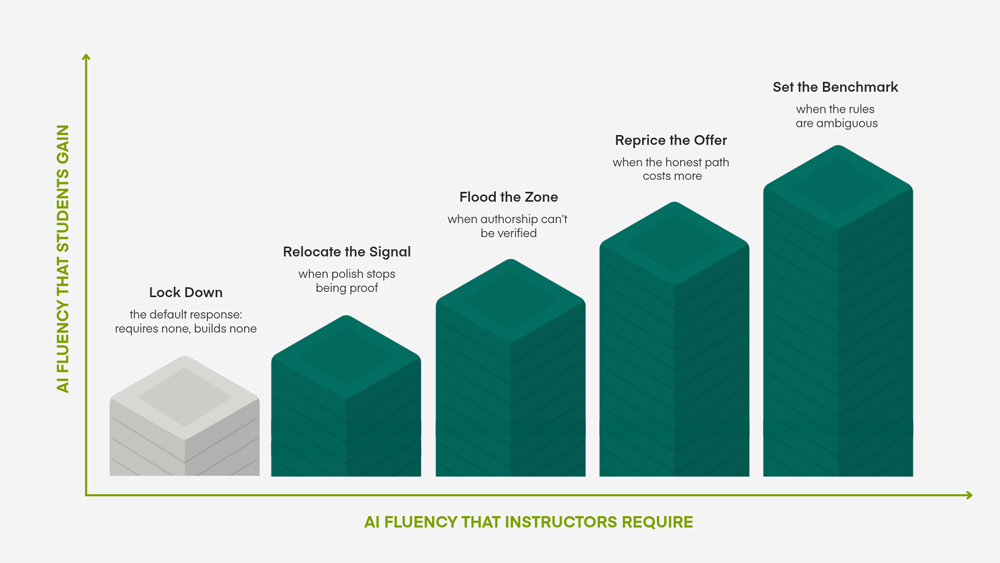
Let’s examine how each strategy has worked in other real-world contexts and then consider how to apply it in the classroom:
Relocate the signal. When advances in printing technology made banknotes easier to imitate, treasuries did not respond by trying to out-print counterfeiters. Instead, they moved authentication into features that remained expensive to fake: watermarks, security threads, and color-shifting ink. The face of the note remained relatively easy to copy, but it was no longer the primary means of verifying authenticity.
In the classroom, fluent prose and clean structure are the “printed” face of student work, which AI can reproduce easily and at little cost. Schools can relocate the signals of capability to features that are still difficult to fake: originality, situational judgment, and the maturity reflected in students’ ideas.Emma MacKie, an assistant professor in the University of Florida’s department of geological sciences, revised her rubric in this direction. As she puts it in the CNN piece, “It’s easier to get a ‘C’ on that assignment, but more difficult to get an ‘A.’”
The takeaway for educators: Grade what remains expensive to fake.
Flood the zone. When the capability of software-based chess engines surpassed the best human players, some players began using engines covertly to cheat in competition. The chess community responded by drawing a boundary between preparation and performance: Players began training with engines, drilling against machine-generated positions, and analyzing their own losses with engine assistance. Players used those engines to develop their capabilities, but competition still required them to demonstrate those capabilities unaided.
Like the chess community, we also can flood our classrooms with AI-generated practice problems, assignments that require critiquing model output, and drills in which students hunt for the model’s errors. Students can then demonstrate their skills under conditions where AI assistance is absent, whether through in-class analyses, live presentations, or exams.
This strategy is better suited to independent work conducted under controlled conditions than to open-ended work in which effective AI collaboration is itself a capability being assessed.
The takeaway for educators: Train with AI, perform without AI, and make the boundary between the two explicit in the syllabus.
Reprice the offer. For years, the recorded music industry responded to a rise in underground file-sharing with lawsuits, copy protection, and shutdowns. Even so, piracy persisted because it offered consumers an alternative source of music with an enormous selection, few restrictions, and no direct cost. Streaming then changed the pricing calculus. Legal access became inexpensive and more convenient, with reliable quality, easy search, and access across devices. Many of the advantages of piracy were removed.
We can “reprice the offer” by designing assignments in which doing the underlying thinking is easier than fabricating evidence that thinking occurred.
In the classroom, we can design assignments in which doing the underlying thinking is easier than fabricating evidence that thinking occurred. In my MBA teaching, for instance, students apply course content to problems in their own organizations, with AI use permitted and disclosure required. AI can help analyze the problem or draft prose, but it cannot supply the student’s constraints, organizational politics, or data.
Students begin with contexts they already know, and a brief live or recorded defense of the finished product completes the design. This structure requires students to explain and defend the judgments reflected in their submissions.
One limitation of this strategy is access: Students who cannot disclose their employers’ situations or who lack professional contexts need an equivalent alternative, such as a common company or case to work from.The takeaway for educators: Redesign assignments so that thoughtful engagement becomes the easier path.
Set the benchmark. Investing in the stock market was once the purview of skilled fund managers and traders. When Jack Bogle introduced index investing in 1976, he made a transparent, low-cost benchmark available to almost anyone. Simply matching the market became less impressive when an index fund could do the same automatically and at low cost. Active managers increasingly had to demonstrate what additional value they provided.
Instructors can create credible AI-assisted baselines for students by providing a model-generated response to an assignment. Or they might present graded exemplars that show the difference between AI outputs that have been minimally reviewed and those that demonstrate genuine excellence. Raw output becomes the index that students should work to exceed.
The question is no longer whether AI was used, but what contributions students added to the baseline. This strategy places the greatest demand on instructors’ AI fluency because the benchmark must be credible and updated as models improve.
The takeaway for educators: Make the AI baseline visible, and grade the value students add to its output.
Diagnosis Before Strategy
Controlled assessments remain appropriate when independent performance is exactly what they are designed to verify. A licensing exam, for example, must establish what the license holder can do alone. With AI, however, instructors must make a diagnosis before adopting an assessment strategy: Identify what has actually failed, and choose the response designed for that failure.
If proof of authorship has failed, lock down or flood the zone. If the graded features have stopped being diagnostic, relocate the signal. If the honest path has become the expensive one, reprice the offer. If expectations about acceptable AI use have become ambiguous, set the benchmark. Surveillance cannot resolve ambiguous expectations, and a published benchmark cannot restore proof of authorship. Each strategy addresses a different failure.
Surveillance cannot resolve ambiguous expectations, and a published benchmark cannot restore proof of authorship.
Academic leaders have their own diagnosis to make. For an individual instructor, locking down is rational: A locked-down course looks orderly this semester, while the costs of redesign are immediate and its benefits are delayed. With this in mind, academic leaders should audit instructor incentives before auditing the instructors themselves. Who bears the cost of redesign? Who is rewarded for it, and how? Where is it most necessary to set program- or college-level expectations? Employer advisory boards belong in this conversation because they can identify the capabilities graduates must demonstrate in an AI-enabled workplace, providing additional motivation to adjust classroom practices.
To summarize this guidance in practical terms:
- Grade what remains expensive to fake.
- Train with AI, perform without AI.
- Make meaningful engagement the easier path.
- Make the AI baseline visible and grade the value students add.
Experiential learning is valuable when it produces credible signals of what graduates can do. AI does not change that objective. It simply makes it easier for students to reproduce the signals we have traditionally measured, even when they have not mastered the underlying skills. When AI evolves to make those signals unreliable, our assessment strategies must evolve with it.
 Podcast