



Entrepreneurship Expos Build More Than Businesses
 Article
- When students present their ideas for new ventures to a wide range of stakeholders, they are immersed in rapid cycles of real-world feedback, reflection, and adaptation that accelerate learning.
- Unlike classroom presentations, expos challenge students to respond to diverse stakeholders whose questions, expectations, and perspectives mirror real market conditions.
- Whether students ultimately launch their ventures or pursue traditional careers, the judgment, adaptability, communication, and relationship-building skills they develop continue to pay dividends long after graduation.
In today’s rapidly evolving world of work, what distinguishes high performers is not simply what they know, but what they are able to do with that knowledge from their first days on the job. Their future success depends on mastering higher-order, transferable capabilities that enable them to integrate knowledge, exercise judgment, adapt across contexts, and create value under conditions of uncertainty.
Embracing a capabilities perspective shifts the focus from what students know to what they can do and become. This perspective emphasizes the development of an individual’s ability to act effectively in diverse and evolving contexts.
In entrepreneurship education specifically, research has increasingly explored how university experiences shape valuable real-world capabilities such as networking ability, proactiveness, adaptability, and self-confidence. Yet one of the most powerful learning environments in this discipline remains surprisingly underexamined: the entrepreneurship expo. Entrepreneurship expos bring students together with entrepreneurs, investors, employers, alumni, faculty, and community members in marketplace settings where ventures are presented, challenged, refined, and often launched.
Entrepreneurship expos require students to respond to unscripted questions, reconcile competing viewpoints, and engage with stakeholders whose perspectives are shaped by market realities rather than grading rubrics. In this way, expos become more than student showcases; they become environments designed to cultivate entrepreneurial capabilities through repeated cycles of action, feedback, reflection, and adaptation.
Expos can take different forms, as we have discovered by comparing those organized by our home schools of Florida State University; Rowan University in Glassboro, New Jersey; and the University of Tampa (UTampa). Despite these differences, our events collectively demonstrate a common educational philosophy: It is important to intentionally create environments where students develop entrepreneurial capabilities through authentic engagement with external stakeholders.
Developing Capabilities, Not Just Ventures
At Florida State, the Entrepreneurship Expo transforms the quad on Landis Green into a bustling marketplace where students actively sell products and services while engaging with entrepreneurs, investors, alumni, employers, faculty, and community members. Rather than presenting hypothetical business concepts, students generate revenue, validate markets, and adapt to continuous, unscripted feedback.
By comparison, Rowan University emphasizes entrepreneurship as an iterative developmental process. The Rohrer New Venture Competition & Expo draws students from disciplines across campus, many of whom return year after year with more refined ventures, greater confidence, and a deeper appreciation for the value of external feedback. Over time, students come to view the expo as a recurring opportunity for entrepreneurial development.
Unlike traditional classroom presentations, where feedback often comes from a single instructor, expos immerse students in diverse (and often competing) perspectives.
At the University of Tampa, the New Venture Expo reinforces this developmental philosophy by recognizing ventures at multiple stages, from validation to growth. The event is structured to encourage students to seek feedback appropriate to where they are rather than feeling pressure to present fully developed businesses. This creates an environment where learning is valued as much as performance.
Despite their differences, all three expos are capability development platforms, not simply venture showcases. Whether an expo is hosted with modest resources or larger investments in infrastructure and prize funding, its effectiveness depends on creating authentic environments where students engage with entrepreneurs, investors, alumni, employers, faculty, community members, and peers.
Unlike traditional classroom presentations, where feedback often comes from a single instructor, expos immerse students in diverse (and often competing) perspectives. Each new perspective requires them to communicate effectively, exercise judgment, and determine which feedback deserves action.
Three Students, Lifetime Rewards
The student outcomes speak for themselves. Consider three former participants.
During his second year as an undergraduate, Andrew Gilliland entered UTampa’s expo with a novelty “spy pen” product and an e-commerce sales strategy. At the time, the business was little more than an opportunity to experiment with entrepreneurship. Like many student founders, Andrew debated with his team about whether investing several hundred dollars into inventory was worthwhile, until a professor pointed out that they had already spent more than that amount in time debating the decision. They moved forward.
That early venture became Andrew’s introduction to e-commerce, customer acquisition, product validation, and entrepreneurial decision-making. Over the next decade, he launched multiple online brands, built a consulting business supporting other e-commerce entrepreneurs, and acquired several existing e-commerce companies. Today, he leads a seven-figure enterprise and was recognized on the Forbes 30 Under 30 list.
Andrew’s experience illustrates how modest student ventures can serve as the foundations upon which entrepreneurial capabilities, confidence, and identity develop over time.

Justin Iannelli, far left, and Harrison Nastasi, far right, stand with a team member to offer samples of their product, Bobica Bars, at the Rohrer New Venture Competition & Expo.
Two alumni of Rowan University followed a similar trajectory in their development. After debuting samples of their homemade granola bars from their parents’ kitchens at the Rohrer New Venture Competition & Expo, Harrison Nastasi and Justin Iannelli grew Bobica Bars over the last four years into a nationally distributed product. Along the way, they earned first place at the CEO Global Pitch Competition, second place at e-Fest, and finalist recognition at the Global Student Entrepreneur Awards. They also had the opportunity to collaborate with Tiki Barber, former star of the National Football League.
Reflecting on their journeys, Andrew, Harrison, and Justin agree that the expo experience was indispensable—not because it offered short-term exposure, but because it accelerated the growth of their entrepreneurial capabilities in ways that continued to compound long afterward.
From Knowledge to Opportunities
These examples highlight a broader point. The lasting value of entrepreneurship expos should not be measured solely by the number of companies launched or dollars raised. Their greater contribution lies in developing capabilities that remain valuable regardless of where students’ careers ultimately lead. Some participants continue building their ventures. Others join startups or established organizations. In every case, the capabilities developed through the expo experience continue to shape how they identify opportunities, solve problems, communicate ideas, and create value.
Collectively, the experiences at Florida State, Rowan, and UTampa reveal a common pattern. All three have purposefully created environments that prioritize capability development over performance alone. Their expos shift the educational emphasis from demonstrating knowledge to developing capabilities through authentic engagement.
What does this mean for business education? In real-world terms, students learn that meaningful outcomes are rarely predetermined. Mentorships emerge organically. The business community sources future talent. Potential customers provide feedback that reshapes business models. Community members connect students with resources that neither students nor universities knew existed before.
While universities can create the conditions for these interactions to occur, expos are all-in-one environments that combine these interactions in a single dynamic experience. As educators, we have few other pedagogical tools that invite students to actively engage with the concepts they have learned, all while asking questions, building relationships, and capitalizing on opportunities in real time.
The four of us have collectively spent two decades designing and operating entrepreneurship expos. Although we initially viewed expos primarily as opportunities for students to showcase their ventures and connect with the business community, we have learned their greatest value is far more significant: Expos are where some of the most meaningful entrepreneurial learning takes place.
Three Primary Educational Benefits
Three characteristics make entrepreneurship expos particularly effective platforms for capability development:
Expos create authentic interaction under pressure. Students engage with dozens of individuals representing different backgrounds, expectations, expertise, and motivations. Participants encounter customers, entrepreneurs, investors, employers, alumni, faculty, journalists, and community members in rapid succession. Every conversation requires students to adapt their communication styles, reassess what matters most, and respond to unexpected questions. Their learning comes not from delivering polished pitches, but from continually refining their thinking through authentic interactions.
Expos compress learning cycles. In a single afternoon, students may explain their venture 30 or 40 times. Each conversation uncovers new insights, challenges assumptions, generates feedback, and prompts small adjustments and reflections that accumulate throughout the event. By day’s end, many have refined not only how they describe their ventures, but how they understand the opportunities that those ventures represent.
Expos expose students to authentic feedback. Faculty naturally balance candor with encouragement as part of their developmental roles. By contrast, entrepreneurs, customers, employers, and investors react as they would in practice—their feedback is immediate, unfiltered, and often contradictory. One visitor may enthusiastically validate a student’s assumptions while the next challenges them entirely.
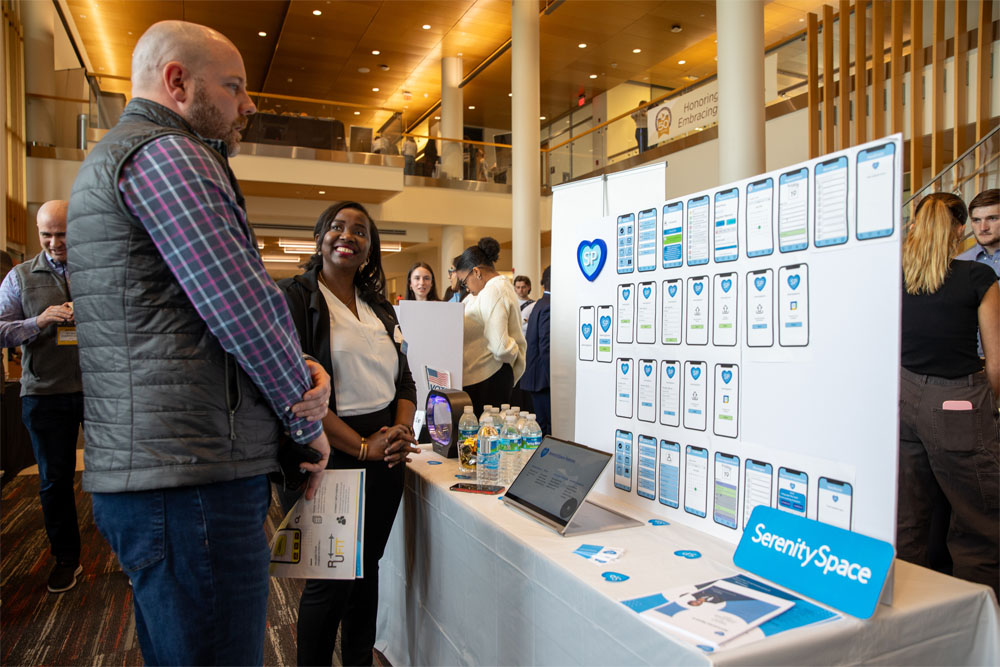

As students speak to wide-ranging stakeholders at the Rohrer New Venture Competition & Expo, they must adapt their communication styles, respond to contradictory feedback, and reassess their business plans.
Navigating these competing perspectives requires students to exercise judgment rather than simply accept advice at face value. They learn that entrepreneurial decision-making depends less on finding the “right” answers than on determining which feedback deserves action.
‘Before’ Versus ‘After’ the Expo Experience
Perhaps the clearest evidence that expos function as platforms for capability development is visible after a single event. Students often arrive believing their primary responsibility is to deliver an effective pitch. They leave realizing their primary responsibility was to learn.
Some walk away disappointed, recognizing they were less prepared than they thought and determined to do better the next time. Others leave energized by a single conversation with a mentor, entrepreneur, or employer who revealed a new opportunity or connected them with resources they never knew existed. But most student participants share a common realization: Entrepreneurship is less about presenting answers than about asking better questions, building relationships, and creating opportunities through engagement with others.
Many of the most meaningful outcomes materialize after the event. Employers return to campus asking to recruit interns or to post job opportunities. Entrepreneurs mentor students they first met at the expo. Community partners open doors by providing workspaces, production facilities, seed funding, or strategic introductions. Local media feature student ventures because they recognize the creativity and professionalism on display.
Universities would find it difficult to intentionally orchestrate every one of these outcomes in any other educational setting. Expos create the perfect conditions for valuable relationships and opportunities to emerge organically.
Importantly, these outcomes extend well beyond venture creation. Some students continue building their businesses, while others discover that the capabilities that they developed position them for success inside established organizations. Employers increasingly recruit directly from expos because they observe qualities that résumés and interviews rarely reveal: initiative, adaptability, communication, resilience, curiosity, and sound judgment under pressure.
Capability Development at Scale
Our own philosophy of entrepreneurship education has evolved alongside these observations. Rather than viewing curricular and co-curricular experiences as separate, we now see them as complementary elements of a broader learning ecosystem. Classrooms provide conceptual foundations and analytical tools; expos provide authentic environments where those ideas are tested, challenged, and refined through engagement with external stakeholders.
The strongest learning occurs when these experiences are intentionally connected. Course assignments can prepare students for expo participation, while expo experiences enrich subsequent classroom discussions.
Students realize that entrepreneurship is less about presenting answers than about asking better questions and creating opportunities through engagement with others.
Our experience also suggests that institutions need not wait for campuswide participation before launching their own expos. Across our universities, growth has been incremental rather than mandated. Typically, one or two faculty members began by integrating expo-style experiences into their courses. As colleagues observed the educational outcomes, participation expanded organically.
Faculty are understandably protective of students’ time, but when expos are professionally organized, supported by engaged community partners, and clearly aligned with learning objectives, buy-in follows naturally.
Perhaps the most encouraging lesson is that impactful entrepreneurship expos do not require extraordinary budgets or elaborate facilities. They require thoughtful design, authentic community engagement, committed faculty champions, and a clear educational purpose. Universities create the conditions; students create the value by engaging proactively, seeking feedback, and building relationships. In doing so, students practice the very behaviors entrepreneurship education seeks to cultivate.
The future of work will increasingly reward individuals capable of navigating ambiguity, exercising judgment, integrating diverse perspectives, and creating value in uncertain environments. These capabilities matter as much within established organizations as they do in entrepreneurial ventures. Entrepreneurship expos demonstrate that, when designed to link directly to learning objectives, experiential learning can cultivate these capabilities at scale.
Expos do not simply offer a valuable model for entrepreneurship education. They provide a roadmap for how business schools can prepare graduates to thrive in an increasingly dynamic world.
 Video
Video