





Connected Courses Build Student Capabilities
 Article
- Too often, business schools teach similar concepts as separate subjects with different names, making it hard for students to understand how topics are related.
- Instead of merely asking faculty to “be more interdisciplinary,” schools should assign someone the task of identifying related courses across the curriculum. AI can help with analysis and suggestions.
- To ensure faculty are invested in making course connections, schools should consider workload allocations, provide faculty development, embed the work within governing bodies, and reward the effort.
Today’s business schools focus on helping students develop capabilities, not just skills. A skill produces a deliverable. A capability produces judgment. But because artificial intelligence needs only seconds to generate a competent memo, a clean regression, or a plausible market-entry plan, such an artifact no longer reliably signals the capability level of the person who produced it.
However, it’s still difficult for AI to decide which tools, concepts, and representations a situation calls for and to justify that choice as the context changes. That level of judgment is exactly what a capabilities-based education is meant to develop.
By nature, capabilities are cross-contextual; they emerge most clearly when they are presented across the curriculum in ways that promote transferable judgment. For business schools, the questions become: How well are capabilities connected across multiple courses, and who is responsible for making those connections happen?
Where We Are Now
Many schools have already taken cross-curricular integration seriously at the degree level. For instance, at my own institution, the University of Arizona in Tucson, the Eller College of Management and the College of Engineering have built the Integrated Business and Engineering program. It combines courses on engineering design, software, AI, and biomedical devices with courses on business analytics, marketing, and entrepreneurship.
Similarly, the Daniels School of Business at Purdue University in West Lafayette, Indiana, and the Leeds School of Business at the University of Colorado Boulder both offer integrated business and engineering degrees co-developed with the engineering colleges at their universities.
But degree-level integration solves only part of the problem. Transferable capability still has to develop within the business curriculum itself, where students usually experience accounting, finance, marketing, operations, analytics, management, and entrepreneurship as separate domains. The first integration challenge may not be across colleges, but within the programs we already own.
How to Recognize Connections
Students learn to transfer judgment by recognizing related ideas across different contexts. But it can be difficult for them to transfer learning when the subjects are not closely related. According to learning scientists, near transfer occurs across similar contexts, while far transfer occurs across dissimilar ones. Far transfer is significantly harder.
Every business program contains recurring concepts that students encounter as separate topics rather than as related parts of the curriculum. For instance, in my teaching across statistics, marketing, programming, and entrepreneurship courses, I have repeatedly seen the same underlying ideas appear in different courses under different names.
Consider needs-based segmentation. Students encounter the same underlying reasoning as segmentation in marketing, correlation and analysis of variance in statistics, clustering in programming, and the venture’s core customer/segment bet in entrepreneurship. Because the labels and methods differ, students can complete every course and still miss the connections unless someone at the school makes them visible.
One Idea, Four Vocabularies
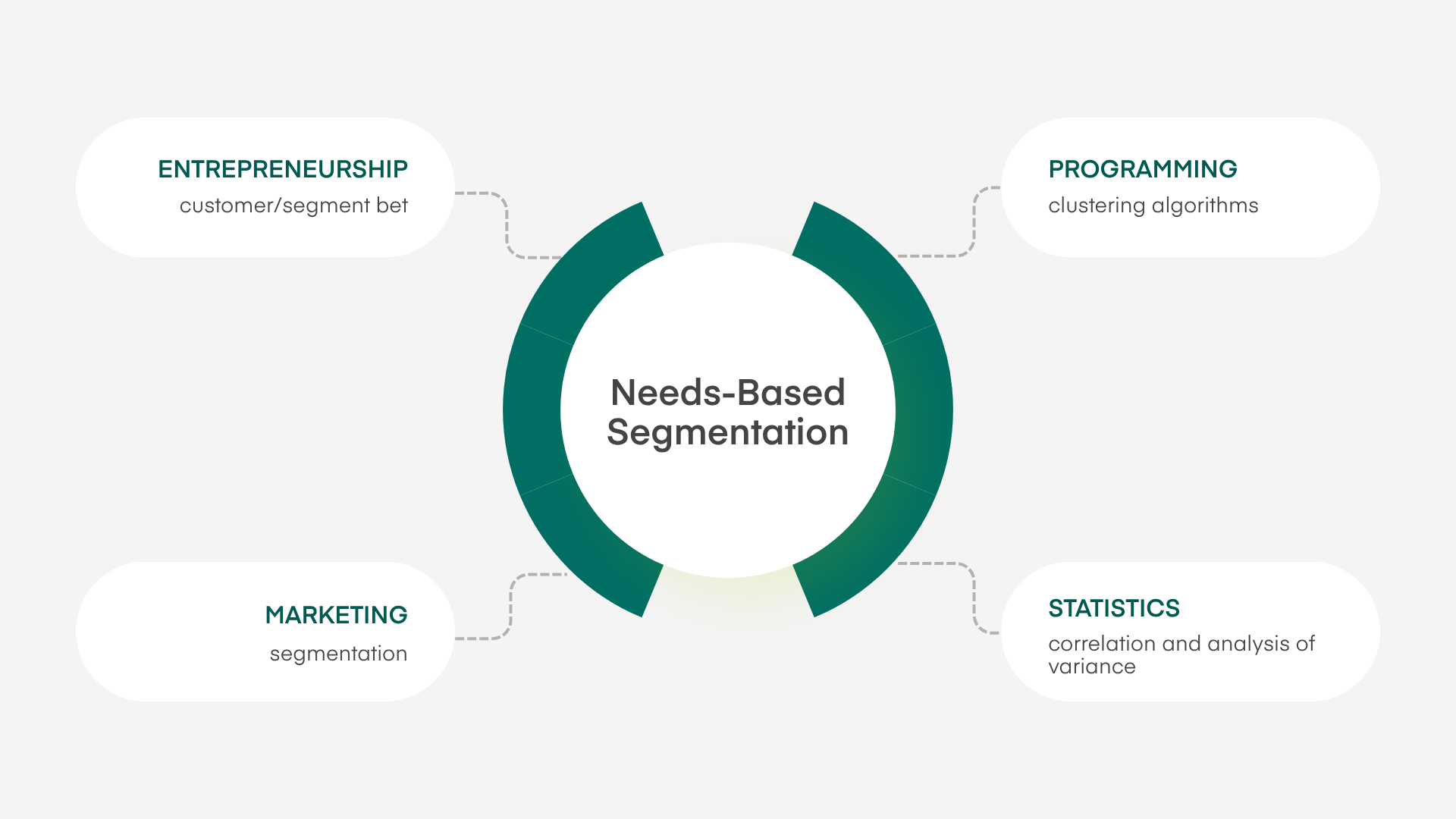
The same underlying reasoning can appear in multiple disciplines under different names, making connections difficult for students to recognize.
The first step is for schools to recognize meaningful connections across courses. For instance, at my school, I have seen business communication and statistics faculty coordinate closely to create a joint assignment that strengthened both courses.
But generative AI can help make connections more broadly. Faculty can upload syllabi, learning objectives, and other curriculum materials to an AI platform, then the AI can identify recurring concepts and complementary topics. Rather than producing a simple list, the AI can deliver an analysis that ranks potential connections by reach, importance to program goals, and likely impact on transferable capability.
AI also can help identify instances where important concepts stop being reinforced across the curriculum. These might include cases where a topic appears in an introductory course but is never revisited or where it is confined to an elective even though it is central to program goals. In addition, AI can weight employer feedback against the curriculum to determine where a concept needs more emphasis or clearer placement.
Administrators and faculty can review the AI’s recommendations, decide which concepts deserve reinforcement, determine where those connections belong across multiple courses, and assign responsibility for maintaining them over time. AI can accelerate discovery and help the school prioritize opportunities, but the institution has to own the work of turning those opportunities into a coherent curriculum.
How to Make Ownership Visible
Discovering the missing connections is the easy part. The harder exercise is making those connections durable. Schools are more likely to succeed if they explicitly assign someone responsibility for making those connections—and if they pay attention to five different dimensions of the task:
Workload allocation. Does the school formally allocate time for this work, or do administrators simply assume that individual faculty will add this task to their teaching loads?
When instructors design cross-course connections on goodwill rather than allocated time, the work might succeed, but it often stays fragile. Cross-course connections are more likely to be strong when the work of designing them is counted as teaching. If the instructors who build those connections receive partial course releases—or some equivalent recognition—the work will become a formal and recognized institutional responsibility rather than an effort left to individual initiative.
But informal approaches also work. For example, instructors whose classes form a sequence can read one another’s syllabi and add sentences that emphasize the connections between their courses. They could also spend some time each term discussing where the concepts in their courses overlap and how they could spend class time making those connections visible.
Discovering the missing connections is the easy part. The harder exercise is making those connections durable.
Governance. Is any governing body explicitly accountable for tracing the connections across the curriculum?
The school could make a substantial investment in this dimension, perhaps by creating a standing integration committee that has a budget and whose meetings appear on the calendar. Or it could make a more limited investment, such as adding a recurring item to the agenda for an existing governing body.
A low-cost option would be for the core curriculum committee to ask each course owner to name one upstream and one downstream connection per term, then log the answers. After the committee reviews and analyzes the connections, it could determine which ones warrant deliberate attention. No matter which approach the school takes, it will be assigning—not assuming—responsibility for making connections.
Faculty development. Does the school sustain this work through faculty development activities, or does it simply encourage faculty to “be interdisciplinary”?
At Eller, one example of a well-funded integrated learning opportunity is the Eller Partnerships program. Faculty advisors, who are compensated for their time, are paired with five students representing different majors. Together, these interdisciplinary teams work on real company projects. In the most recent term, the Partnerships program supported 26 projects with 21 corporate sponsors and involved roughly 120 students and more than 20 faculty advisors. These experiences give both students and faculty tangible examples of how knowledge that is siloed in academia is integrated in the workplace.
Schools also can promote faculty development through internal grants or summer stipends that support paired-course design sprints aimed at producing reusable cross-course connections. Lighter-weight versions also work: Schools can invite faculty to attend recurring lunch-hour groups or contribute to a shared document of cross-course concepts that grows over time and survives faculty turnover.
Recognition. Is this work recognized in evaluations and promotion and tenure decisions, or is it left to discretionary interpretation?
The process of building connections will only become durable when a school’s review systems capture, name, and reward the work. A school might take the formal approach of adding a line to promotion criteria or a more general approach of asking about cross-course contributions on annual review forms. The test is simple: Would the person who did the work be able to point to recognition of it in a personnel file?
Schools have three options when it comes to connection-making: build it into the administrative process, quietly encourage it, or leave it to luck.
Coordinator roles. Is there a designated person responsible for maintaining connections over time, or does integration depend on informal effort?
Schools have three options when it comes to connection-making: build it into the administrative process, quietly encourage it, or leave it to luck. When no one person or office takes ownership of curricular integration, it’s up to individual faculty to take the initiative. Under these circumstances, integration rarely occurs across the curriculum.
Schools will find it relatively straightforward to make connections within a defined sequence. For instance, at Eller, our entrepreneurship program and our Master’s in Healthcare Management both pull faculty from across disciplines into core courses. Similarly, in our marketing minor program, students follow the same company through an evolving vignette across a sequence of courses, culminating in a case competition built on that shared history. The design is deliberate, and it endures because one department owns it.
However, extending that model across accounting, finance, operations, analytics, management, and entrepreneurship requires ownership beyond any single department. It is more likely to happen if the school provides release time to a designated integration lead who makes sure documented cross-course connections continue to be reinforced even if instructors rotate out.
Where the Framework Meets the Standards
Building durable cross-course connections along these five dimensions requires financial, logistical, and organizational investment, and those demands compete with other priorities. But as capabilities-based assessment becomes more central to accreditation review, such investment is growing more essential.
AACSB’s Global Standards emphasize that students must develop capabilities, and capabilities are developed when students connect experiences across the curriculum. In particular, Standard 5, which focuses on assurance of learning, asks whether learners are achieving a program’s stated competency goals.
To answer that question, schools might need to make responsibility for curriculum-level coherence more visible than it has ever been. Capability development depends on learning transfer and cross-context reasoning. In academic environments, both transfer and reasoning develop most reliably when cross-course connections are intentional rather than aspirational.
Technology may make connections easier to identify, but it’s up to the institution to decide which connections will become enduring parts of the curriculum. Before their school undergoes an accreditation visit or a continuous improvement review, administrators should ask: Who at our institution owns the responsibility for making connections? If there is no clear answer, capability development rests on good intentions rather than thoughtful design.