





AACSB Pulse: Leading With Knowledge, Caring, and Courage
 Podcast
Recorded at the Deans Conference in Toronto, host Eileen McAuliffe, AACSB's executive vice president, chief thought leadership officer, and managing director of EMEA, sits down with Minna Martikainen, rector at the University of Vaasa, to discuss how a leader’s identity influences their actions. As two women leaders, they explore the role of gender in leadership and whether it is—or should be—a factor in leading today’s business schools and beyond. They examine the following three big questions:
- How much of your leadership journey has been influenced by your identity as a woman, and how has that identity influenced the way you lead?
- How do you make sense of the uneven progress women have experienced in leadership opportunities in recent years, and what responsibility do business schools have to sustain forward momentum globally?
- What actions can institutions take to ensure that more women have access to—and support in—top leadership roles worldwide?
Transcript
[00:00] Intro: Welcome to AACSB Pulse, the podcast that tackles critical topics in global business education today, three questions at a time. We talk with deans, industry leaders, and other big thinkers about the trends reshaping education, leadership, and the future of work. AACSB Pulse brings these topics and more into sharp focus. AACSB Pulse: Three big questions. Bold answers. Better business schools.
[00:26] Eileen McAuliffe: Welcome to AACSB Pulse. I'm delighted to welcome our guest, Minna Martikainen, rector at the University of Vaasa in Finland. Minna has held numerous leadership and academic positions at the University of Vaasa, and other excellent institutions in Finland and in the U.S. Thank you so much for speaking with me today, Minna.
[00:51] Minna Martikainen: Well, thank you, Eileen, for asking me to join your discussion. This is a pleasure.
Question 1
[00:59] Eileen McAuliffe: You’re welcome. Let’s get started with our three big questions. So, given that you’ve had this extensive leadership journey in academia, how much of your journey has been influenced by our identity as a woman? And how has that identity influenced the way in which you lead?
[01:19] Minna Martikainen: I think that I very much agree that we lead partly with our own identity, our internal instincts. But then I think the leaders really are the learners. We learn all the time, and this is the way to make the leadership view the way and lead with the knowledge.
In my way, I would say that I have some probably very internal intrinsic values and one big one is caring. And I think that loving and caring is seen all the way in my work, partly also in our university logo, which is a heart, although it was established earlier of my rectorship positioning.
The other value, which is very deep in my thoughts, is caretaking. Take care of the matters in responsible way. And this is also seen very much in Finnish society.
[02:36] Minna Martikainen: We talk about comprehensive security, resilience, and that this kind of care-taking in that way, I would say the Nordic values.
[02:46] Eileen McAuliffe: Some of the things you said there really resonate with me. Leading with kindness, caring. But it’s not to be mistaken for weakness, of course.
[02:56] Minna Martikainen: Absolutely not. I think it actually requires strength at the same time to show the values of caring. Very often leadership is thought to be, expected to be, strong roles and that kind of resonating, not thinking that widely, making only rational a decision based on figures and numbers.
My academic area is accounting and finance, so I would say that I can really resonate on the numbers, KPIs, and goal orientation, and at the same time inbuilt with the caring.
[03:46] Eileen McAuliffe: Yeah, that’s great. It’s great. So, when you’ve been a woman in a leadership role, you can kind of observe the leadership pipeline coming after you—you can see the men and females coming through the pipeline.
Are there any particular inflection points where you’ve seen being a woman in a leadership pipeline has changed your self-perception of yourself or others’ expectations of you? So the way in which you have moved through—I mean you’ve had a very successful leadership career, but while you were working your way through, what were the, what were your self-perceptions or what do you think the expectations of others were of you as you progressed through your leadership career?
[04:37] Minna Martikainen: Indeed, I would say that the expectations are always changing, and you feel it when you have and when you start a new position. And this is exactly what I meant, that leadership is learning and it is actually joint learning with your superiors, like university board or boards and the faculties or the employees. You will be set up the goals by somebody else. You can have your own impact with the goals if everything goes really well.
If you don’t observe, actually you can’t lead.
But this is also the first stage of learning. You need to figure out, what are the expectations set for you, and then work with an organization. And that is constant learning. And that has an impact on you. You are the observer, and if you don’t observe, actually you can’t lead.
[05:46] Eileen McAuliffe: So, giving yourself the time to reflect on your leadership and your journey, because no two days are the same. But it’s as you grow into your leadership role, it’s reflecting on how you develop given the circumstances, given the goals, the metrics that you’re given. I really like that concept.
Let me ask you something else here. So some people would argue that gender shouldn’t be a focus in leadership discussions and that good leadership is simply good leadership regardless of gender. How do you respond to that perspective?
[06:25] Minna Martikainen: I would say that diversity should be in the focus of leadership. And why? Because only diversity in the leader’s mind-setting or with the group you are leading can make sure that you have a large variety of different views, different metrics. When you make your decisions, if your own head is too narrow-minded, you will only get certain type of decisions and having impact on future, maybe even the whole societies like we see.
[07:09] Eileen McAuliffe: Yes.
[07:11] Minna Martikainen: So whether it’s called gender or diversity, but inclusiveness, to have different views, and to make decisions based on large views is very important.
[07:26] Eileen McAuliffe: Yeah, I agree with you. I think creativity in leadership teams stems from diversity.
[07:33] Minna Martikainen: Absolutely.
[07:35] Eileen McAuliffe: And without that you tend to have a very—in my experience as a female leader, I tend to observe very myopic kind of views, you know, kind of one track. And then when you change the leadership team, you know, it evolves into a kind of more inclusive or diverse team, you do get the kind of, you agree to disagree, but you disagree in a rational, sensible way. But it's a kind of an agreed way.
Let me ask you another one. What experiences or turning points defined your leadership philosophy? Have you got some examples? Because you were at Hanken before Vaasa, another very successful school. You must have seen some interesting stories, situations that you’ve navigated or, you know, as a female leader, where you have shown particular strengths, where all around them were losing their heads perhaps, or...
[08:27] Minna Martikainen: Yeah, I would say that my lessons learned very often are that different views bring like new paths that you would not even think about, and that makes better decisions. Like my experience in Swedish-speaking business school, being my mother tongue Finnish, so it definitely gave different views into different decision-making bodies, and then in the discussions. And I think that to make that constructive discussion is very fruitful, and there I learned a lot and I think that also the organization learned quite a bit.
My lessons learned very often are that different views bring like new paths that you would not even think about, and that makes better decisions.
Question 2
[09:25] Eileen McAuliffe: Yeah, great. Let’s move on. We have question two here, which is zooming out. So we’re coming out from your schools and out from Finland, but let’s zoom out a bit and look at the global landscape of leadership because it is a—how do some people describe some of the current situations we’re in—as a hot mess?
You know, there’s kind of geopolitical turbulence. In our region we have, up until recently, two wars going on. There’s quite a lot of turbulence, and we need good leadership in our schools. So across the world, opportunities for women in leadership have grown, but progress is not consistent. And it almost feels to me that it’s a bit of a stop-start.
[10:13] Eileen McAuliffe: So there’s a focus on it for a while, female leadership, then you see the progression, and then the focus drifts away to something else, and it stops. And then, you know, you sort of see this step change, but it’s very slow, some might say.
So, in some places, I think we even see regression. We even see it going a bit backwards as well. So, how do you make sense of this uneven progress, and what responsibility do business schools have to sustain forward momentum on a global scale?
[10:46] Minna Martikainen: I see clearly that the number one responsibility is for the business educators. If we think that the businesses are the units leading the economies of societies, and most largest percentage of the leaders are educated in business education institutions. So the business schools have a huge responsibility how the landscape looks like in future forthcoming years, and that can be progressed with our leadership to show the way to see the equality opportunities, diversity in business management. And we have a huge role on that.
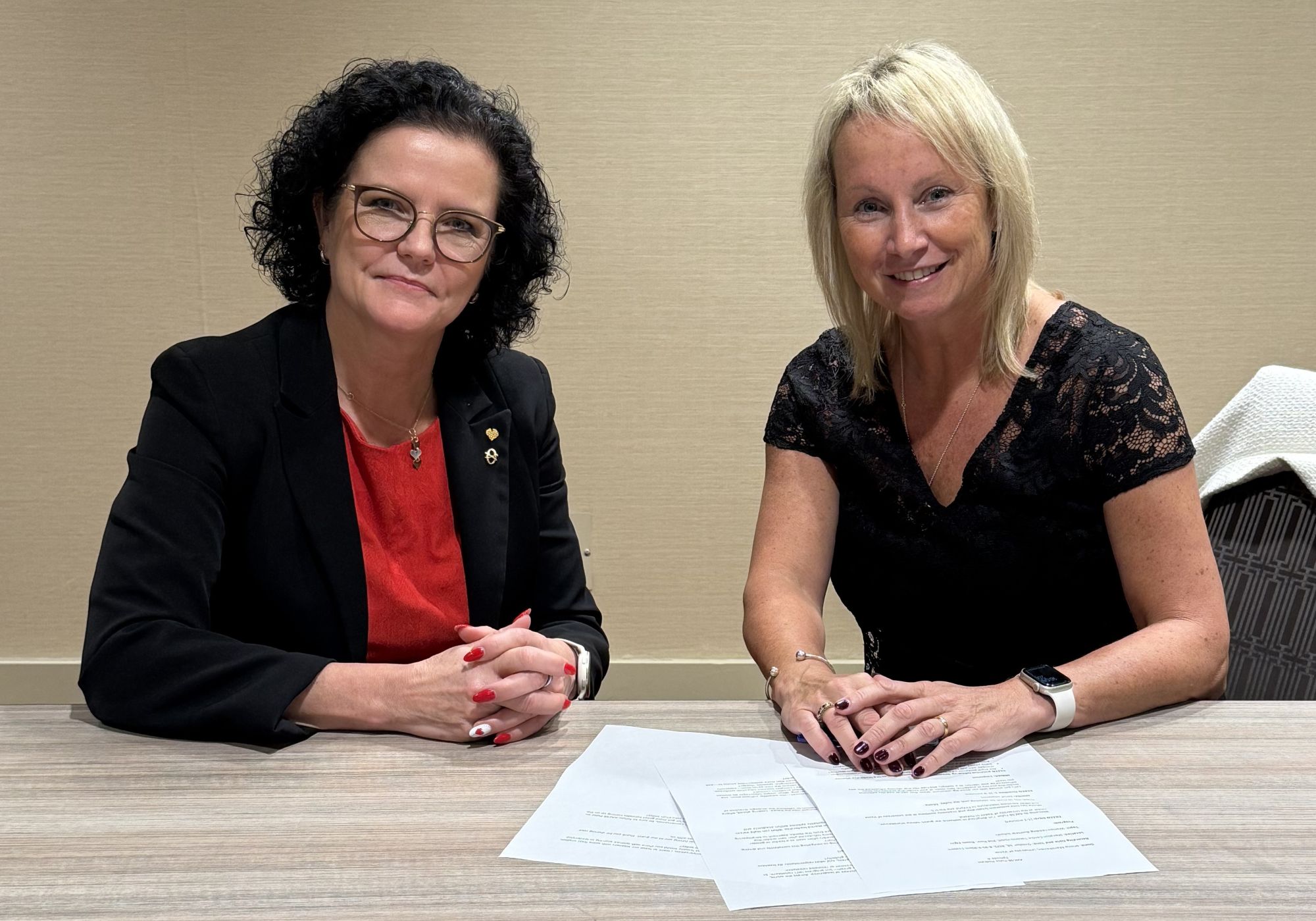
Eileen McAuliffe (left) and Minna Martikainen (right) take time during AACSB's Deans Conference in Toronto to record a podcast episode.
[11:38] Eileen McAuliffe: Yeah, we do have a huge role. Earlier today were talking about impact and the possibility of impact ratings. I mean, this could be a dimension for a school bringing forward their learners, helping them to recognize their place in the global world, and to go forth and create impact, which I know your school is very passionate about.
So moving on. Your school is well known for innovation, particularly in the energy and sustainability field. Do you think that women bring some unique perspectives to navigating complexity and driving innovation across global business education?
[12:19] Minna Martikainen: Absolutely. They bring, again, with the view of diversity. They, I think historically, starting how the human beings are developed, females and males, we simply had different roles in lives. Of course, by the hundreds of years, probably they developed to the same direction, but now simply the view of thinking mind-setting is different.
And then to bring that actually there is scientific research already shown in variety of research, that if you have more diversity in research groups and innovations in startups, you simply have different paths of growth. And I think that it’s really our responsibility to see that we have the equal opportunities for all, and this is the way to do that.
[13:24] Minna Martikainen: However, having said that, I would like to raise up that it is everybody’s responsibility, females for themselves to be involved in that view, that they need to see it similarly: I want to participate, this is me who is going to make the impact, and not to expect that somebody is doing it for you just because you are female. This is not the way to do it.
[13:55] Eileen McAuliffe: Yeah, so I have this conversation with a lot of young colleagues and people that you meet along the way, and my advice is you take ownership of your own destiny. It’s your responsibility. If you’re unhappy, do something about it.
But I think you’re spot on with that comment that, you know, you can have mentors around you that will support you, but at the end of the day, you have to have responsibility for yourself, for your own future, for your own brand and where you want to be. So I think you’re completely clear on that.
Let me move along here, because you’ve built your career in Finland, which is a beautiful country. I visited it very recently and I loved every minute of it. And it’s a country that is often seen as a leader in gender equality, and it’s well known for that.
[14:47] Eileen McAuliffe: So how has that cultural environment, do you think, influenced your own leadership journey? And what can other regions learn from the Nordic philosophy around equality that empowers women in higher education, or certainly in business education?
[15:10] Minna Martikainen: Yes. Finland, of course, is very well known about having the female rights in early years of everything, voting, and at the same time carrying the responsibility in the work life. And this came with our, unfortunately, history of many wars. And I think that shows in our culture, of course—welfare society, everyone having the same possibility for free education. And this is, I think, where it starts from. We don’t have closed doors, depending on the families where you come from. We have only open doors because you can select.
[16:03] Eileen McAuliffe: Yes. So you mean the socioeconomic piece doesn’t feature as much; you select based on the entire community or the entire population.
[16:13] Minna Martikainen: Exactly. I think this is one of the main starting points. And at the same time, when coming to our history, I said that women participating for the work life, that becomes the DNA of I can, with the opportunities to have the education and then society supporting, for instance, very good child care, healthcare, and then the attitude which is built in our DNA, that I can and I do it. So, carry responsibility of your own doings. I think it’s a very Finnish and very Nordic way.
[16:57] Eileen McAuliffe: It’s a very strong mindset.
[16:59] Minna Martikainen: It is.
[17:00] Eileen McAuliffe: But it’s a very strong mindset that’s been presumably generations embedded in your philosophy as a country which stands you to good stead, I think. So, real progress, some might say, some might say, real progress in equity often depends on shared leadership. What can male voices contribute to building more balanced, equitable systems within academia, but more importantly, business education, do you think?
[17:28] Minna Martikainen: I say quite often in my own management group that I want views. If we have a problem, if we have a question to be found out the solutions, I say that I want views. I want different views. I don’t want any yes, yes, yes views. I want different views. And then, I think, everyone has a role there with the different views. And this is for the males and equally for females.
[18:01] Eileen McAuliffe: I think in Finland that’s obviously very well respected. I think in some other countries, there can be situations where some male leadership teams have stronger voices than females. So there’s a lot to learn from the Finnish model here in terms of the way it’s balanced and the way you approach things.
Question 3
[18:22] Eileen McAuliffe: Let me move on. Our final question—question three—of our three big questions. So I want to take us both into the future. I mean, we’re kind of, you know, impressive ladies. We’ve enjoyed our careers. We’ve done really well. We’re fortunate to have made, you know, so many friends and great colleagues over the years, and we are blessed. We are lucky.
But looking ahead, where do you see the greatest opportunities for women to influence the strategic direction of business schools worldwide?
[18:57] Minna Martikainen: I think women can have the absolutely largest impact stepping up, stepping forward into leadership roles. And reason being that we simply need much more diversity. I think quite groundbreaking is that 1 percent of all human beings in the world own almost 50 percent of financial net assets globally. One percent?
[19:36] Eileen McAuliffe: Yeah, wow.
[19:37] Minna Martikainen: And we created, we human beings created this like that. Is this the way to go forward next 50, 100 years? I think much more responsibility on diversity is needed so that we have better well-being.
I think women can have the absolutely largest impact stepping up, stepping forward into leadership roles.
[19:59] Eileen McAuliffe: So are you arguing for a greater distribution of that wealth of assets going forwards?
[20:06] Minna Martikainen: It is not built like that.
[20:08] Eileen McAuliffe: Yes.
[20:10] Minna Martikainen: That can be diversified with only major changes.
[20:15] Eileen McAuliffe: Yes.
[20:16] Minna Martikainen: But thinking how we led our way to this stage is probably quite narrow paths with not diversity. Otherwise, it would not be only 1 percent. Diversity is needed to see what type of globe we want to be leading our way forward next 50, 100 years.
[20:41] Eileen McAuliffe: And how do you see the female voice manifesting? We lead our schools, we lead our universities, and that itself is telling a story—when people look back over history, they’ll see this development. What other forums do you think we as female leaders should be advocating in or talking in to try and create a stronger path, stronger pipeline for the future of female leadership?
[21:15] Minna Martikainen: I would say seek leadership roles, but seek the role with the help of knowledge. And this is the role of academia. Not only that we have female leaders, but be analytic, strategic, and then with the help of knowledge to be and to show what is the role of academic knowledge and to make the leadership around it. And to be visible, not to be in the shadows.
[21:48] Eileen McAuliffe: And that visibility, I mean, there’s plenty of forums around the world. I mean, in your kind of typical year, are there other forums that you would represent at, you know, around the world, or different kind of conferences that you would go to where you would advocate for female leadership, or just by being there, you know, you’re in yourself, you’re advocating for…
[22:13] Minna Martikainen: Well, of course, the research. Everybody typically in academia have their own field of research. To be very active in your teaching, research, education roles.
[22:30] Eileen McAuliffe: Yes.
[22:31] Minna Martikainen: Then of course, like we’re doing here now—to show up in the leadership, to be participating these global networks like AACSB—it’s hugely important because this is the way to show actually what we do in different parts of the world and to show the best practices. The most important.
[22:56] Eileen McAuliffe: Yeah, it’s very powerful, I agree. So as we come through to sort of the end of the key three big questions, what actions can institutions take to ensure that more women have access to and some support in top leadership roles worldwide?
I mean, you’ve got to the top of your institution. I know we have many other mutual female colleagues leading very impressive institutions, but it wasn’t an easy journey for you, was it? I mean, what sort of support do you think would be good to put in place for future leaders?
[23:34] Minna Martikainen: I think, first of all, it’s very important to talk about it. It’s very important to show that difficulties, challenges, and feeling of being too small is more than natural. And no one is like a power person by itself. You can grow. Like I said, it’s constant learning. And I think that we simply have to show our way, teach about it, talk about it.
But then of course, see in organizations that we recruit in an equal way. We try to maximize it, to do it in an equal way. However, it has to be justified. And there, I think the role of knowledge is the most important. We always have to show that this is why you are competent. You did this, this is your record. And then to make the best out of it.
It’s very important to show that difficulties, challenges, and the feeling of being too small is more than natural.
[24:42] Eileen McAuliffe: So here’s something that’s a little bit contentious is, some women might say that, to be equal to men, I have to better, I have to be more competent, I have to have published more, I have to have achieved more. Do you think that’s true, to be comparable with a male counterpart?
[25:01] Minna Martikainen: According to my experience, it’s not true.
[25:06] Eileen McAuliffe: Okay, great.
[25:08] Minna Martikainen: But—I would say but it requires that you show yourself off. It might be natural for females to a little bit stay in the shadows. It might be a little bit more difficult to say that, this is what I think.
[25:31] Eileen McAuliffe: Yes.
[25:32] Minna Martikainen: And, here, I think that we have to go inside in our inbuilt systems and say I can and I will, and then it’s equal.
[25:44] Eileen McAuliffe: Okay, great. That’s a great point to end on, thank you.
But before we do, I want to leave our listeners with some final wisdom from you, Minna. So what lessons would you share with women aspiring to leadership roles in business schools today?
[26:00] Minna Martikainen: Lead with the knowledge. Lead with the knowledge in the way that you use analytics so that you are fair and you’re offering equal opportunities. And encourage. If you see that somebody is shy, not willing, by the nature, willing to show up, ask for different views to make your decisions more thorough.
[26:31] Eileen McAuliffe: Yeah. And circling back to where we started, you talked a lot in your, in the first part of this interview around caring. So presumably it’s great to have the knowledge, the analytics, the data, but also have that wraparound being mindful of, you know, sensitivities and caring about people and bringing people along. So that’s kind of gone full circle.
Minna, that’s great. And it’s been such a treat here in the Deans Conference in Toronto in Canada. So thank you for sharing your journey and your perspective with us.
[27:03] Minna Martikainen: Thank you, Eileen. I really love to have this opportunity with you.
[27:07] Eileen McAuliffe: And to our listeners, if you enjoyed this conversation, be sure to follow AACSB Pulse on AACSB Insights, Apple, or Spotify. We’ve got more great episodes coming up on the biggest issues shaping global business education today.
About AACSB Pulse
A podcast produced by AACSB International, AACSB Pulse explores current topics impacting global business education—three questions at a time—with business school deans, industry leaders, and other big thinkers of today.
To receive new episodes, make sure to sign up for AACSB’s email newsletter, LINK, or subscribe to AACSB Pulse on Apple Podcasts or Spotify.
 Article
 Video
Video