





Redefining Executive Education in Turbulent Times
 Article
- To weather upheavals, business schools must answer ontological and epistemological questions: What is executive education, and what counts as valid knowledge within the field?
- Recent social and political disruptions such as Brexit, the COVID-19 pandemic, the AI revolution, and geopolitical realignments have forced schools to rethink the paradigms they’re teaching and the students they’re serving.
- As new leadership models arise in the Global South, particularly China and India, a more pluralistic view of management education is offering an alternative to the dominant Western-style perspective.
Executive education is a multibillion-dollar industry. Employers invest heavily in the development of their leadership pipelines, and thousands of executives enroll each year seeking transformation. Media outlets develop rankings that measure the impact of executive education in terms of a student’s skills and employability or a school’s market share and reputation.
Yet rarely do any of these stakeholders pause to ask a basic question: What is executive education for?
The question is underpinned by two broader ones related to the concepts of ontology and epistemology. Ontology is about assumptions of being: What is executive education? Epistemology is about assumptions of knowing: What counts as legitimate knowledge within the field? While these might sound like philosophical abstractions, they are, in fact, practical considerations.
For decades, executive education has been dominated by a 20th-century North American paradigm of management—one rooted in economics (productivity, efficiency) and psychology (motivation, behavior). Aspects of education such as philosophy and ethics were marginalized, relegated to optional modules if they appeared at all. Peter Drucker once noted that “Management is doing things right; leadership is doing the right things.” For too long, however, executive education has focused overwhelmingly on the former.
The result is a narrow epistemology. What “counts” as knowledge is largely instrumental—strategy frameworks, financial models, behavioral assessments. This orientation has served corporations well during stable times, but it falters in today’s volatile, uncertain, complex, and ambiguous (VUCA) world.
Consequently, a third, more urgent question might be: What happens when the philosophical foundations of executive education are disrupted?
Brexit as an Ontological Shock
Political and social upheavals can shake executive education at its foundations. One vivid illustration is provided by the 2016 Brexit referendum and its aftermath.
Brexit was more than a political realignment; it was an ontological shock to British higher education. For decades, executive education in the U.K. had rested on a cosmopolitan ontology—an implicit belief in open markets, managerial mobility, and global integration. Brexit fractured that assumption. Schools suddenly had to demonstrate value to more domestically oriented organizations, public bodies, and small and medium enterprises (SMEs) navigating regulatory divergence.
I contend that, during the Brexit era, executive education in the U.K. experienced what British academic Mark Thomson has called ontological drift and shift. Drift refers to the gradual erosion of foundational assumptions. For example, leading U.K. institutions such as Oxford Saïd Business School and London Business School—long bastions of globalist managerialism—began to recalibrate their narratives and executive offerings. Brexit-related themes, from trade uncertainty to regulatory nationalism to domestic competitiveness, increasingly surfaced in events, discussions, and program content.
Brexit showed that executive education is shaped by political ontology—changing assumptions about who is served, what leadership means, and how knowledge is legitimized.
A shift, by contrast, is an abrupt reconfiguration. In the U.K., for instance, business schools quickly redefined their audiences to focus less on highly mobile executives from the European Union and more on participants from Commonwealth markets and domestic SMEs. Schools even targeted public sector managers enrolled in Senior Leadership Apprenticeship programs, which combine on-the-job training with university-level study.
Ethical and political commitments shifted too, as populist critiques of elite business schools forced programs to foreground inclusivity, legitimacy, and civic purpose. Schools forged new partnerships with institutions in Asia and Africa as their collaborations with European universities were disrupted.
Brexit functioned as an ontological shock: a moment when what executive education is had to be reconsidered. The epistemological corollary soon followed. Knowledge once prized for its global reach now seemed detached from local relevance. Participants wanted an education that provided context and moral direction, not just frameworks for competitiveness.
Brexit showed that executive education is not shaped just by market demand but also by political ontology—changing assumptions about who is served, what leadership means, and how knowledge is legitimized.
Any time executive education programs respond to turbulence, they will stand between these poles of drift and shift. Those that drift will simply digitize delivery or repackage content; they will teach “innovation” without changing their ontology. Those that shift will confront their epistemic assumptions and consciously re-examine what their institutions and programs are for. In the end, those that shift are better positioned to navigate turmoil.
Global Disruptions and Competing Worldviews
Brexit was only one of a series of systemic dislocations that have recently reshaped the field of executive education. The COVID-19 pandemic, the artificial intelligence revolution, and geopolitical realignments—such as the Ukraine war and trade frictions between the U.S. and China—each have redefined what it means to lead and learn.
These crises have forced business schools to pivot rapidly. Schools have moved from physical classrooms to hybrid ecosystems because of the pandemic. Geopolitical tensions have caused them to confront new ethical expectations around sustainability, inclusion, and digital equity. Together, such events have exposed the need for ontological agility: the ability to re-examine foundational assumptions when the external order changes.
Another issue that has challenged traditional executive programs is the recent call to decolonize higher education. While the terminology can provoke unease, when the debate is stripped of politics, it highlights a deeper question: Whose knowledge defines managerial competence and which realities do curricula serve? If decolonization is reframed as an effort at epistemic renewal, the movement can inspire schools to broaden the sources of legitimate knowledge they draw from as they design programs in management and leadership.
As distinct cultures generate diverse and intersecting managerial approaches, business schools must acknowledge the pluralization of what counts as legitimate knowledge.
Changing geopolitical realities also are causing business schools to rethink what constitutes leadership and how it should be taught in executive education courses. One powerful example is the rise of China’s Belt and Road Initiative (BRI), in which China is promoting international trade by investing in the economic development of more than 150 countries. BRI is not only an infrastructure project but also a knowledge project—a reassertion of alternative concepts of value, development, and leadership.
Many Chinese and regional business schools are exploring the ramifications of BRI through new programs. Examples include Tsinghua University’s Belt and Road Leadership Program, Fudan University’s Belt and Road Executive Education series, and Silk Road Business School’s Global Cooperation Network.
These programs challenge the dominant Western managerial paradigm, which is grounded in liberal individualism and shareholder capitalism and treats knowledge as universal and transferable. By contrast, the BRI framework, which is relational and state-coordinated, relies on harmony and interdependence. That approach is reflected in business programs that stress Confucian ideals, connectivity, and pragmatism.
Similarly, new managerial approaches are arising in India, where management is considered a plural, dharmic responsibility. There, business schools are creating programs that show managers how to fuse their moral duty with adaptive pragmatism. For instance, the Indian Institute of Management Bangalore runs an executive series on Ethics and Spirituality in Management.
Additional alternatives to the universalist Western viewpoint are provided by communal leadership models from Africa, Asia, and Latin America. When Catholic social thought, Confucian relational ethics, Islamic finance principles, and African Ubuntu philosophies are integrated into executive education, they provide more than ideological diversity—they provide ontological reconstruction. They reground management education in the plural moral and cultural orders shaping the 21st-century economy.
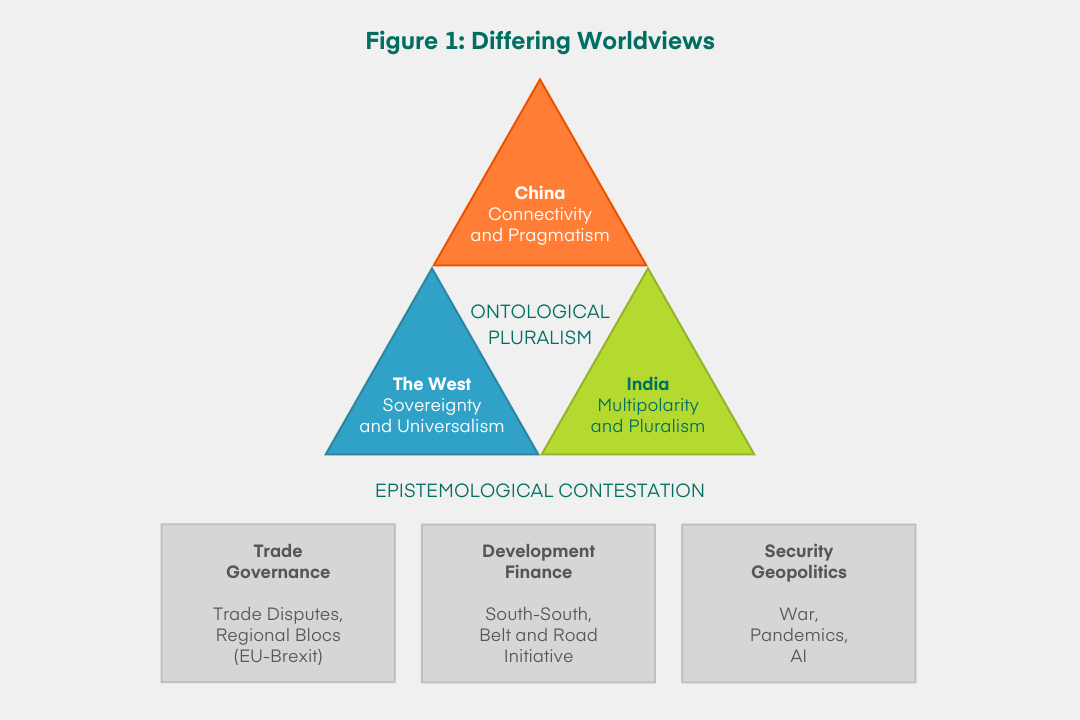
Management paradigms in China, India, and the West offer contrasting ontological and epistemological assumptions.
Today’s management worldviews are competing and multipolar (see Figure 1 above), and a 2024 report from the World Economic Forum underscores the importance of understanding these different values. As distinct cultures generate diverse and intersecting managerial approaches, business schools must acknowledge the pluralization of what counts as legitimate knowledge by creating programs, partnerships, and laboratories where researchers can study different approaches. As business schools acknowledge and draw from multiple intellectual lineages, they will recover both global legitimacy and moral coherence.
Commercial Success and Societal Good
Institutions that operate from a plural ontology do not simply consider diverse forms of leadership as legitimate. They also accept that business education does not rest on a single conception of knowledge or purpose, generally defined as commercial success. They acknowledge that their programs also must examine leaders’ civic and moral responsibilities.
A few institutions are already launching executive education initiatives and innovation spaces that train leaders to align profit with purpose:
- Oxford Saïd Business School’s “Leadership in Extraordinary Times” podcast convenes leaders across sectors to discuss moral courage under crisis.
- INSEAD’s “A Force For Good” campaign reframes management as an ethical enterprise that joins economics with anthropology.
- ESADE’s Center for Social Impact connects executives, faculty, and social entrepreneurs to test ethical business models.
- The University of Limerick’s Kemmy Business School has launched a new Executive DBA in Leadership, Sustainability and Systemic Transformation. Its design and delivery explicitly integrate systems thinking with an underlying philosophy of inquiry, deep reflexivity, and praxis.
Through these initiatives, plural ontology becomes a design principle for epistemic ecosystems, where economics, ethics, and experience co-produce meaning.
Institutions that operate from a plural ontology consider diverse forms of leadership as legitimate and accept that business education does not rest on a single conception of knowledge or purpose.
Plural ontology thrives at schools where faculty research is integrated into executive learning through practical exercises. Finance scholars studying environmental, social, and governance disclosure could run board simulations. Organizational theorists exploring trust could embed ethnographic insight into diagnostics. Ethicists could create labs designed to track how moral decisions are made.
Through this lived experimentation, executives have a chance to co-create knowledge, and schools have an opportunity to align their programs with AACSB’s impact standards.
Stakeholders and Their Competing Claims
Because of their knowledge contributions, faculty can help ensure that executive education weathers any upheaval. But the truth is, faculty make up just one group of stakeholders who hold important roles within schools. Executive education is a contested field where different stakeholders carry competing ontological and epistemological assumptions. As Figure 2 illustrates, three actors dominate:
- Participants see education as a transformative career and identity project. They value experiential, peer-validated knowledge: learning from action, coaching, and cohort exchange.
- Employers and corporate sponsors view it as a strategic investment. For them, knowledge is legitimate when it delivers measurable ROI: tools, frameworks, and improved performance outcomes.
- Business schools consider executive education a product that balances academic rigor with market relevance. They impart evidence-based, research-informed knowledge that also has practical applications.
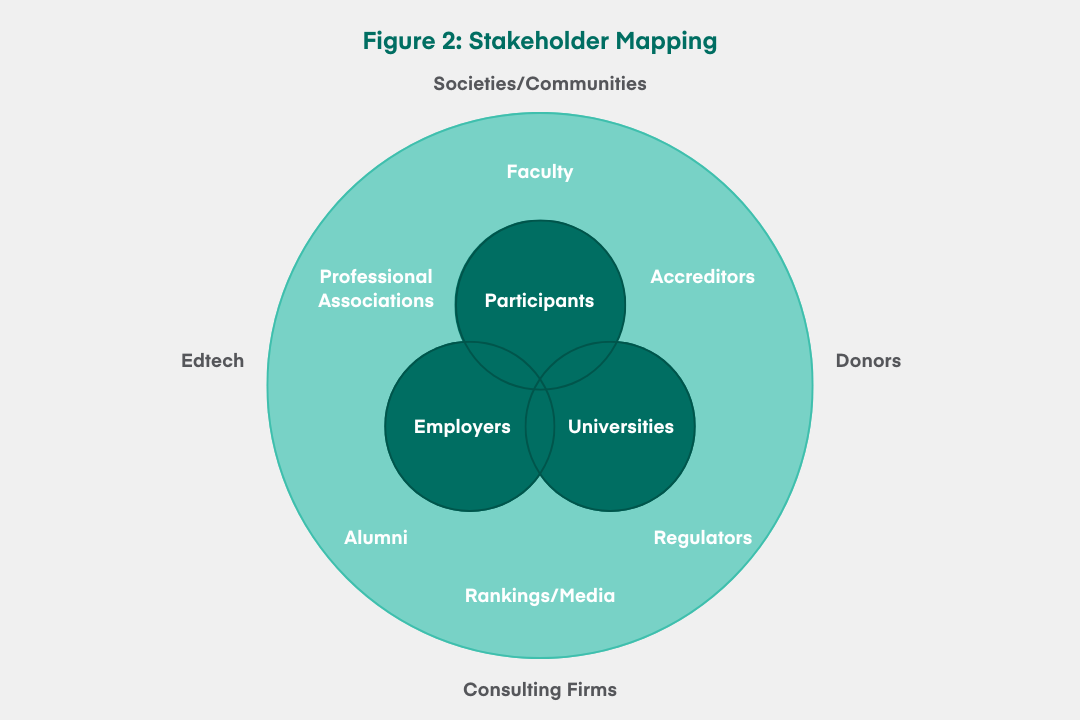
Executive education programs are shaped by the competing interests of eight groups of stakeholders.
Surrounding these three groups are other influential stakeholders:
- Faculty emphasize conceptual and analytical knowledge, but they often struggle with the demand for relevance.
- Accreditors (AACSB, EFMD, and the Association of MBAs) impose standards-based epistemologies that privilege auditable metrics such as learning outcomes and faculty qualifications.
- Governments and regulators prioritize compliance knowledge that can be used to underpin visas, prove accountability, and meet national skills agendas.
- Rankings organizations and media outlets reduce knowledge to indicators such as salary uplift or internationalization.
- Alumni and professional associations bring relational and competency-based perspectives.
- External stakeholders—society, donors, consulting firms, and edtech providers—all reframe executive education from different perspectives. They might consider it a mission-driven lever; a proprietary consultancy tool; a scalable platform of modular, data-driven microcredentials; or a forum for addressing ethics and environmental, societal, and governance issues.
Executive education must negotiate through a pluralism of perspectives, while also navigating external societal disruptions.
Resilience and Renewal
The turbulence reshaping executive education parallels upheavals in the wider world. The rules-based order that governed much of society after World War II began to fracture in the late 20th century as plural realities took hold. Business schools, like multilateral institutions that address common societal problems, must cultivate epistemic resilience to cope with these significant changes. They must be able to sustain dialogue among competing truths without collapsing into relativism or dogma.
The legitimacy of executive education depends on its ability to adapt ontologically and epistemologically when confronted by new realities such as Brexit, pandemics, AI, and a contested world order. Schools cannot merely update their content—they must reconstitute what counts as knowledge itself.
As they adapt to changing conditions, institutions can fulfill AACSB’s vision of a world where business schools contribute to societal good by cultivating leaders who can think across moral, cultural, and epistemic frontiers. In an uncertain world, those able to learn through plurality will shape the institutions that endure.
 Video
Video