





VR and AI: A Dream Team for Teaching and Learning
 Article
- During traditional role-playing exercises, some students focus more on their real-time performance than on the long-term development of transferable skills.
- Educators can combine virtual reality and artificial intelligence technologies to create controlled environments where students can practice interpersonal skills repeatedly and receive feedback tailored to specific learning goals.
- Used together, VR and AI make learning more inclusive and give students more space to experiment, reflect, and practice without the pressure of a live classroom exercise.
Many key concepts and challenges in the management curriculum are highly personal in nature—from the intricacies of negotiation style and the nuances of leadership tendencies to the effects of personality on communication and the psychological pitfalls of strategy formulation and execution. Unfortunately, standard learning environments are often not conducive to helping students fully master topics that are dependent on such personal idiosyncrasies.
As an educator with more than 20 years of classroom experience, I am convinced that emerging technologies such as virtual reality and artificial intelligence have transformative potential to enhance the way we teach these “soft skills.” VR and AI are not simply new tools. They offer entirely new ways for us to teach topics that require personal skill and adaptation—particularly in simulations and role-playing exercises. But students will only realize this benefit if their schools fully capitalize on these opportunities.
The Status Quo of Management Education
Because negotiation is the area I know best through direct experience, I will begin there. The dominant mode of teaching negotiation is for faculty to engage students with entertaining role-play “deal-making” exercises; then, faculty debrief them on their performance by showing them how (usually poorly) they did. Rinse. Repeat. Hundreds of exercises have been written for this purpose, by some of the best negotiation minds in the world. These activities are clever, fun, and provide opportunities for insight through “gotcha” moments.
However, these approaches allow for various biases and aggressions to play out in ways that are artificial at best and harmful at worst. For example, many of these exercises are forced into tight teaching windows, with limited time for preparation. The resulting uncertainty that some students experience can manifest as cognitive pitfalls, such as confirmation bias (relying on cases that confirm what they already know rather than seeking those that offer deeper meaning), availability (using only the most salient information, ignoring minor but critically important details), and projection (assuming that others think in similar ways as they do).
These shortcuts invite student interactions that can either be miserable (if biases hurt them) or satisfying (if biases help them), but often not illuminating. Further, these interactions can be so stressful that afterward many students might not have the cognitive capacity to step outside that role and learn what actually happened and why. The result? Students learn how they experience in-class role-playing, but do not cultivate deeper knowledge for how they should conduct their own real-world negotiations.
This problem extends far beyond negotiation classes. In courses in leadership, strategy, communication, or any other domain where students synthesize and debate cases, there is a performative aspect to their learning that can inhibit rather than encourage participation. Moreover, when some students don’t speak up, we sometimes view our nonparticipating students, and not the exercise itself, as the problem, ignoring how the context we have created facilitated that stressful experience.
Our task as educators is to enrich the conventional classroom experience by mimicking the real world, providing great feedback, and allowing students to practice without cognitive-restricting anxiety. Integrating VR and AI satisfies all three of these criteria.
VR and Inclusivity
VR supports equitable learning by creating standardized learning environments and experiences for both distanced and co-located learners. VR is immersive, visual, engaging, and appealing to students. It levels the playing field while ensuring rigor.
It may seem paradoxical to use technology to explore the intangible, often emotional, dimensions of leadership. Yet Alon Epstein, co-founder of VR educational provider AVRIS Technologies, calls VR “an empathy machine.” He cites as an example a negotiations module that his company co-designed with educators from INSEAD in France, titled “Negotiating the Future of Spiral Flow.”
Using 360-degree video and scripted content performed by professional actors, the module simulates a tense negotiation between a founder of a South African corporation and the CEO of one the organization’s subsidiary companies based in Abu Dhabi. The learner plays the role of a mentor assigned first to one counterparty, then the other. As the negotiation progresses and the learner absorbs contrasting opinions from the two sides, the VR module imparts key lessons about how subjective feedback and pre-existing bias can skew an individual’s impressions during a dynamic negotiation.
VR creates standardized learning environments and experiences for both distanced and co-located learners in a way that is immersive, visual, engaging, and appealing to students.
“This brings [to bear], in such a vivid way, how our prejudice, our predisposition, and the information that we hold influence our perception of reality,” Epstein says.
In addition, VR can be deployed in a way that can help learners feel represented. Given the modest (at best) progress made toward diversifying the student population at many business schools, inclusivity increasingly depends upon underrepresented students being able to see their own identities reflected in their learning environments.
For example, AVRIS’ “Mission to Mars” module transports learners into a science-fiction scenario with genre-appropriate character diversity. The “Star Trek”-like team of five high-performing astronauts includes representation from Asia, Europe, Africa, and the Middle East.
Students can also control how they appear within the VR platform by creating their own avatars. For, say, transgender students grappling with self-consciousness around their gender identities, this functionality can create a stronger sense of belonging. They might not achieve the same level of learning while taking part in a stressful in-person exercise.
AI as Training Partner
With VR, students can stop, start, practice, try things out, and repeat the experience, all while getting real-time feedback on their performance. It’s a pedagogical tool we simply didn’t have before. On its own, however, VR can offer only one-way, standardized feedback based on general learning objectives.
By adding AI tools, we can generate a feedback loop that tailors the interaction to the needs of individual learners. This loop provides students with room to adapt and allows them to repeat exercises to strengthen specific skills.
I gained firsthand experience with these advantages as the academic and content advisor for Sage’s recently released module, the Negotiation and Conflict Management Skills VR Experience. In this role, I drew upon both classroom exercises I have developed and material from a negotiations textbook I have co-authored with Claus Langfred, Matt Cronin, and Jimena Ramirez-Marin. This module uses technology from Bodyswaps, a U.K.-based educational VR company that allows learners to observe their own mannerisms, demeanors, and body language via a motion-capture avatar.
Recently, within the online learning platform, I augmented the VR training with an AI boot camp designed around specific learning goals. The VR environment in the Sage module is far more inclusive and engaging than a textbook; the technology provides a realistic, interactive way to introduce nuanced interpersonal concepts, such as reading body language, making small talk, and leveraging influence. The AI component gives learners a personalized forum to onboard what they’ve learned, because instructors can program the AI to train for specific skills.
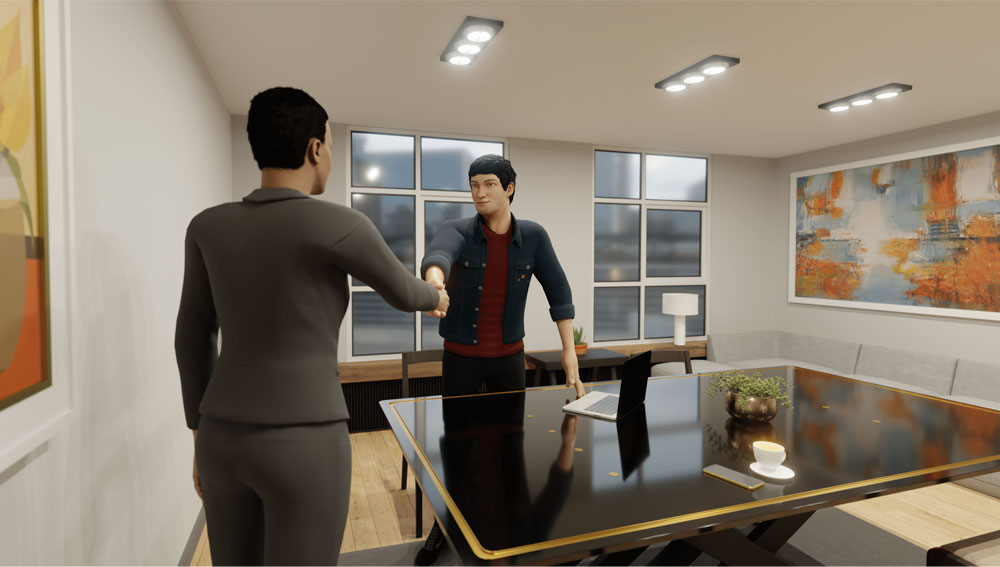
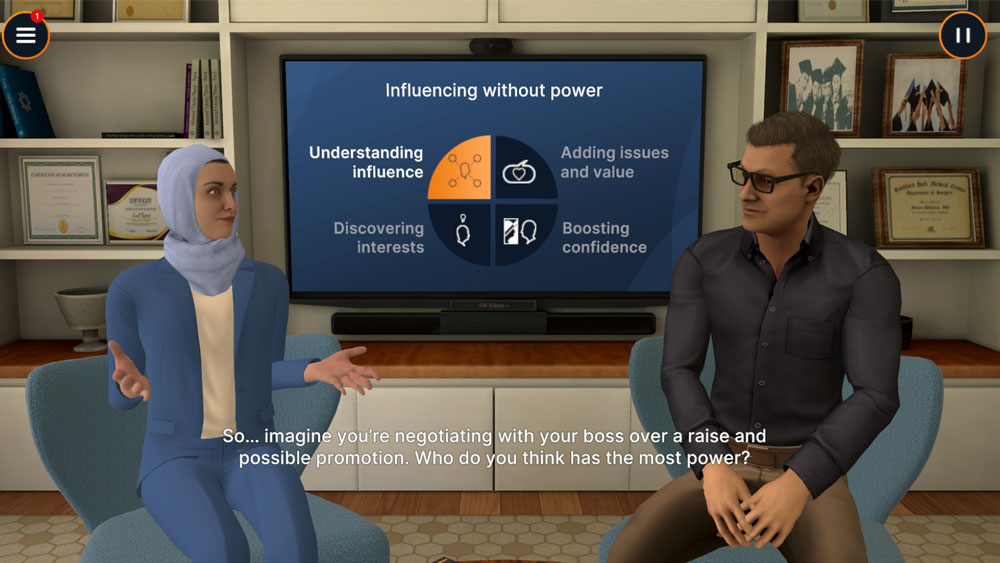
The Sage VR module places students in a virtual environment where they choose their own avatars and practice negotiating skills, such as asking for a higher salary, with an AI chatbot in real time.
For example, one crucial but complicated attribute of effective negotiations is perspective-taking—the ability to understand a counterparty’s point of view. When students negotiate with the AI in real time in my VR module, the chatbot notes how often they use interest-based language that gets to the heart of why a party might care about an issue (an indicator of perspective-taking), instead of position-based language, which seeks only to convince the other side of their point. In a salary negotiation, for instance, they might focus on how an employer measures value rather than solely on specific numbers.
I have used this combination in my last two negotiation courses. For example, I helped craft one scenario that puts students in the shoes of a mid-level designer asking “Santiago,” their hypothetical supervisor, for a promotion and salary bump. Their virtual interactions with Santiago, played by an AI-enabled chatbot, are complicated by true-to-life issues such as mixed performance feedback in prior evaluations and Santiago’s time pressures amid myriad stakeholder demands.
Learners can gauge Santiago’s body language and calibrate their own. Bodyswaps’ VR technology adds lifelike immersion via the interplay of avatars in a realistic office environment.
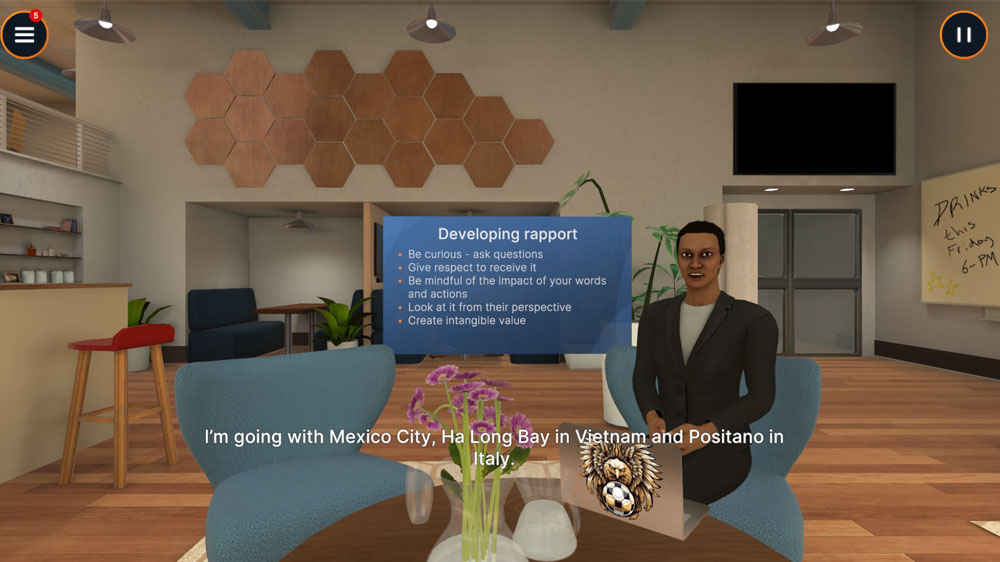
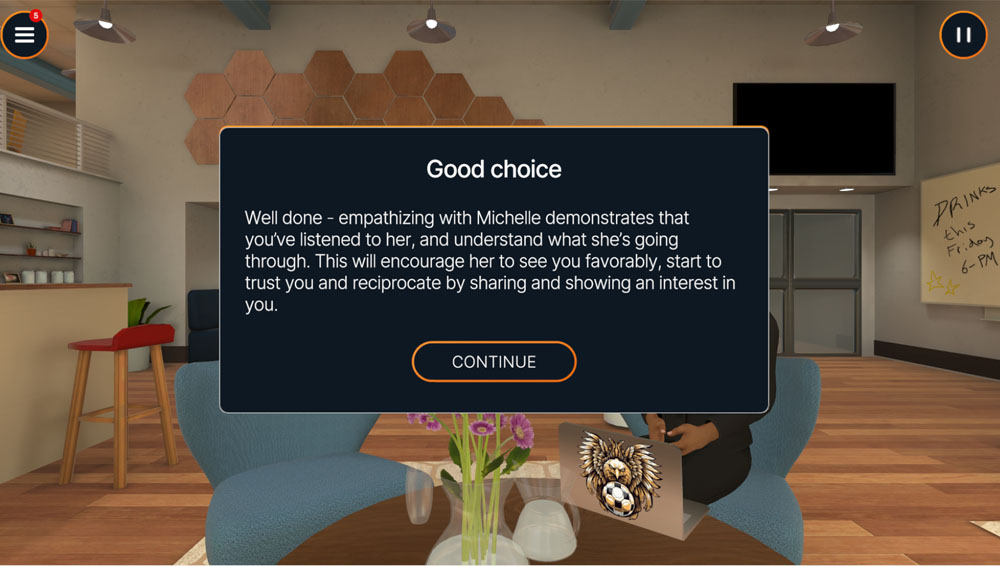
Within the VR module, students receive immediate personalized feedback that they can apply the next time they repeat the exercise.
After each trial negotiation, the module also lets learners review their side of the conversation from Santiago’s vantage point, a feature that only VR makes possible. Then, the AI model analyzes students’ performance according to criteria the instructor can select, such as showing respectfulness, using facts and figures, and displaying creativity.
Based on these criteria, the AI provides personalized feedback that students can immediately put into practice as they repeat the exercise as many times as they like. Following the exercise, the instructor receives a PDF summary of each student’s feedback and a full transcript of the mock negotiation, which can be used to fuel further reflection and dialogue.
Students See the Difference
When I have used the VR module in my classes, feedback from students has been strongly positive. In their post-course evaluations, they report learning lessons in negotiation that are far more individualized, detailed, and relevant than those reported by students who have completed more conventional, in-person exercises.
As one wrote, “Through this experiment with AI, I learned that my instinctive reaction in negotiations is to avoid conflict, especially when I perceive another party has more power or expertise. I also realized that I begin my discussions with a convincing approach, trying to justify my position rather than attempting to learn what the other party’s interests are and taking an understanding approach.”
Students who complete the VR module report learning lessons that are more individualized and relevant than those reported by students who complete in-person exercises.
Learners also gleaned affirming information about their negotiation strengths from their interactions with Santiago. “In the conversation with the AI, it came naturally to me to build rapport with him and maintain a positive and respectful tone. I could see based on his responses that this was an effective strategy and allowed us to have an open conversation about my growth,” another student wrote.
Tips and Takeaways
This approach—using VR to support engaging, democratized content delivery and deploying AI to provide personalized feedback and support iterative training—could be applied across a variety of pedagogical contexts. However, the success of this combination depends on instructors basing their training modules on clear and applicable criteria for AI assessment.
On the VR side, advocates should be ready to counter common cost-based objections from institutional decision-makers. Many people are surprised to learn that a fully modern VR headset (such as the Meta Quest 3S) without the bells and whistles can cost less than an academic textbook. Or, even better, faculty discover that most educational VR modules do not require any specialized equipment because they are designed to be fully usable when accessed through a web browser.
That said, AI and VR can enhance our pedagogy, helping us overcome institutional barriers and biases that can be endemic to traditional role-playing exercises and that can potentially lock out certain learners. Used in combination, these technologies can cultivate safe, customized, and inclusive spaces where our students don’t just learn to perform better in role-playing exercises. They develop skills that are essential for long-term success in the real-world workplace.
 Report