





Business Accreditation
Download the Global Standards.
Key Changes
- A new structure that distinguishes between global standards and the process of accreditation.
- Teaching effectiveness is recognized as a key criteria for faculty qualifications (effective with visits in 2029-30).
- Societal impact has been consolidated into Standard 9 and includes more flexibility for schools.
- Eligibility criteria are rigorous and quantifiable to better reflect the expectations of the new Global Standards.
View a list of all key changes here.
Download the Accounting Accreditation Standards.
Key Changes
- Reordered and modernized the standards to align with the structure of the Global Standards for Business Education.
- Strengthened Digital Agility Standard A5: focused not only on what technology is being deployed, but on how technology is being used to solve accounting problems, exercise professional judgment, and respond to real-world accounting contexts.
- Repositioned and sharpened Impact of Accounting Scholarship Standard A6 which explicitly calls out the expectation that accounting scholarship should meaningfully inform or influence accounting practice, professional standards, regulatory oversight, public policy, governmental and nonprofit accounting, etc.
- Disaggregated the former Table A6 into two distinct tables: 1) Table A3, aligned with Business Standard 3, focusing on the professional qualifications of accounting faculty, and 2) Table A5, aligned with the new Accounting Standard A5 on Digital Agility, focusing on technology expectations in accounting education.
- Added new Standard A7 to elevate academic and professional engagement, emphasizing strong connections to practice and preparation of graduates for professional success.
View a list of all key changes here.
Gain an overview of the revised AACSB Global Standards for Business Education™ and 2026 Accounting Accreditation Standards, including key elements of the final proposal and where feedback from the exposure period informed refinements.
The AACSB Standards Task Force (STF) is comprised of global business education leaders, entrusted with guiding the review and refresh of AACSB’s accreditation standards to ensure their continued relevance and alignment with the future of business education. Learn more about the task force here.
Exposure drafts for the AACSB Global Standards for Business EducationTM and 2026 Accounting Accreditation Standards were released for feedback on January 9, 2026. In the spirit of transparency and continuous improvement, those drafts are available below, but are superseded by the final standards documents listed above.
Global Standards Exposure Draft January 9, 2026
2026 Accounting Accreditation Standards Exposure Draft January 9, 2026
Yes, the Accounting Standards are being revised. The main updates are:
- Reordered and modernized the standards to align with the structure of the Global Standards for Business Education.
- Digital Agility is a standalone, strengthened standard: focused not only on what technology is being deployed, but on how technology is being used to solve accounting problems, exercise professional judgment, and respond to real-world accounting contexts.
- Added Standard A6: Impact of Accounting Scholarship which explicitly calls out the expectation that accounting scholarship should meaningfully inform or influence accounting practice, professional standards, regulatory oversight, public policy, governmental and nonprofit accounting, etc.
- Disaggregated the former Table A6 into two distinct tables: 1) Table A3, aligned with Business Standard 3, focusing on the professional qualifications of accounting faculty, and 2) Table A5, aligned with the new Accounting Standard A5 on Digital Agility, focusing on technology expectations in accounting education.
- Increased expectations around professional engagement for all accounting learners.
CIR schools with visits between 1 March 2027 and 30 June 2027 should contact their AACSB accreditation manager if they are interested in being a pilot school.
- Faculty currency of subject matter expertise
- Use of current and relevant technology in the classroom
- Meaningful and regular engagement with the business community
- Learner preparedness to enter the workforce or advance in their current employment
- Innovative pedagogical approaches in instructional delivery
Yes, schools will be given time to align with this new requirement. The implementation timeline is shown below.
2026–27 (Year 1 – Pilot Year)
- Approximately 30 volunteer pilot schools.
- Remaining schools continue under 2020 standards.
- Technical refinements based on pilot experience.
- 2026 standards effective.
- Schools classify faculty under Standard 3 as they were under 2020 standards.
- Schools describe how they are developing and piloting teaching effectiveness criteria.
- No peer review evaluation of teaching effectiveness application yet.
2028–29 (Year 3 – Transition Year)
- Continued refinement and local testing of teaching effectiveness criteria.
- Schools discuss progress in reports.
- Still no formal evaluation of teaching effectiveness with these visits.
2029–30 (Full Implementation of TE in Standard 3)
- First cohort evaluated on application of school-defined teaching effectiveness criteria.
- Work will have been completed during the self-study year.
2030–31 and Beyond
- System fully operational across all schools.
In the spirit of continuous improvement, AACSB enhances the accreditation standards and interpretive guidance annually.
On 28 February 2025, AACSB released its annual update which took into consideration the legal and political environment surrounding higher education and accreditation and reframed terms that have become politicized in the U.S. and around the world. These changes to the 2020 Guiding Principles and Standards for Business Accreditation and Interpretive Guidance uphold our mission and values, while mitigating risks for our members. The technical edits also clarified that Scholarly Academic faculty are indeed expected to produce peer-reviewed journal articles as part of their portfolio of scholarship.
AACSB is proud to serve its diverse global network and has issued an open letter to clarify the intent, content, and implications of the changes. You can find more information in the FAQ.
The standards fulfill the following key objectives:
- Reinforce long-held AACSB commitments to mission focus and peer review
- Emphasize a principles-based and outcomes-focused approach, as well as relevance for business schools now and in the future
- Recognize the changing landscape of student demographics and reflect the activities we envision business schools of the future will undertake to ensure continuous improvement and high quality in business education
- Elevate the importance of thought leadership in the context of a school’s mission.
- Characterize the guiding principles that represent key values to AACSB
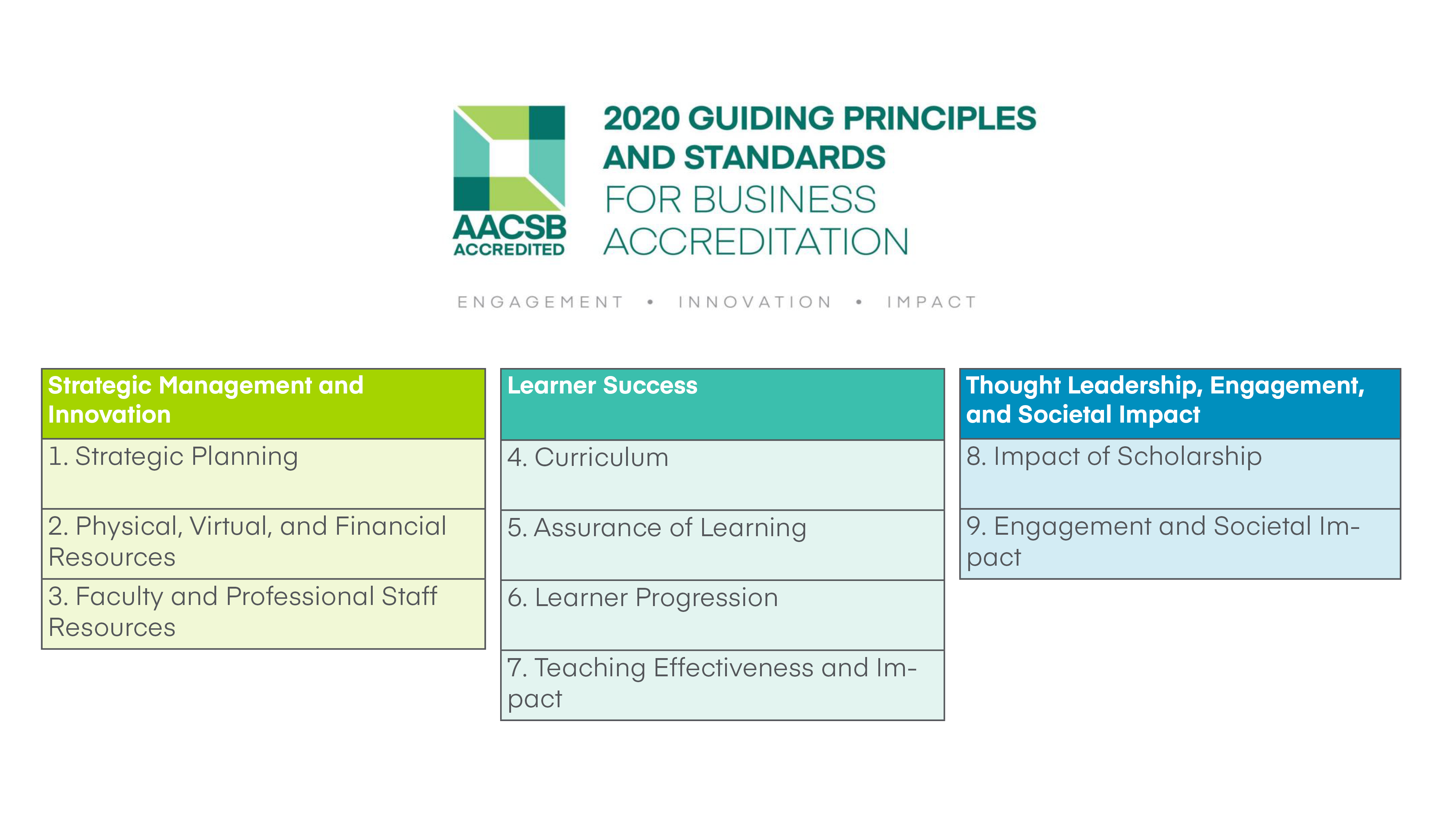
The nine standards are organized into three categories:
For accounting accreditation standards, click here.